Question 3
A tangent PQ at a point P of a circle of radius 5 cm meets a line through the centre O at a point Q so that OQ = 12 cm. Length PQ is :
(A) 12 cm (B) 13 cm (C) 8.5 cm (D) cm.
Tangent: A line that touches a circle at exactly one point (the point of tangency) without crossing through it. The radius drawn to that point is always perpendicular to the tangent.
Let's use the property that the radius is perpendicular to the tangent at the point of contact.
Step 1 — Identify the given information
We have a circle. Its center is O. Its radius OP is 5 cm. PQ is a tangent to the circle. P is the point of tangency. A line from the center O meets the tangent at Q. The length OQ is 12 cm. We need to find the length of PQ.
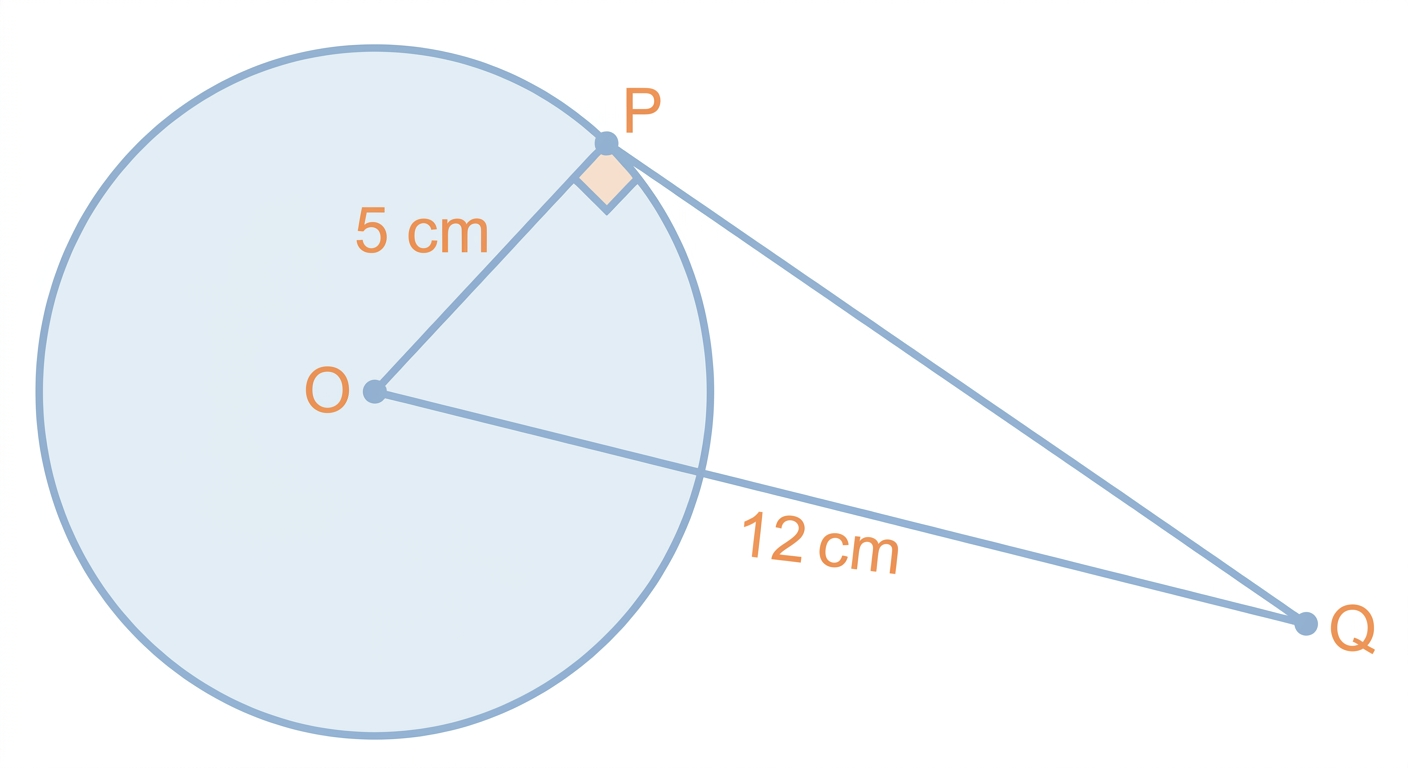
Step 2 — Form a right-angled triangle
Tangent-Radius Perpendicularity Theorem: The radius drawn to the point of tangency is always perpendicular to the tangent at that point. This is a fundamental property of tangents.
The radius OP is perpendicular to the tangent PQ. This happens at the point of contact P. So, angle OPQ is . Triangle OPQ is a right-angled triangle. OP and PQ are the legs of this triangle. OQ is the hypotenuse — it is the side opposite the 90° angle at P, and is always the longest side.
Step 3 — Apply Pythagoras Theorem
Pythagoras Theorem: In a right-angled triangle, .
We can use the Pythagoras theorem. The square of the hypotenuse equals the sum of the squares of the other two sides. In , . Let's substitute the known values.
Answer
(D) cm.
More questions in Exercise 10.1
How many tangents can a circle have?
Fill in the blanks:
(i) A tangent to a circle intersects it in ____________ point(s).
(ii) A line intersecting a circle in two points is called a ____________.
(iii) A circle can have ____________ parallel tangents at the most.
(iv) The common point of a tangent to a circle and the circle is called ____________.
A tangent PQ at a point P of a circle of radius 5 cm meets a line through the centre O at a point Q so that OQ = 12 cm. Length PQ is :
(A) 12 cm (B) 13 cm (C) 8.5 cm (D) cm.
Draw a circle and two lines parallel to a given line such that one is a tangent and the other, a secant to the circle.