Question 2
In each of the problems below, show the different stages of mathematical modelling for solving the problems.
- Suppose the adjoining figure represents an aerial photograph of a forest with each dot representing a tree. Your purpose is to find the number of trees there are on this tract of land as part of an environmental census.
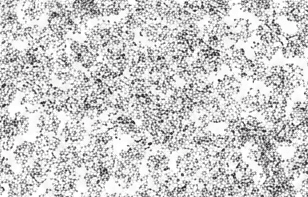
- Counting every tree individually on an aerial photograph is impractical.
- We use mathematical modelling via quadrat sampling:
- Divide the total area into a uniform grid of equal-sized smaller squares.
- Count the trees in a few randomly selected sample squares.
- Calculate the mean (average) number of trees per sample square.
- Multiply the average by the total number of squares to estimate the total tree count.
Step 1 · Formulate the Model (Grid Division)
Divide the entire photograph into a uniform grid of equal squares.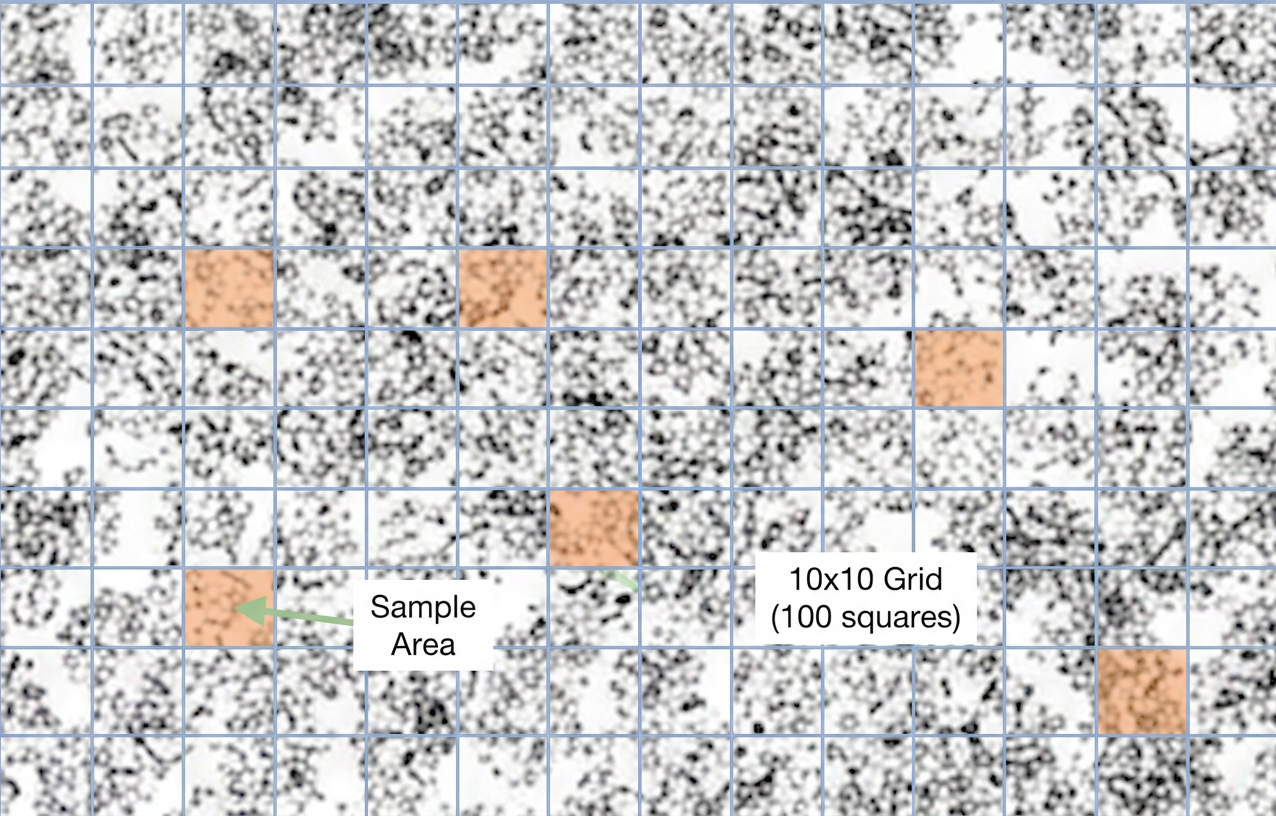
- Total number of squares,
- Number of randomly selected sample squares,
Step 2 · Data Collection (Sample Counts)
Count the number of trees in the randomly chosen squares. Let the sample counts be:
Step 3 · Calculate the Total Estimated Trees
Find the total trees in the sample squares
Find the average number of trees per square
Estimate the total tree population across all squares
Step 4 · Interpretation and Refinement
The calculated value of trees is an approximation. The model assumes a relatively uniform distribution of trees across the tract.
To increase accuracy and reduce error, we can:
- Increase the number of sample squares (larger sample size ).
- Use stratified sampling if certain regions (e.g. riverbanks or dense forest patches) have significantly different tree densities.
Estimated number of trees
- Counting all dots: Trying to count every single dot is impractical; the core objective of mathematical modelling here is sampling and statistical estimation.
- Non-random sampling: Selecting only dense or sparse squares leads to overestimation or underestimation; sample squares must be randomly selected across the grid.
- Ignoring distribution variations: Assuming the estimate is exact rather than an approximation that depends on sample size and tree uniformity.
More questions in A2.2
In each of the problems below, show the different stages of mathematical modelling for solving the problems.
- An ornithologist wants to estimate the number of parrots in a large field. She uses a net to catch some, and catches 32 parrots, which she rings and sets free. The following week she manages to net 40 parrots, of which 8 are ringed.
(i) What fraction of her second catch is ringed? (ii) Find an estimate of the total number of parrots in the field.
In each of the problems below, show the different stages of mathematical modelling for solving the problems.
- Suppose the adjoining figure represents an aerial photograph of a forest with each dot representing a tree. Your purpose is to find the number of trees there are on this tract of land as part of an environmental census.
- A T.V. can be purchased for ₹ 24000 cash or for ₹ 8000 cashdown payment and six monthly instalments of ₹ 2800 each. Ali goes to market to buy a T.V., and he has ₹ 8000 with him. He has now two options. One is to buy TV under instalment scheme or to make cash payment by taking loan from some financial society. The society charges simple interest at the rate of 18% per annum simple interest. Which option is better for Ali?