Question 3
- A T.V. can be purchased for ₹ 24000 cash or for ₹ 8000 cashdown payment and six monthly instalments of ₹ 2800 each. Ali goes to market to buy a T.V., and he has ₹ 8000 with him. He has now two options. One is to buy TV under instalment scheme or to make cash payment by taking loan from some financial society. The society charges simple interest at the rate of 18% per annum simple interest. Which option is better for Ali?
- Ali has ₹ and needs to choose between two payment methods for a ₹ TV:
- Option 1 (Instalment Scheme): Pay ₹ down payment plus monthly instalments of ₹ .
- Option 2 (Loan Scheme): Pay ₹ from his cash and take a loan of the remaining ₹ for months at simple interest per annum.
- To find the better option, we calculate and compare the total cost paid by Ali in each scheme.
Step 1 · Calculate Cost of Instalment Scheme
Given cashdown payment and monthly instalments of ₹ each.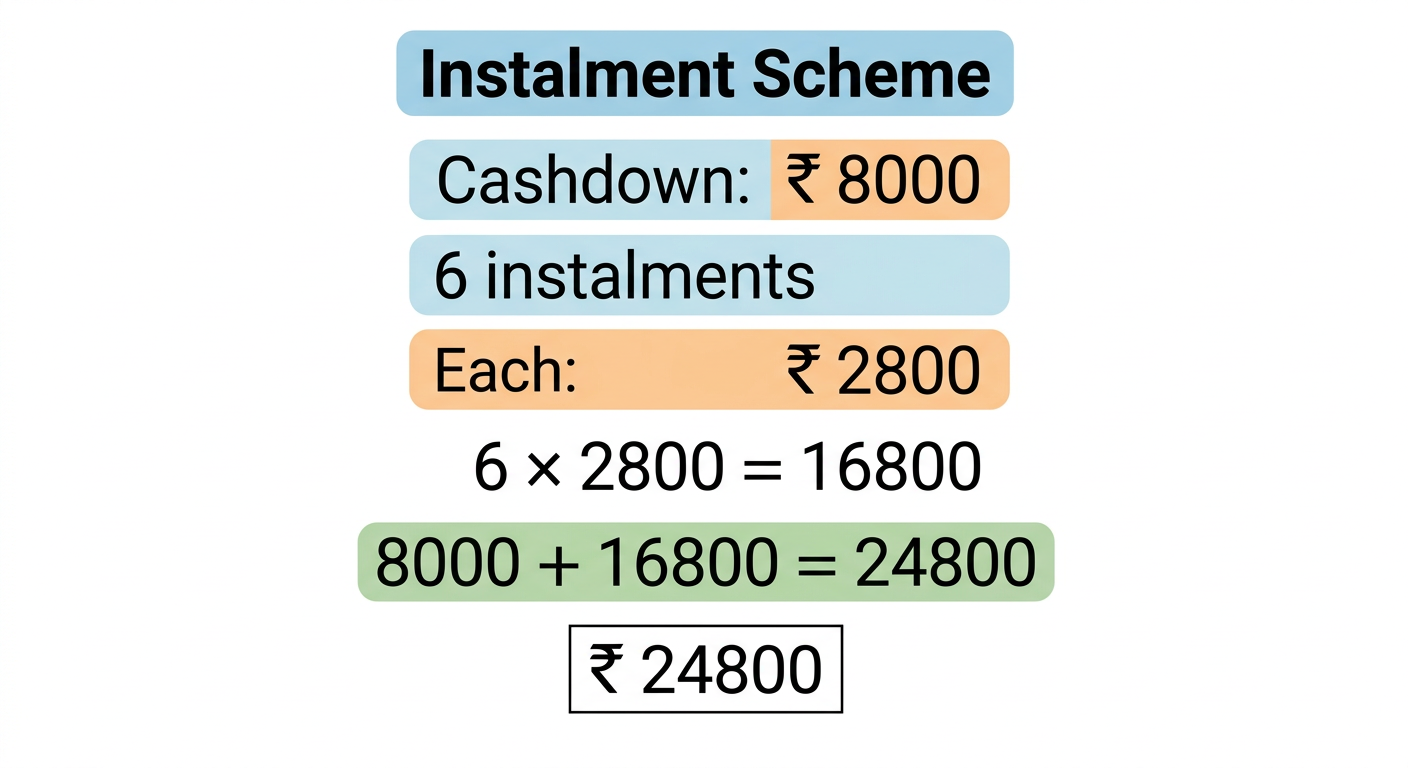
Total cost under instalment scheme .
Step 2 · Calculate Cost of Loan Scheme
Ali pays his ₹ in cash and borrows the remaining amount as a loan.
Loan period and rate
Total cost under loan scheme .
Step 3 · Compare the Options
Comparing the two options:
- Total cost in Instalment Scheme
- Total cost in Loan Scheme
Since , the instalment scheme costs less.
The instalment scheme is better for Ali.
- Time Unit Error: Forgetting to convert the loan period from months to years () before substituting into the simple interest formula.
- Incorrect Principal: Calculating simple interest on the entire cash price (₹ ) instead of only the borrowed principal amount (₹ ).
More questions in A2.2
In each of the problems below, show the different stages of mathematical modelling for solving the problems.
- An ornithologist wants to estimate the number of parrots in a large field. She uses a net to catch some, and catches 32 parrots, which she rings and sets free. The following week she manages to net 40 parrots, of which 8 are ringed.
(i) What fraction of her second catch is ringed? (ii) Find an estimate of the total number of parrots in the field.
In each of the problems below, show the different stages of mathematical modelling for solving the problems.
- Suppose the adjoining figure represents an aerial photograph of a forest with each dot representing a tree. Your purpose is to find the number of trees there are on this tract of land as part of an environmental census.
- A T.V. can be purchased for ₹ 24000 cash or for ₹ 8000 cashdown payment and six monthly instalments of ₹ 2800 each. Ali goes to market to buy a T.V., and he has ₹ 8000 with him. He has now two options. One is to buy TV under instalment scheme or to make cash payment by taking loan from some financial society. The society charges simple interest at the rate of 18% per annum simple interest. Which option is better for Ali?