Question 2
Take two consecutive odd numbers. Find the sum of their squares, and then add 6 to the result. Prove that the new number is always divisible by 8.
- Any odd number can be represented algebraically in the form (or ), where is an integer.
- Two consecutive odd numbers differ by , so we can represent them as and .
- We compute the sum of their squares, , and add to the resulting expression.
- If the simplified result can be written as , it proves the number is always divisible by .
Step 1 · Represent the Consecutive Odd Numbers
Let the two consecutive odd numbers be and , where is an integer.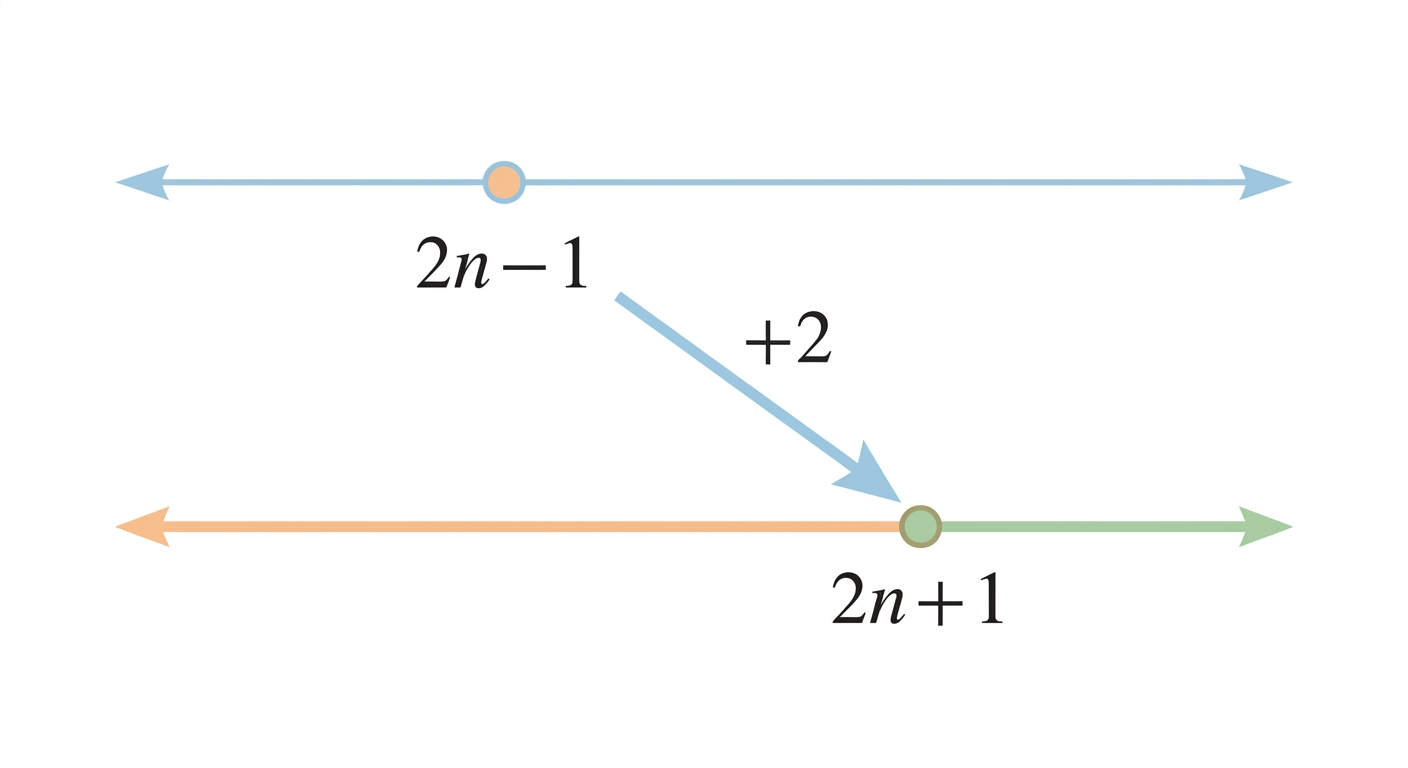
Step 2 · Find the Sum of Their Squares
Squaring each number
Adding the two squares
Step 3 · Add 6 to the Result
Adding to the sum of squares
Step 4 · Prove Divisibility by 8
Factoring out
Since is an integer, is also an integer.
Therefore, is a multiple of and is always divisible by .
Hence proved that the new number is always divisible by .
- Incorrect Algebraic Setup: Assuming consecutive odd numbers are and without defining as an odd integer, or using and (which would be an odd and an even number).
- Expansion Errors: Forgetting the cross-term when expanding squares, such as writing as instead of .
More questions in A1.3
Prove that the sum of two consecutive odd numbers is divisible by 4.
Take two consecutive odd numbers. Find the sum of their squares, and then add 6 to the result. Prove that the new number is always divisible by 8.
If is a prime number, show that is divisible by 3.
[Hint: Use Example 11].
Let and be rational numbers. Show that is a rational number.
If and are positive integers, then you know that , , where is a whole number. Prove that .
[Hint: Let . So, and , where and are coprime.]
A line parallel to side of a triangle , intersects and at and respectively.
Prove that .