Appendix 1: Proofs in Mathematics | A1.3

Question 6

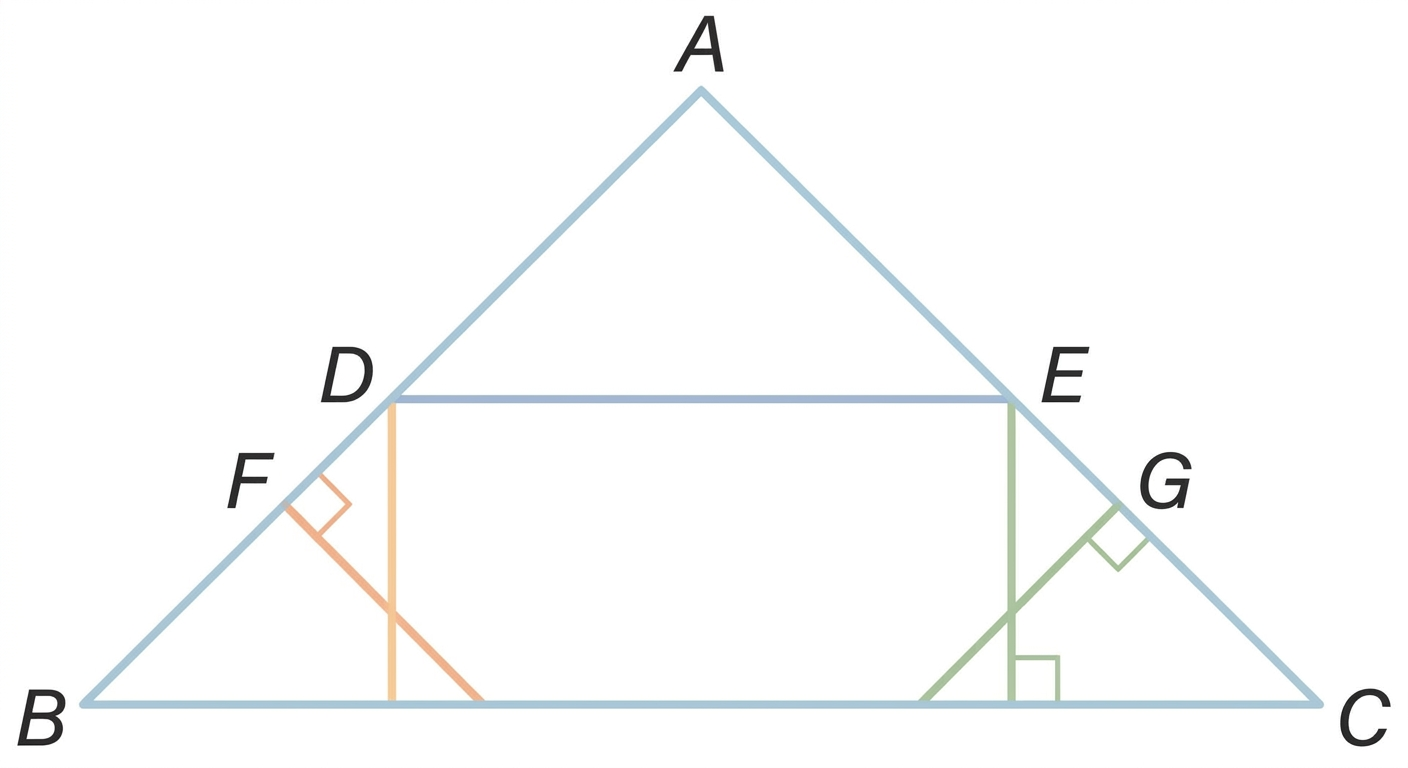
A line parallel to side BCBC of a triangle ABCABC, intersects ABAB and ACAC at DD and EE respectively.

Prove that ADDB=AEEC\dfrac{\text{AD}}{\text{DB}} = \dfrac{\text{AE}}{\text{EC}}.

Check your answer with HomiSolve it yourself, then let Homi check your steps and spot mistakes.
Solution
Understand the Question
  • To prove the Basic Proportionality Theorem (Thales' Theorem), we express the ratio of side lengths using the ratio of areas of triangles.
  • The area of a triangle is given by Area=12×base×height\text{Area} = \dfrac{1}{2} \times \text{base} \times \text{height}.
  • By drawing perpendicular heights from EE to ABAB and from DD to ACAC, we can express Area(ADE)\text{Area}(\triangle ADE) in two ways and compare it to Area(BDE)\text{Area}(\triangle BDE) and Area(CDE)\text{Area}(\triangle CDE).
  • Since BDE\triangle BDE and CDE\triangle CDE lie on the same base DEDE and between the same parallel lines DEBCDE \parallel BC, their areas are equal, which allows us to equate the two side ratios.

Step 1 · Express Areas Using Altitudes

Draw EFABEF \perp AB and DGACDG \perp AC. Join BEBE and CDCD.Diagram 1

With altitude EFABEF \perp AB: Area(ADE)=12×AD×EF\text{Area}(\triangle ADE) = \dfrac{1}{2} \times \text{AD} \times \text{EF}

Area(BDE)=12×DB×EF\text{Area}(\triangle BDE) = \dfrac{1}{2} \times \text{DB} \times \text{EF}

With altitude DGACDG \perp AC: Area(ADE)=12×AE×DG\text{Area}(\triangle ADE) = \dfrac{1}{2} \times \text{AE} \times \text{DG}

Area(CDE)=12×EC×DG\text{Area}(\triangle CDE) = \dfrac{1}{2} \times \text{EC} \times \text{DG}

Step 2 · Form Area Ratios and Conclude

Taking the ratio of areas with base on ABAB:

Area(ADE)Area(BDE)=12×AD×EF12×DB×EF=ADDB(1)\begin{aligned} \dfrac{\text{Area}(\triangle ADE)}{\text{Area}(\triangle BDE)} &= \dfrac{\frac{1}{2} \times \text{AD} \times \text{EF}}{\frac{1}{2} \times \text{DB} \times \text{EF}} \\[1.1em] &= \dfrac{\text{AD}}{\text{DB}} \quad \dots (1) \end{aligned}

Taking the ratio of areas with base on ACAC:

Area(ADE)Area(CDE)=12×AE×DG12×EC×DG=AEEC(2)\begin{aligned} \dfrac{\text{Area}(\triangle ADE)}{\text{Area}(\triangle CDE)} &= \dfrac{\frac{1}{2} \times \text{AE} \times \text{DG}}{\frac{1}{2} \times \text{EC} \times \text{DG}} \\[1.1em] &= \dfrac{\text{AE}}{\text{EC}} \quad \dots (2) \end{aligned}

Since BDE\triangle BDE and CDE\triangle CDE are on the same base DEDE and between the same parallel lines DEDE and BCBC: Area(BDE)=Area(CDE)(3)\text{Area}(\triangle BDE) = \text{Area}(\triangle CDE) \quad \dots (3)

From (1)(1), (2)(2), and (3)(3), the left-hand sides are equal. Therefore: ADDB=AEEC\dfrac{\text{AD}}{\text{DB}} = \dfrac{\text{AE}}{\text{EC}}

Answer

Hence proved that ADDB=AEEC\dfrac{\text{AD}}{\text{DB}} = \dfrac{\text{AE}}{\text{EC}}.

Common Mistakes
  • Altitude Misplacement: Assuming that the altitude for obtuse triangle BDE\triangle BDE lies inside the triangle rather than understanding that EFEF acts as the perpendicular height to the extended base line ABAB.
  • Parallel Line Property: Forgetting to justify Area(BDE)=Area(CDE)\text{Area}(\triangle BDE) = \text{Area}(\triangle CDE) by stating that both triangles share the common base DEDE and lie between the same parallel lines DEBCDE \parallel BC.

More questions in A1.3

Q1

Prove that the sum of two consecutive odd numbers is divisible by 4.

Q2

Take two consecutive odd numbers. Find the sum of their squares, and then add 6 to the result. Prove that the new number is always divisible by 8.

Q3

If p5p \ge 5 is a prime number, show that p2+2p^2 + 2 is divisible by 3.

[Hint: Use Example 11].

Q4

Let xx and yy be rational numbers. Show that xyxy is a rational number.

Q5

If aa and bb are positive integers, then you know that a=bq+ra = bq + r, 0r<b0 \le r < b, where qq is a whole number. Prove that HCF(a,b)=HCF(b,r)\text{HCF}(a, b) = \text{HCF}(b, r).

[Hint: Let HCF(b,r)=h\text{HCF}(b, r) = h. So, b=k1hb = k_1 h and r=k2hr = k_2 h, where k1k_1 and k2k_2 are coprime.]

Q6

A line parallel to side BCBC of a triangle ABCABC, intersects ABAB and ACAC at DD and EE respectively.

Prove that ADDB=AEEC\dfrac{\text{AD}}{\text{DB}} = \dfrac{\text{AE}}{\text{EC}}.

← Back to Appendix 1: Proofs in Mathematics