Question 2
Find three distinct rational numbers that lie strictly between and .
- To find rational numbers strictly between and , first convert both fractions to a common denominator.
- If there are not enough intermediate integers between the numerators, multiply the numerator and denominator by a suitable integer to create a larger common denominator.
- Any three distinct values lying strictly between the resulting endpoints can be chosen.
Step 1 · Find a Common Denominator
Given rational numbers are and .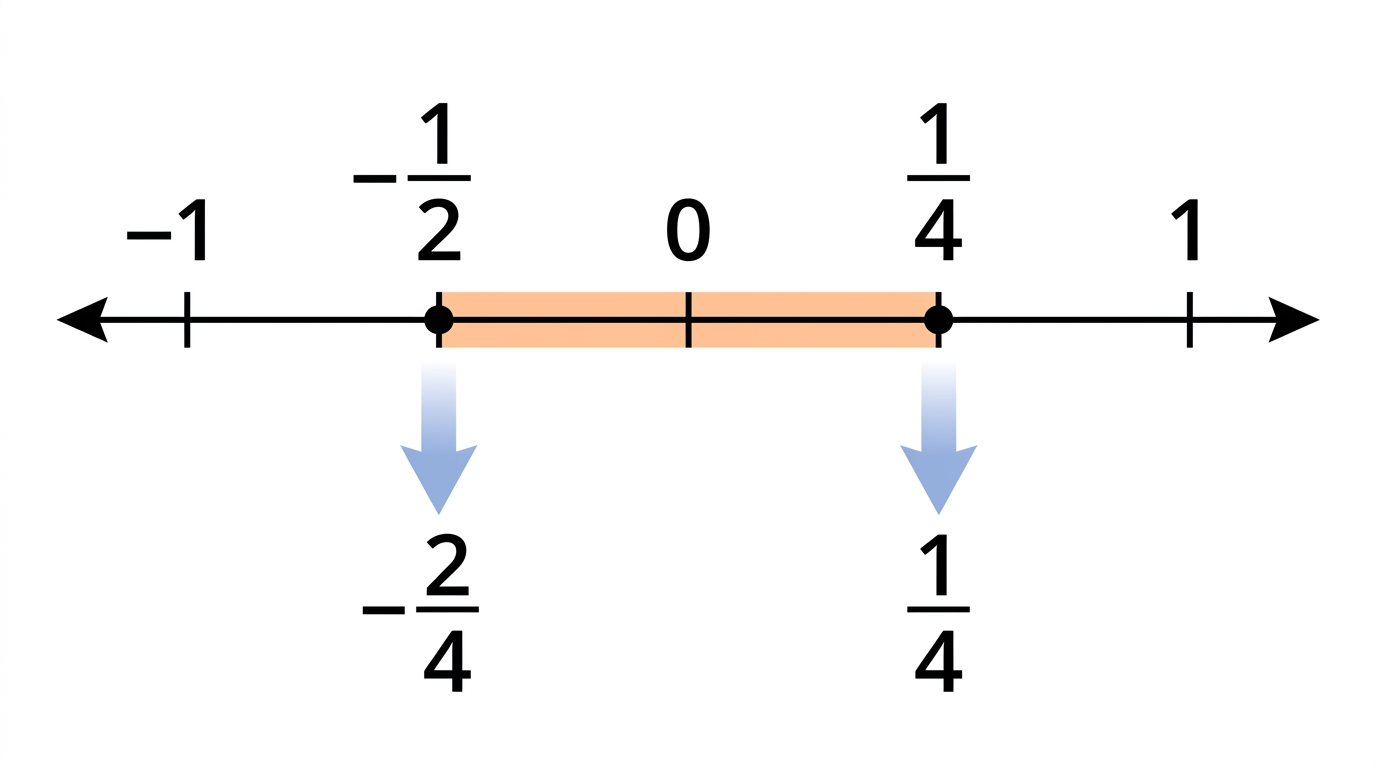
The LCM of denominators and is .
The two numbers are and .
Step 2 · Convert to a Larger Denominator and Choose Values
The integers strictly between the numerators and are and , which provides only two rational numbers ( and ).
Multiply numerator and denominator of both fractions by to obtain denominator :
The integers strictly between and are .
Rational numbers between and are:
Selecting any three distinct numbers:
- Including Endpoints: Numbers must lie strictly between and ; the endpoint values themselves cannot be included.
- Negative Number Ordering: Remember that on a number line, . Do not reverse the order for negative numbers.
- Not Expanding Denominator: Denominator gives only two intermediate fractions ( and ). To find three or more, scale up the denominator by multiplying both numerator and denominator by an integer like or .
More questions in Exercise 3.4
Represent the rational numbers , and on a single number line.
Find three distinct rational numbers that lie strictly between and .
Simplify the expression: .
A tailor has metres of fine silk. If making one kurta requires metres of silk, exactly how many kurtas can he make?
Find three rational numbers between and .
Can you think of other way(s) to find a rational number between any two rational numbers?