The World of Numbers | Exercise 3.4

Question 4

A tailor has 153415\dfrac{3}{4} metres of fine silk. If making one kurta requires 2142\dfrac{1}{4} metres of silk, exactly how many kurtas can he make?

Check your answer with HomiSolve it yourself, then let Homi check your steps and spot mistakes.
Solution
Understand the Question
  • Total length of silk available is 1534 metres15\dfrac{3}{4}\text{ metres}, and each kurta requires 214 metres2\dfrac{1}{4}\text{ metres} of silk.
  • To find the total number of kurtas that can be made, divide the total length of silk by the length needed for one kurta: Number of kurtas=Total silk÷Silk per kurta\text{Number of kurtas} = \text{Total silk} \div \text{Silk per kurta}
  • First, convert both mixed fractions into improper fractions to simplify division.

Step 1 · Convert Mixed Fractions to Improper Fractions
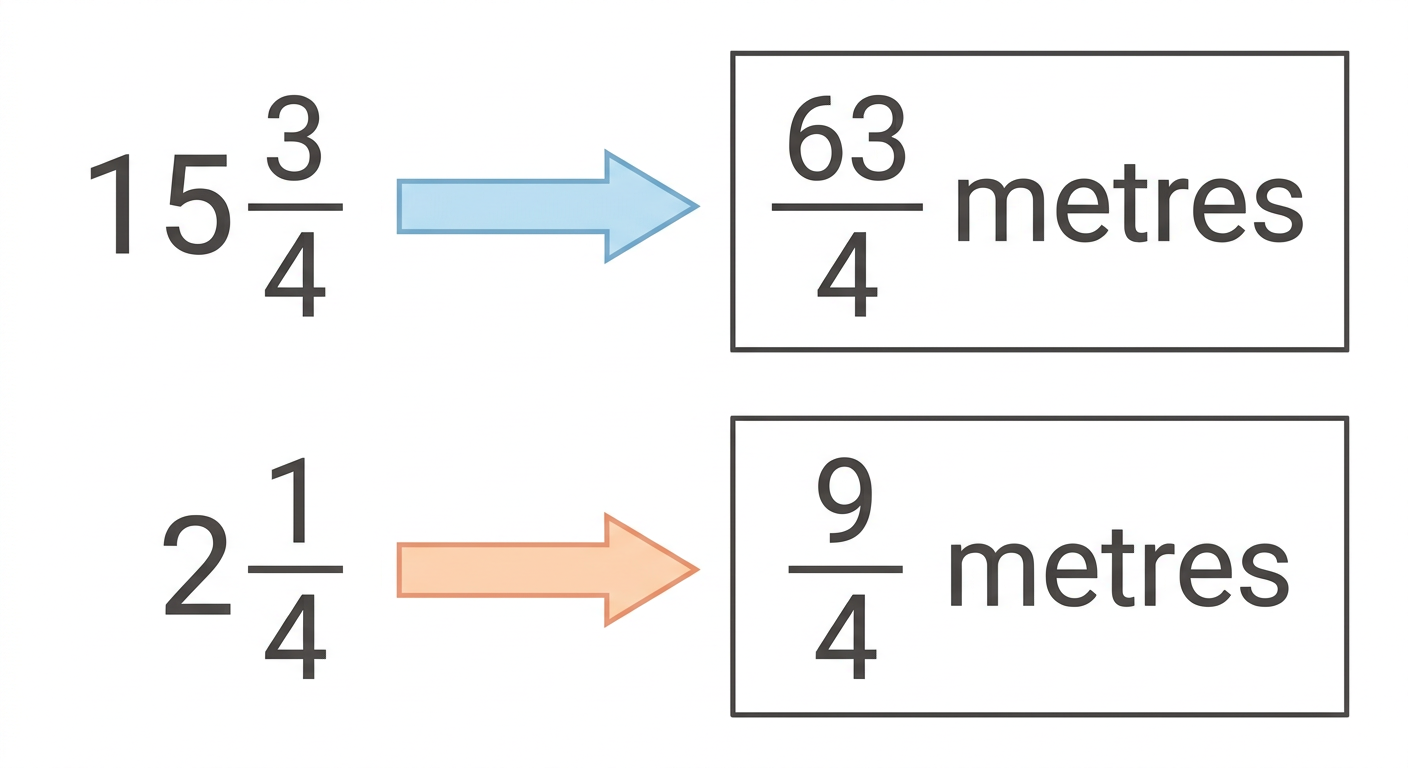
Diagram 1

Total silk available:

1534=(15×4)+34=60+34=634 metres\begin{aligned} 15\dfrac{3}{4} &= \dfrac{(15 \times 4) + 3}{4} \\[0.6em] &= \dfrac{60 + 3}{4} \\[0.6em] &= \dfrac{63}{4}\text{ metres} \end{aligned}

Silk required per kurta:

214=(2×4)+14=8+14=94 metres\begin{aligned} 2\dfrac{1}{4} &= \dfrac{(2 \times 4) + 1}{4} \\[0.6em] &= \dfrac{8 + 1}{4} \\[0.6em] &= \dfrac{9}{4}\text{ metres} \end{aligned}

Step 2 · Calculate the Number of Kurtas

Divide total silk by silk required per kurta: Number of kurtas=Total silk÷Silk per kurta\text{Number of kurtas} = \text{Total silk} \div \text{Silk per kurta}

Number of kurtas=634÷94=634×49=639=7\begin{aligned} \text{Number of kurtas} &= \dfrac{63}{4} \div \dfrac{9}{4} \\[0.6em] &= \dfrac{63}{4} \times \dfrac{4}{9} \\[0.6em] &= \dfrac{63}{9} \\[0.6em] &= 7 \end{aligned}
Answer

7

Common Mistakes
  • Fraction Inversion Error: Forgetting to take the reciprocal of the second fraction when changing division to multiplication (e.g. dividing 634×94\dfrac{63}{4} \times \dfrac{9}{4} instead of 634×49\dfrac{63}{4} \times \dfrac{4}{9}).
  • Mixed Fraction Conversion: Adding the whole number to the numerator before multiplying by the denominator (e.g. writing 153415\dfrac{3}{4} as 15+34\dfrac{15+3}{4} instead of (15×4)+34\dfrac{(15 \times 4) + 3}{4}).

More questions in Exercise 3.4

Q1

Represent the rational numbers 23\dfrac{2}{3}, 54-\dfrac{5}{4} and 1121\dfrac{1}{2} on a single number line.

Q2

Find three distinct rational numbers that lie strictly between 12-\dfrac{1}{2} and 14\dfrac{1}{4}.

Q3

Simplify the expression: (14)+(512)\left(-\dfrac{1}{4}\right) + \left(\dfrac{5}{12}\right).

Q4

A tailor has 153415\dfrac{3}{4} metres of fine silk. If making one kurta requires 2142\dfrac{1}{4} metres of silk, exactly how many kurtas can he make?

Q5

Find three rational numbers between 3.14153.1415 and 3.14163.1416.

Q6

Can you think of other way(s) to find a rational number between any two rational numbers?

← Back to The World of Numbers