Question 2
Find the sum:
(i) (ii) (iii)
We will find the sum of fractions by first finding a common denominator.
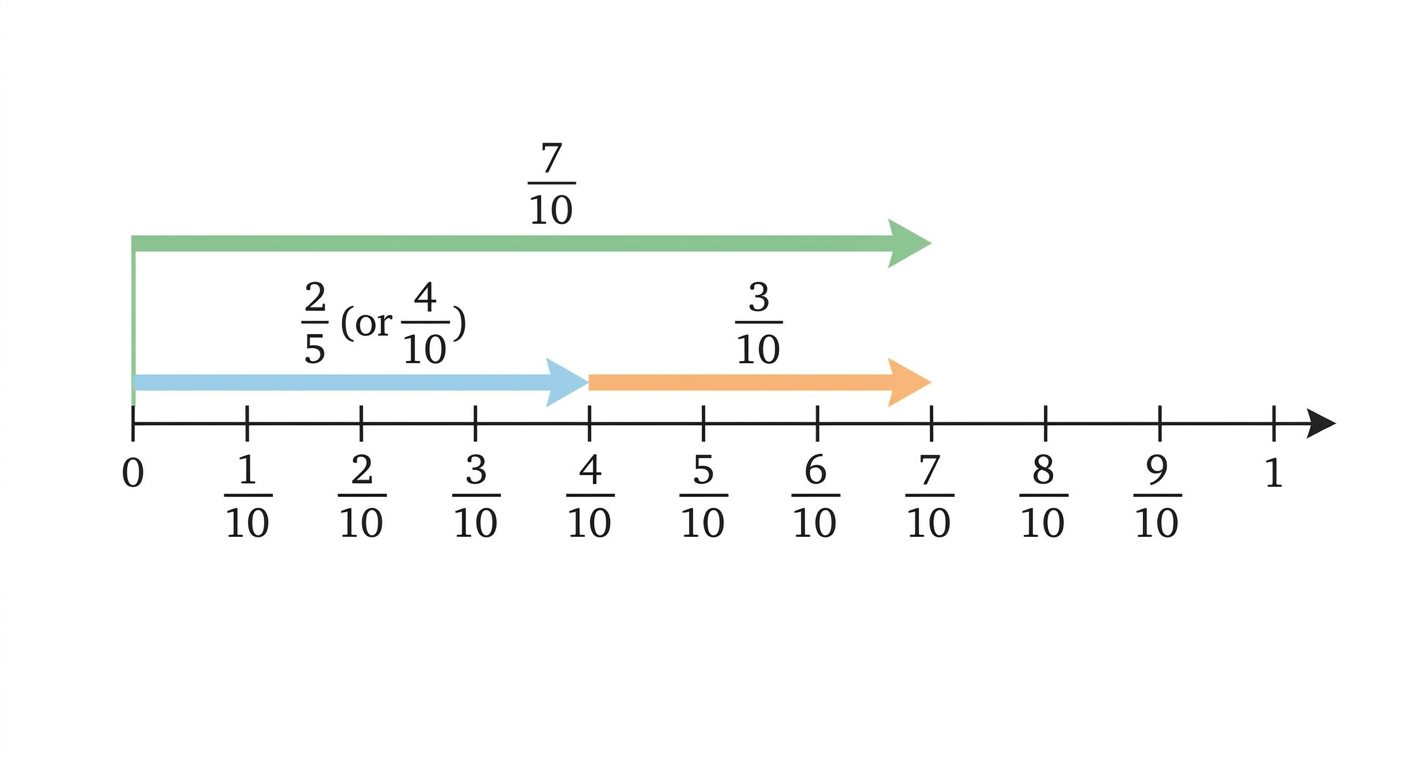
Step 1 — Sum of
First, let's find the Least Common Multiple (LCM) of the denominators. The denominators are 5 and 10. The LCM of 5 and 10 is 10. Now, we convert each fraction to have a denominator of 10.
Next, we add the fractions with the common denominator.
Step 2 — Sum of
Let's find the LCM of the denominators. The denominators are 12 and 8. The LCM of 12 and 8 is 24. We convert each fraction to have a denominator of 24.
Now, we add these new fractions.
Step 3 — Sum of
Again, we find the LCM of the denominators. The denominators are 7 and 14. The LCM of 7 and 14 is 14. We convert the first fraction to have a denominator of 14.
Now, we add the fractions. Remember the negative sign.
Answer
(i) (ii) (iii)
More questions in Exercise 3.3
Prove that the following rational numbers are equal:
(i) and (ii) and (iii) and (iv) and
Find the sum:
(i) (ii) (iii)
Find the difference:
(i) (ii) (iii)
Find the product:
(i) (ii) (iii)
Find the quotient:
(i) (ii) (iii)
Show that:
Simplify the following using the distributive property:
Find the rational number such that: