Question 1
When a single 6-sided die is rolled, what is the total number of possible outcomes in the sample space?
- A standard -sided die has faces numbered and .
- The sample space is the set of all possible outcomes of an experiment.
- The total number of outcomes is the number of elements in , denoted by .
Step 1 · List the Sample Space
A standard -sided die has faces numbered from to .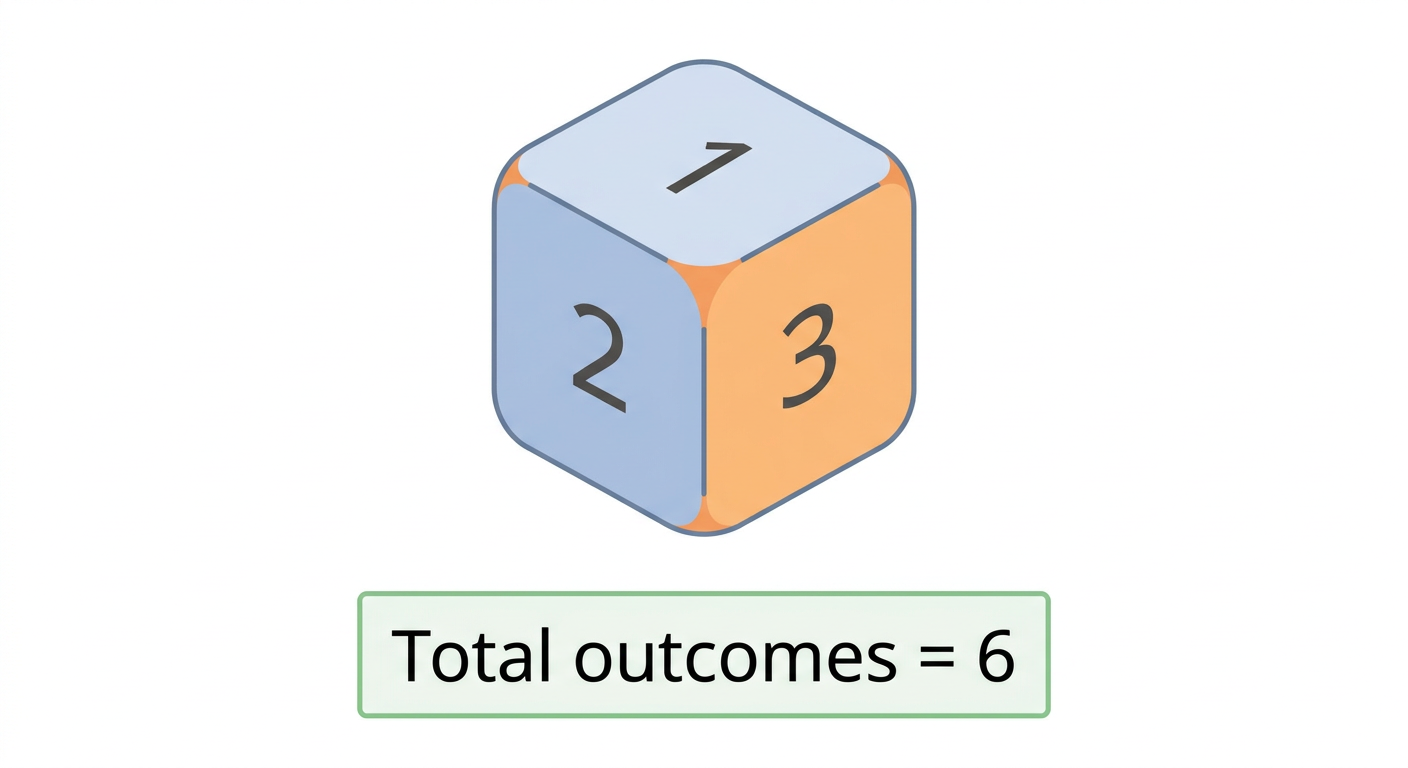
The set of all possible outcomes (sample space ) is:
Step 2 · Count the Number of Outcomes
The number of elements in the sample space is denoted as :
- Including Zero: Assuming a die starts from ; a standard die is numbered from to .
- Confusing Outcome with Probability: Stating the probability of an event (such as ) instead of the total count of outcomes in the sample space ().
More questions in Exercise 7.3
When a single 6-sided die is rolled, what is the total number of possible outcomes in the sample space?
For the following experiments write down the sample space .
(i) Rolling a die and tossing a coin together.
(ii) Choosing a random integer between and .
(iii) A box containing 5 green and 7 red balls. One ball is drawn at random.
In a village fair, there are 3 popular snacks available: Samosa, Pakora, and Bhaji. For drinks, villagers can choose either Chai or Lassi.
(i) List the sample space of all possible snack and drink combinations a person could choose at the fair.
(ii) List the event 'Selecting Samosa as a snack.'