Question 3
In a village fair, there are 3 popular snacks available: Samosa, Pakora, and Bhaji. For drinks, villagers can choose either Chai or Lassi.
(i) List the sample space of all possible snack and drink combinations a person could choose at the fair.
(ii) List the event 'Selecting Samosa as a snack.'
- There are snacks (Samosa, Pakora, Bhaji) and drinks (Chai, Lassi).
- Each snack can be paired with either drink, giving a total of possible combinations in the sample space ().
- An event is a subset of the sample space satisfying a specific condition (e.g., choosing Samosa as the snack).
(i) List the sample space of all possible snack and drink combinations a person could choose at the fair.
Step 1 · List all combinations in the sample space
Combine each of the snacks with each of the drinks: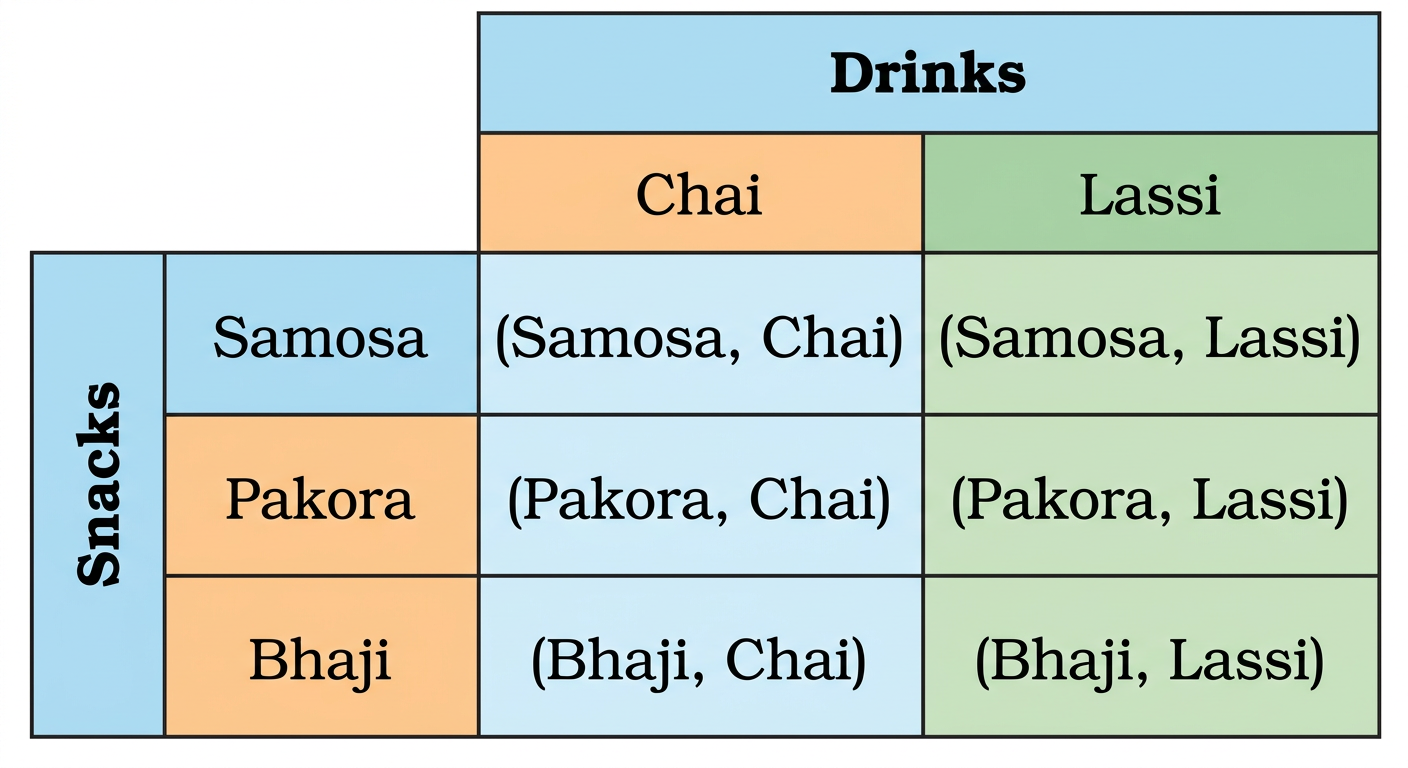
Total number of outcomes:
(i)
(ii) List the event 'Selecting Samosa as a snack.'
Step 1 · Identify favorable outcomes and calculate probability
The event of selecting Samosa contains all pairs where Samosa is the snack:
Number of favorable outcomes .
(ii)
- Listing items individually: Writing individual items like instead of paired outcomes .
- Incomplete pairings: Forgetting to pair each snack with every drink option, leading to fewer than total outcomes.
- Unsimplified probability: Leaving the probability as instead of simplifying to lowest terms .
More questions in Exercise 7.3
When a single 6-sided die is rolled, what is the total number of possible outcomes in the sample space?
For the following experiments write down the sample space .
(i) Rolling a die and tossing a coin together.
(ii) Choosing a random integer between and .
(iii) A box containing 5 green and 7 red balls. One ball is drawn at random.
In a village fair, there are 3 popular snacks available: Samosa, Pakora, and Bhaji. For drinks, villagers can choose either Chai or Lassi.
(i) List the sample space of all possible snack and drink combinations a person could choose at the fair.
(ii) List the event 'Selecting Samosa as a snack.'