Predicting What Comes Next: Sequences and Progressions | EOT

Question 13

The sum of the first three terms of a geometric progression is 26, and the sum of their squares is 364. Find the terms of the GP.

Check your answer with HomiSolve it yourself, then let Homi check your steps and spot mistakes.
Solution
Understand the Question
  • Let the first three terms of the Geometric Progression (GP) be aa, arar, and ar2ar^2, where aa is the first term and rr is the common ratio.
  • We are given two conditions:
    1. Sum of the terms: a+ar+ar2=26a + ar + ar^2 = 26
    2. Sum of their squares: a2+(ar)2+(ar2)2=364a^2 + (ar)^2 + (ar^2)^2 = 364
  • We use the algebraic identity 1+r2+r4=(1+r+r2)(1r+r2)1 + r^2 + r^4 = (1 + r + r^2)(1 - r + r^2) to solve for rr, and then find the corresponding values of aa to determine the terms.

Step 1 · Set up the Equations

Let the first three terms of the GP be aa, arar, and ar2ar^2.Diagram 1

From the first condition

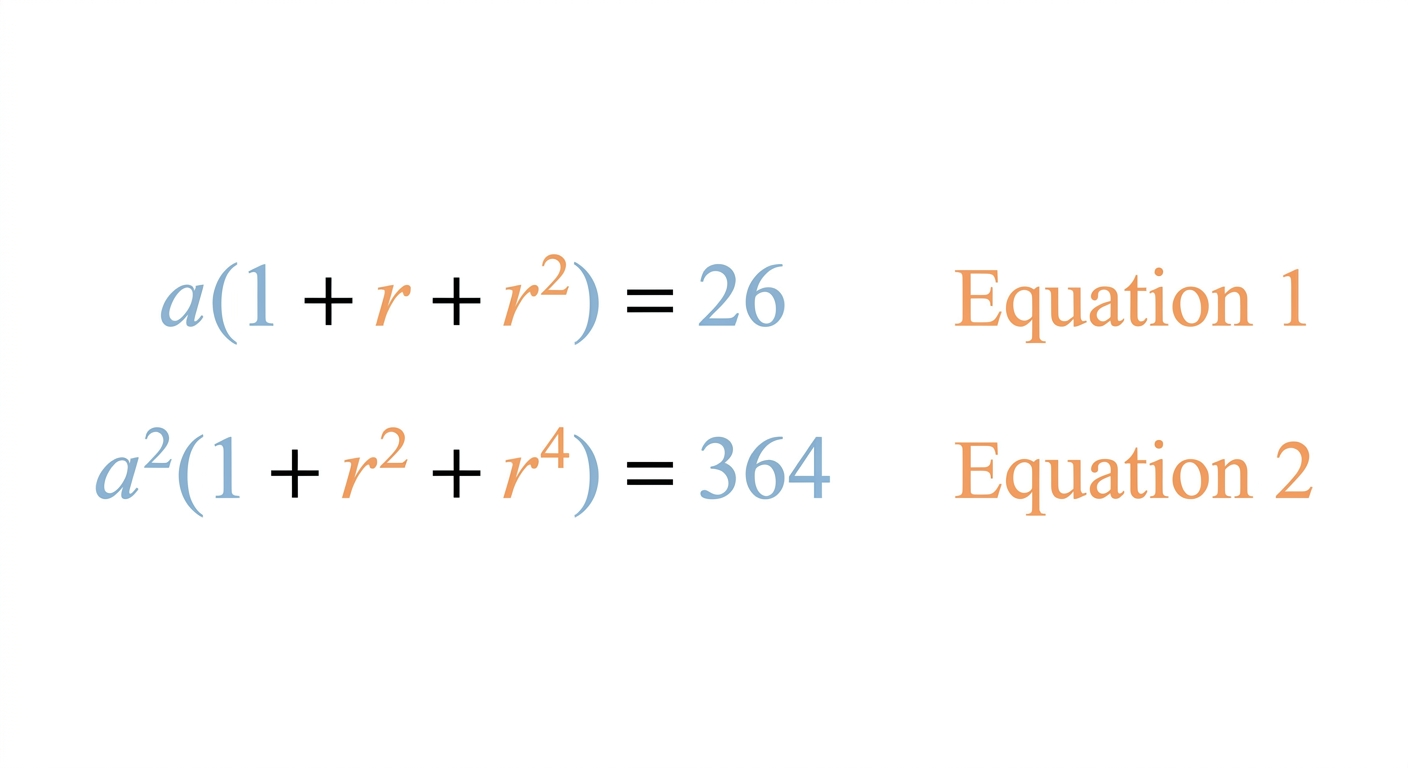
a+ar+ar2=26a + ar + ar^2 = 26 a(1+r+r2)=26(1)a(1 + r + r^2) = 26 \quad \dots (1)

From the second condition

(a)2+(ar)2+(ar2)2=364(a)^2 + (ar)^2 + (ar^2)^2 = 364 a2+a2r2+a2r4=364a^2 + a^2r^2 + a^2r^4 = 364 a2(1+r2+r4)=364(2)a^2(1 + r^2 + r^4) = 364 \quad \dots (2)

Step 2 · Find the Common Ratio rr

Divide Equation (2)(2) by the square of Equation (1)(1)

a2(1+r2+r4)[a(1+r+r2)]2=364262a2(1+r2+r4)a2(1+r+r2)2=3646761+r2+r4(1+r+r2)2=713\begin{aligned} \dfrac{a^2(1 + r^2 + r^4)}{[a(1 + r + r^2)]^2} &= \dfrac{364}{26^2} \\[1.1em] \dfrac{a^2(1 + r^2 + r^4)}{a^2(1 + r + r^2)^2} &= \dfrac{364}{676} \\[1.1em] \dfrac{1 + r^2 + r^4}{(1 + r + r^2)^2} &= \dfrac{7}{13} \end{aligned}

Using the identity 1+r2+r4=(1+r+r2)(1r+r2)1 + r^2 + r^4 = (1 + r + r^2)(1 - r + r^2)

(1+r+r2)(1r+r2)(1+r+r2)2=7131r+r21+r+r2=713\begin{aligned} \dfrac{(1 + r + r^2)(1 - r + r^2)}{(1 + r + r^2)^2} &= \dfrac{7}{13} \\[1.1em] \dfrac{1 - r + r^2}{1 + r + r^2} &= \dfrac{7}{13} \end{aligned}

Cross-multiplying

13(1r+r2)=7(1+r+r2)13(1 - r + r^2) = 7(1 + r + r^2) 1313r+13r2=7+7r+7r213 - 13r + 13r^2 = 7 + 7r + 7r^2 13r27r213r7r+137=06r220r+6=03r210r+3=0\begin{aligned} 13r^2 - 7r^2 - 13r - 7r + 13 - 7 &= 0 \\[0.6em] 6r^2 - 20r + 6 &= 0 \\[0.6em] 3r^2 - 10r + 3 &= 0 \end{aligned}

Factoring the quadratic equation

3r29rr+3=03r(r3)1(r3)=0(3r1)(r3)=0\begin{aligned} 3r^2 - 9r - r + 3 &= 0 \\[0.6em] 3r(r - 3) - 1(r - 3) &= 0 \\[0.6em] (3r - 1)(r - 3) &= 0 \end{aligned} 3r1=0orr3=03r - 1 = 0 \quad \text{or} \quad r - 3 = 0 r=13orr=3r = \dfrac{1}{3} \quad \text{or} \quad r = 3

Step 3 · Find the Terms of the GP

Case 1: When r=13r = \dfrac{1}{3}

Substitute into Equation (1)(1)

a(1+13+(13)2)=26a(1+13+19)=26a(9+3+19)=26a(139)=26a=26×913a=18\begin{aligned} a\left(1 + \dfrac{1}{3} + \left(\dfrac{1}{3}\right)^2\right) &= 26 \\[1.1em] a\left(1 + \dfrac{1}{3} + \dfrac{1}{9}\right) &= 26 \\[1.1em] a\left(\dfrac{9 + 3 + 1}{9}\right) &= 26 \\[1.1em] a\left(\dfrac{13}{9}\right) &= 26 \\[1.1em] a &= 26 \times \dfrac{9}{13} \\[0.6em] a &= 18 \end{aligned}

The three terms are a,ar,ar2a, ar, ar^2: 18,18×13=6,18×19=218, \quad 18 \times \dfrac{1}{3} = 6, \quad 18 \times \dfrac{1}{9} = 2

Case 2: When r=3r = 3

Substitute into Equation (1)(1)

a(1+3+32)=26a(1+3+9)=26a(13)=26a=2613=2\begin{aligned} a(1 + 3 + 3^2) &= 26 \\[0.6em] a(1 + 3 + 9) &= 26 \\[0.6em] a(13) &= 26 \\[0.6em] a &= \dfrac{26}{13} = 2 \end{aligned}

The three terms are a,ar,ar2a, ar, ar^2: 2,2×3=6,2×32=182, \quad 2 \times 3 = 6, \quad 2 \times 3^2 = 18

Both cases give the same set of numbers: 2,6,182, 6, 18.

Answer

2,6,182, 6, 18 (or 18,6,218, 6, 2)

Common Mistakes
  • Identity Error: Forgetting the identity 1+r2+r4=(1+r+r2)(1r+r2)1 + r^2 + r^4 = (1 + r + r^2)(1 - r + r^2) when simplifying 1+r2+r4(1+r+r2)2\dfrac{1 + r^2 + r^4}{(1 + r + r^2)^2}.
  • Missing a Solution: Discarding r=13r = \dfrac{1}{3} or r=3r = 3. Both values are valid and yield the same set of terms in ascending and descending order.
  • Squaring Error: Squaring ar2ar^2 as ar4ar^4 instead of (ar2)2=a2r4(ar^2)^2 = a^2r^4.

More questions in EOT

Q1

Find the 31st31^{\text{st}} term of an AP whose 11th11^{\text{th}} term is 38 and 16th16^{\text{th}} term is 73.

Q2

Determine the AP whose third term is 16 and whose 7th7^{\text{th}} term exceeds the 5th5^{\text{th}} term by 12.

Q3

How many three-digit numbers are divisible by 77? (Hint: All three-digit numbers divisible by 77 form an AP. Find the smallest and largest such three-digit numbers.)

Q4

How many multiples of 4 lie between 10 and 250? (Hint: All multiples of 4 form an AP. Find the smallest and largest multiples of 4 between 10 and 250.)

Q5

Find a GP for which the sum of the first two terms is 4-4 and the fifth term is 4 times the third term.

Q6

Find all possible ways of expressing 100100 as the sum of consecutive natural numbers.

Q7

The number of bacteria in a certain culture doubles every hour. If there were 30 bacteria present in the culture originally, how many bacteria will be present at the end of the 2nd2^{\text{nd}} hour, 4th4^{\text{th}} hour and nthn^{\text{th}} hour?

Q8

The sum of the 4th4^{\text{th}} and 8th8^{\text{th}} terms of an AP is 24 and the sum of the 6th6^{\text{th}} and 10th10^{\text{th}} terms is 44. Find the first three terms of the AP.

Q9

Find the smallest value of nn such that the sum of the first nn natural numbers is greater than 1,000.

Q10

Which term of the GP: 2,8,32,2, 8, 32, \dots is 131072131072? Write the explicit formula as well as the recursive formula for the nthn^{\text{th}} term.

Q11

The sum of the first three terms of a GP is 1312\dfrac{13}{12} and their product is 1-1. Find the common ratio and the terms.

Q12

If the 4th4^{\text{th}}, 10th10^{\text{th}} and 16th16^{\text{th}} terms of a GP are xx, yy and zz respectively, prove that x,y,zx, y, z are in GP.

Q13

The sum of the first three terms of a geometric progression is 26, and the sum of their squares is 364. Find the terms of the GP.

Q14

Suppose P1=1P_1 = 1, P2=2P_2 = 2 and for n>2n > 2, Pn=P1+P2++Pn1+1P_n = P_1 + P_2 + \dots + P_{n-1} + 1. Find the values of P1,P2,,P8P_1, P_2, \dots, P_8. Can you find a simpler recursive formula for PnP_n? Can you give an explicit formula?

Q15

Suppose W1=1W_1 = 1, W2=2W_2 = 2 and for n>2n > 2, Wn=W1+W2++Wn2+2W_n = W_1 + W_2 + \dots + W_{n-2} + 2. Find the values of W1,W2,,W8W_1, W_2, \dots, W_8. Do you recognise this sequence?

← Back to Predicting What Comes Next: Sequences and Progressions