Question 5
How many 2-digit numbers are divisible by 3? What is the sum of all these 2-digit numbers?
- The two-digit numbers divisible by form an Arithmetic Progression (AP):
- In this AP:
- First term ()
- Common difference ()
- Last term ( or )
- To find how many numbers there are, we use the term formula: .
- To find their sum, we use the sum formula: .
Step 1 · Find the Number of 2-Digit Numbers Divisible by 3
The list of 2-digit numbers divisible by is .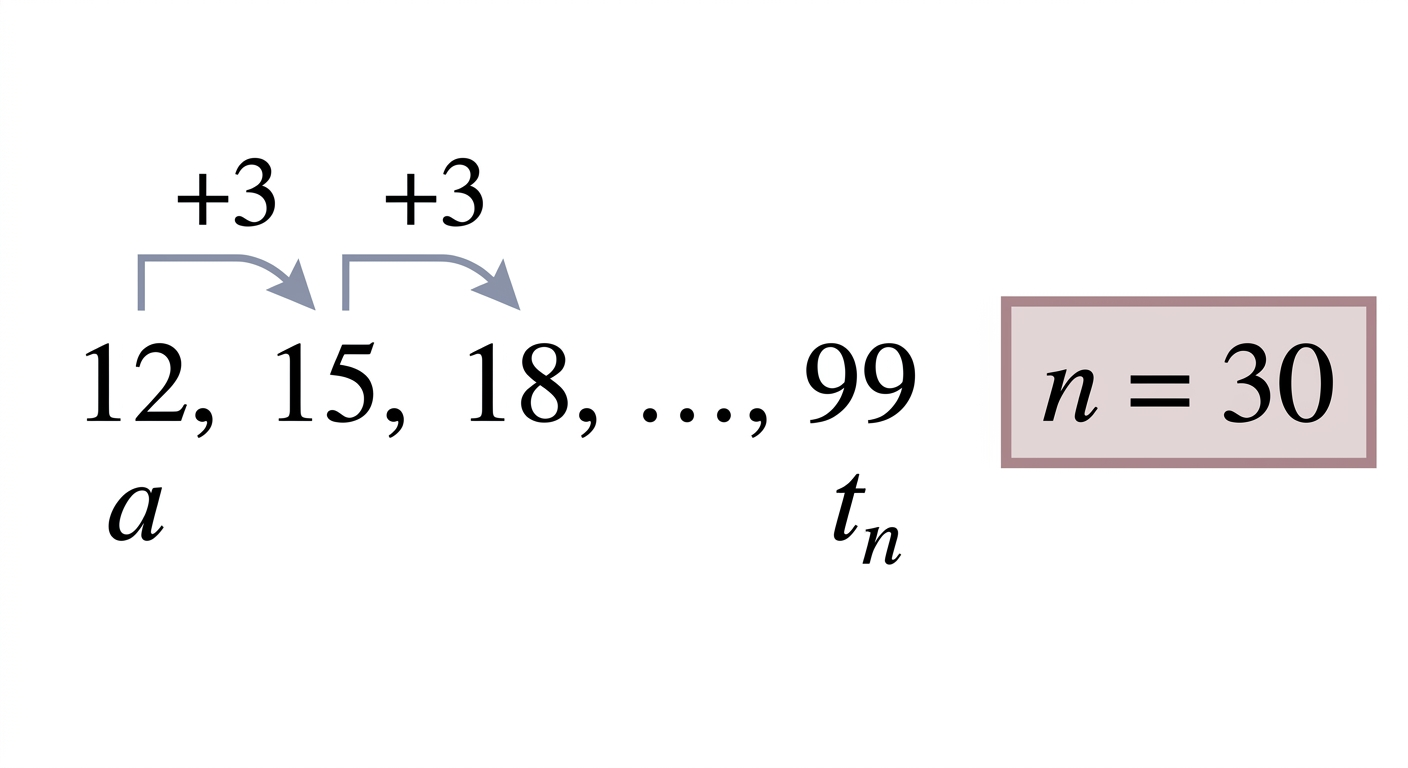
This is an AP with:
- First term,
- Common difference,
- Last term,
Using the term formula
There are two-digit numbers divisible by .
Step 2 · Calculate the Sum of the Numbers
Using the sum formula for an AP
Substitute , , and
Number of 2-digit numbers divisible by ; Sum
- Wrong First/Last Term: Using (not a 2-digit number) instead of as the first term, or instead of as the last term.
- Off-by-One Error: Forgetting to add when solving , leading to instead of .
- Sum Formula Substitution: Using or forgetting to multiply by the factor .
More questions in Exercise 8.2
Find the and terms of the AP:
Which term of the AP: is ? Also, is a term of this AP? Give reasons for your answer.
Find the term of the AP: . Write the recursive rule for this AP.
An AP consists of 50 terms in which the term is 12 and the last term is 106. Find the term.
(Hint: If is the first term and the common difference, then we arrive at the equations and . Solve this pair of linear equations for and .)
How many 2-digit numbers are divisible by 3? What is the sum of all these 2-digit numbers?
Harish started work at an annual salary of ₹5,00,000 and received an increment of ₹20,000 each year. After how many years did his income reach ₹7,00,000?
A child arranges marbles in rows so that the first row has 1 marble, the second has 2 marbles, the third has 3, and so on up to 25 rows. How many marbles does the child use in all?