Question 1
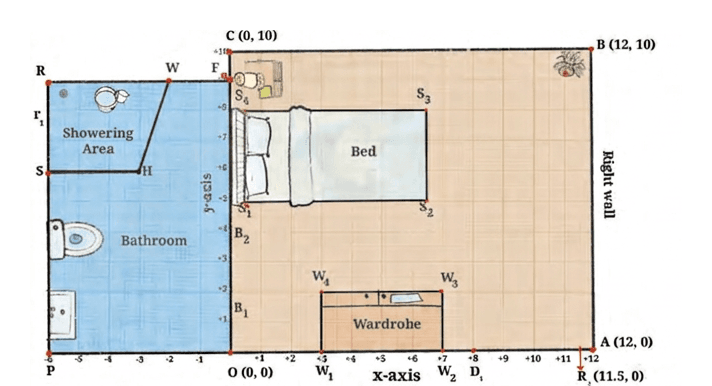
Place Reiaan’s rectangular study table with three of its feet at the points , and .
(i) Where will the fourth foot of the table be?
(ii) Is this a good spot for the table?
(iii) What is the width of the table? The length? Can you make out the height of the table?
- A rectangle's opposite sides are equal in length and parallel to each other.
- On a 2D grid aligned with the coordinate axes, a rectangle with horizontal and vertical sides has vertices sharing the same - or -coordinates in pairs.
- Three feet of the table are given at , , and .
- The 2D grid only gives two-dimensional information ( and ), so dimensions along these axes can be measured, but vertical height in the third dimension cannot be determined.
(i) Where will the fourth foot of the table be?
Step 1 · Find the Coordinates of the Fourth Foot
Let the given three vertices be , , and .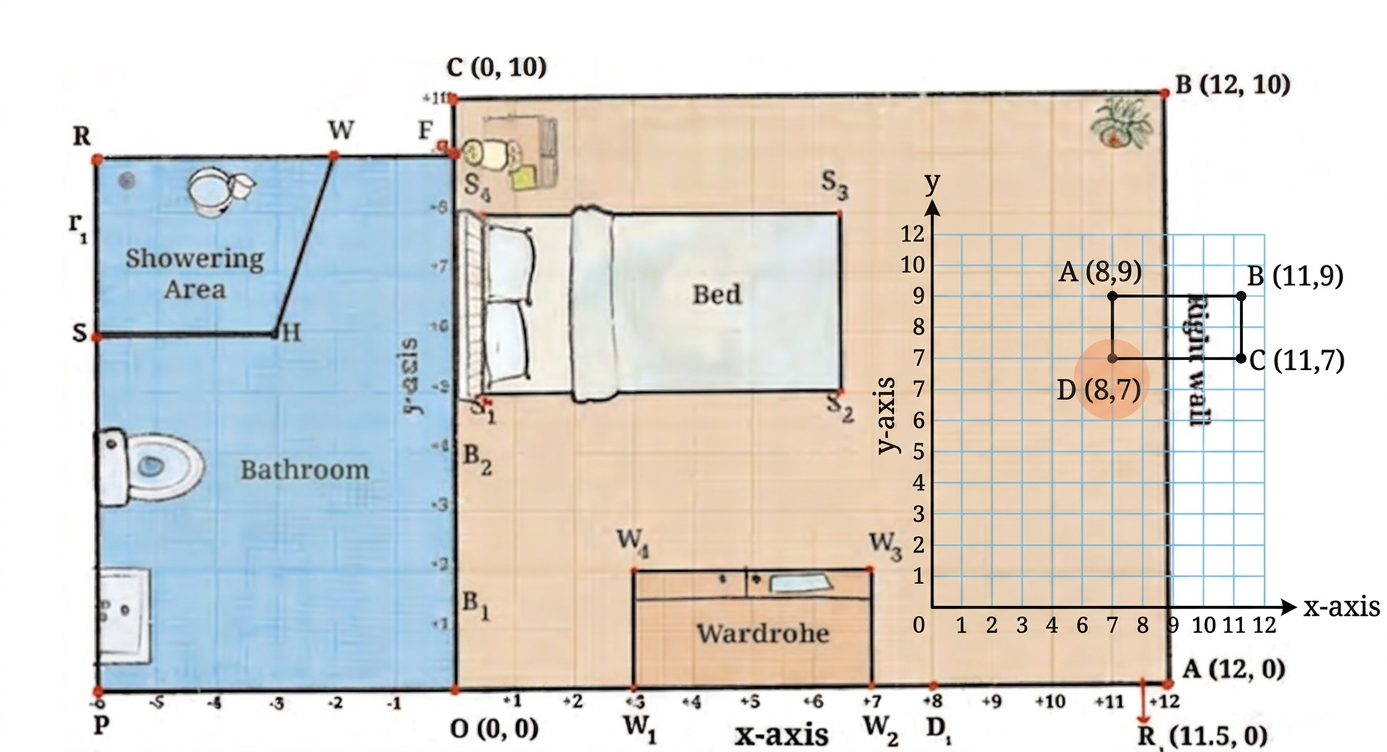
In a rectangle with sides parallel to the coordinate axes:
- is a horizontal side since both points have .
- is a vertical side since both points have .
The fourth vertex must share the -coordinate of and the -coordinate of :
Therefore, the fourth foot is at .
(i)
(ii) Is this a good spot for the table?
Step 1 · Evaluate the Position of the Table
The table occupies the region where ranges from to and ranges from to .
This position places the table near the corner and along the walls of the room, leaving the main central area open and free for movement.
(ii) Yes, this is a good spot for the table as it is placed near the walls, leaving the central room area clear.
(iii) What is the width of the table? The length? Can you make out the height of the table?
Step 1 · Calculate Dimensions and Height
The distance along the -axis between and gives the length:
The distance along the -axis between and gives the width:
Since the coordinate plan is two-dimensional (showing only and ), there is no information about the third dimension (height). Thus, the height cannot be determined.
(iii) , . The height cannot be determined from a 2D floor plan.
- Coordinate Swapping: Writing the fourth foot as instead of . Remember that the -coordinate comes from the vertical line and the -coordinate comes from the horizontal line .
- Assuming Height in 2D: Attempting to calculate the table's height using or values; a 2D coordinate plane only represents length and width.
More questions in Exercise 1.2
Place Reiaan’s rectangular study table with three of its feet at the points , and .
(i) Where will the fourth foot of the table be?
(ii) Is this a good spot for the table?
(iii) What is the width of the table? The length? Can you make out the height of the table?
If the bathroom door has a hinge at and opens into the bedroom, will it hit the wardrobe? Are there any changes you would suggest if the door is made wider?
Look at Reiaan’s bathroom.
(i) What are the coordinates of the four corners , , , and of the bathroom?
(ii) What is the shape of the showering area in Reiaan’s bathroom? Write the coordinates of the four corners.
(iii) Mark off a space for the washbasin and a space for the toilet. Write the coordinates of the corners of these spaces.
Other rooms in the house:
(i) Reiaan’s room door leads from the dining room which has the length and width . The length of the dining room extends from point to point . Sketch the dining room and mark the coordinates of its corners.
(ii) Place a rectangular dining table precisely in the centre of the dining room. Write down the coordinates of the feet of the table.