Question 2
Explain why the following statement is true: If the perpendicular distance of a chord from the centre is and the radius is , then the chord length is .
- The perpendicular drawn from the centre of a circle to a chord bisects the chord.
- Joining the centre to an endpoint of the chord creates a right-angled triangle where:
- The hypotenuse is the radius .
- One leg is the perpendicular distance .
- The other leg is half the chord length.
- Applying the Pythagoras theorem gives half the chord length as , making the total chord length .
Step 1 · Set Up the Geometry
Let be the centre of the circle, be the chord, and where lies on .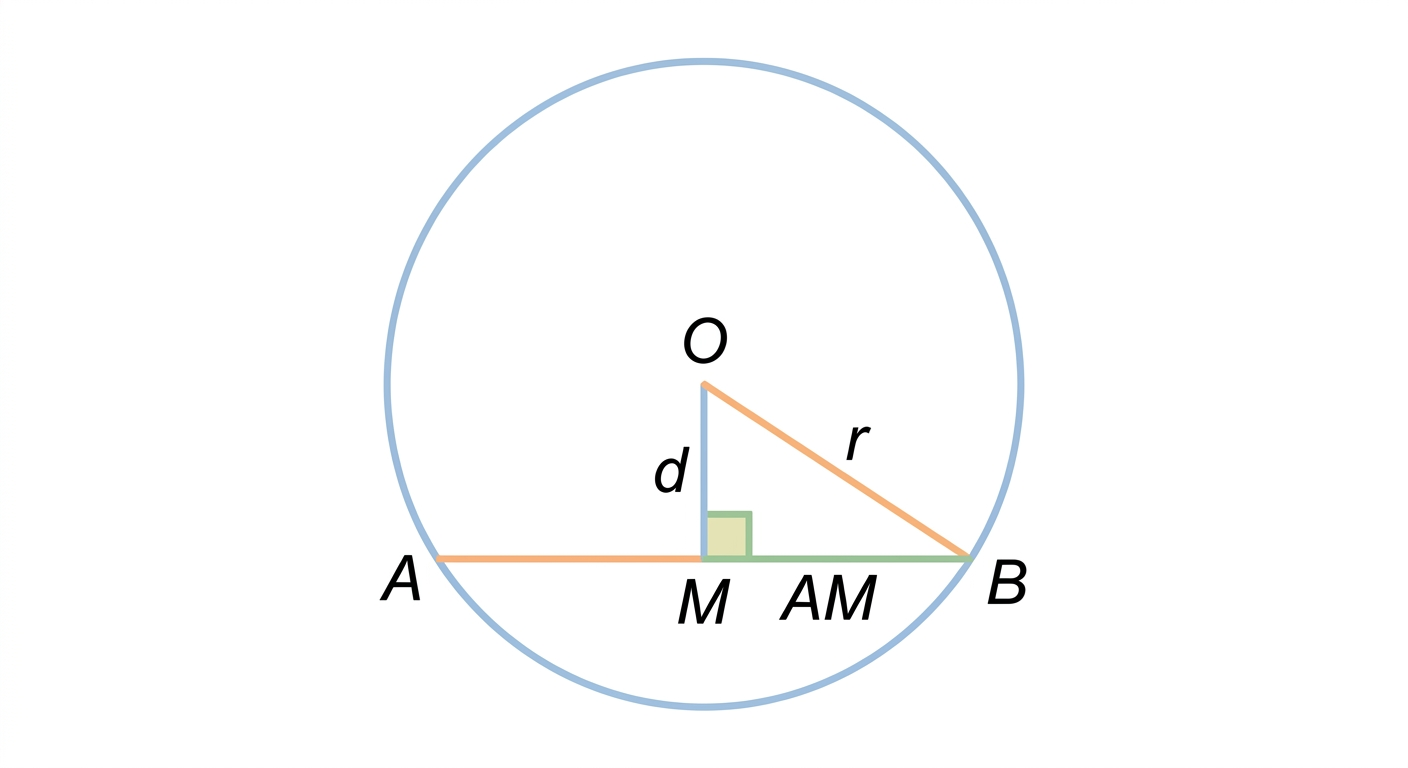
Given:
- Radius
- Perpendicular distance
Since the perpendicular from the centre to a chord bisects the chord, is the midpoint of :
Step 2 · Apply Pythagoras Theorem
In right-angled triangle (with ):
Therefore, the full chord length is:
Hence proved, the chord length is .
- Forgetting to Double the Segment: Finding and forgetting that is only half the chord, so total chord length requires multiplying by .
- Misidentifying the Hypotenuse: Treating the perpendicular distance or half-chord as the hypotenuse instead of the radius , which incorrectly leads to .
More questions in Exercise 5.5
Find the length of the chord of a circle where the radius is and perpendicular distance is .
Explain why the following statement is true: If the perpendicular distance of a chord from the centre is and the radius is , then the chord length is .
In a circle, if the distance of chord from the centre is twice the distance of another chord from the centre, then can we conclude that ? Give reasons for your answer.