Question 4
There are 3 closed boxes—one containing only red balls, the second containing only blue balls and the third containing only green balls. The boxes are labelled RED, BLUE and GREEN such that ‘no’ box has the correct label. We need to find which label goes with which box. How can this be done if we are allowed to open only one box?
- We have three boxes labelled RED, BLUE, and GREEN.
- Given condition: Every box is mislabelled (no box has the correct label):
- Box labelled
- Box labelled
- Box labelled
- Opening just one box allows us to determine its true contents. By elimination and the mislabelling rule, the contents of the remaining two boxes are uniquely determined.
Step 1 · Choose One Box to Open
Choose and open any box, for example, the box labelled RED, and draw one ball.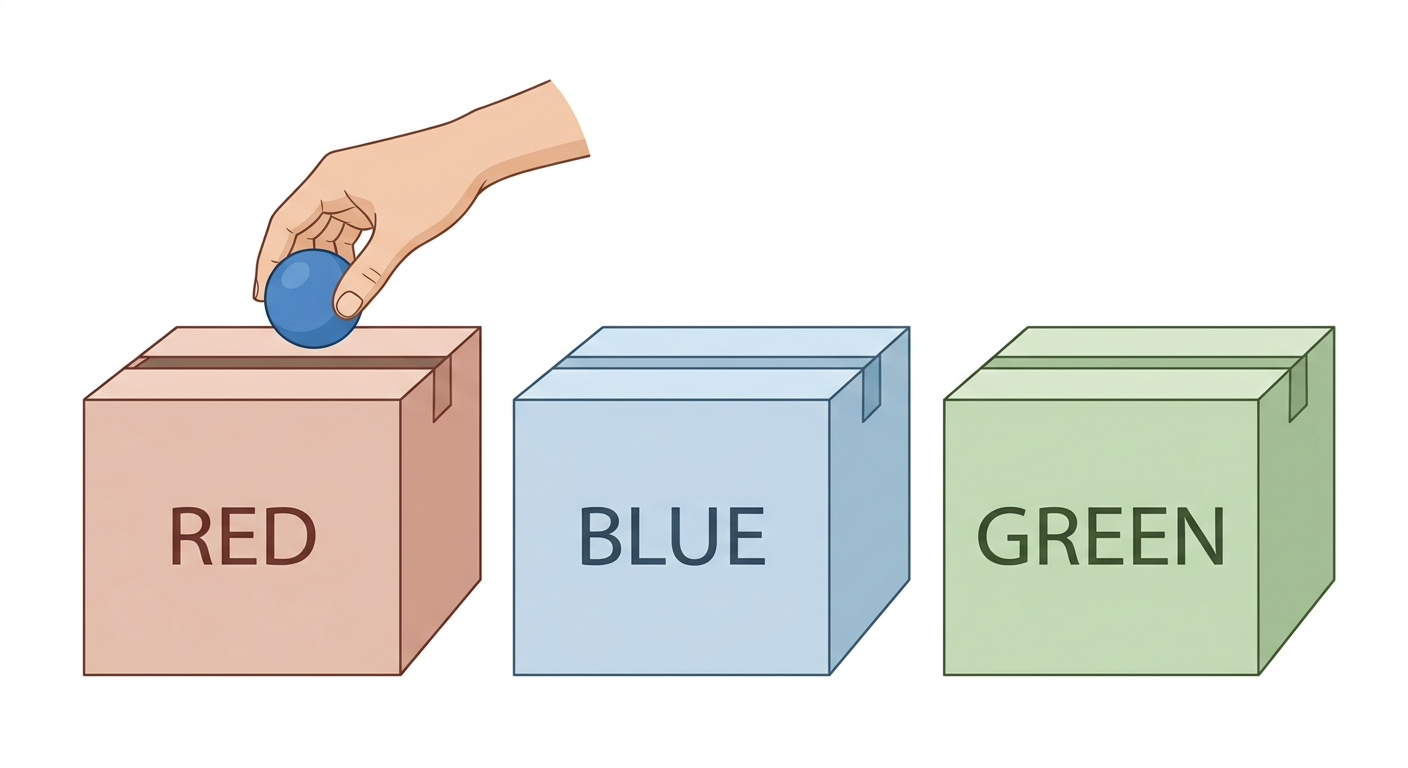
Since the box labelled cannot contain red balls, the ball drawn must be either Blue or Green.
Step 2 · Case 1: If a Blue Ball is Drawn
If the box labelled contains Blue balls:
- Box labelled : Cannot contain blue balls (already in ) and cannot contain its own label (blue). Therefore, it must contain Green balls.
- Box labelled : By elimination, it must contain Red balls.
Step 3 · Case 2: If a Green Ball is Drawn
If the box labelled contains Green balls:
- Box labelled : Cannot contain green balls (already in ) and cannot contain blue balls (its own label). Therefore, it must contain Red balls.
- Box labelled : By elimination, it must contain Blue balls.
Open the box labelled RED:
- If it has Blue balls
- If it has Green balls
- Overlooking the "No Correct Label" Rule: Forgetting that every box is strictly mislabelled leads to the false conclusion that opening one box leaves ambiguity for the remaining two.
- Drawing from More than One Box: The problem allows opening only one box; once its true contents are known, logic and elimination completely resolve the other two boxes without opening them.
More questions in A
Cut out two identical squares of paper. Draw, label, and cut as follows:
Now place the pieces 5, 6, 7, and 8 around Square 1 to get a square with double the area.
Halving a Square Using Paper
Cut out a square from a piece of paper. Now make a square whose area is half the area of the first square.
Will the square having half the sidelength have half the area? Why not? How many such squares will fill the original square?
Fold the square paper inward, as shown, such that the crease lines pass through the midpoints of the sides. is the required square with half the area.
There are 3 closed boxes—one containing only red balls, the second containing only blue balls and the third containing only green balls. The boxes are labelled RED, BLUE and GREEN such that ‘no’ box has the correct label. We need to find which label goes with which box. How can this be done if we are allowed to open only one box?