Question 1
Cut out two identical squares of paper. Draw, label, and cut as follows:
Now place the pieces 5, 6, 7, and 8 around Square 1 to get a square with double the area.
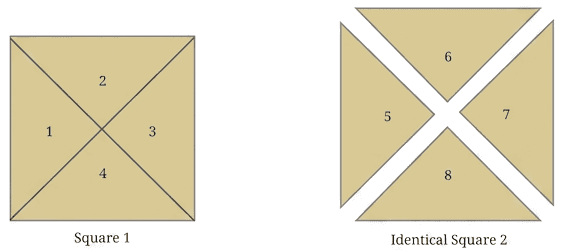
- Let Square 1 have side length and area .
- An identical square (Square 2) is divided along its diagonals into congruent right-angled isosceles triangles numbered and .
- Each triangle has an area equal to and a hypotenuse equal to .
- Placing these triangles along the four edges of Square 1 adds an area of , resulting in a combined area of , which is exactly double the area of Square 1.
Step 1 · Calculate the Area and Dimensions of the Pieces
Let be the side length of Square 1.
Square 2 is identical to Square 1 and cut into four identical right-angled isosceles triangles (). Each triangle has legs of length and hypotenuse .
Total area when pieces and are added to Square 1:
Side length of the new square ():
Step 2 · Arrange the Pieces to Form the Larger Square
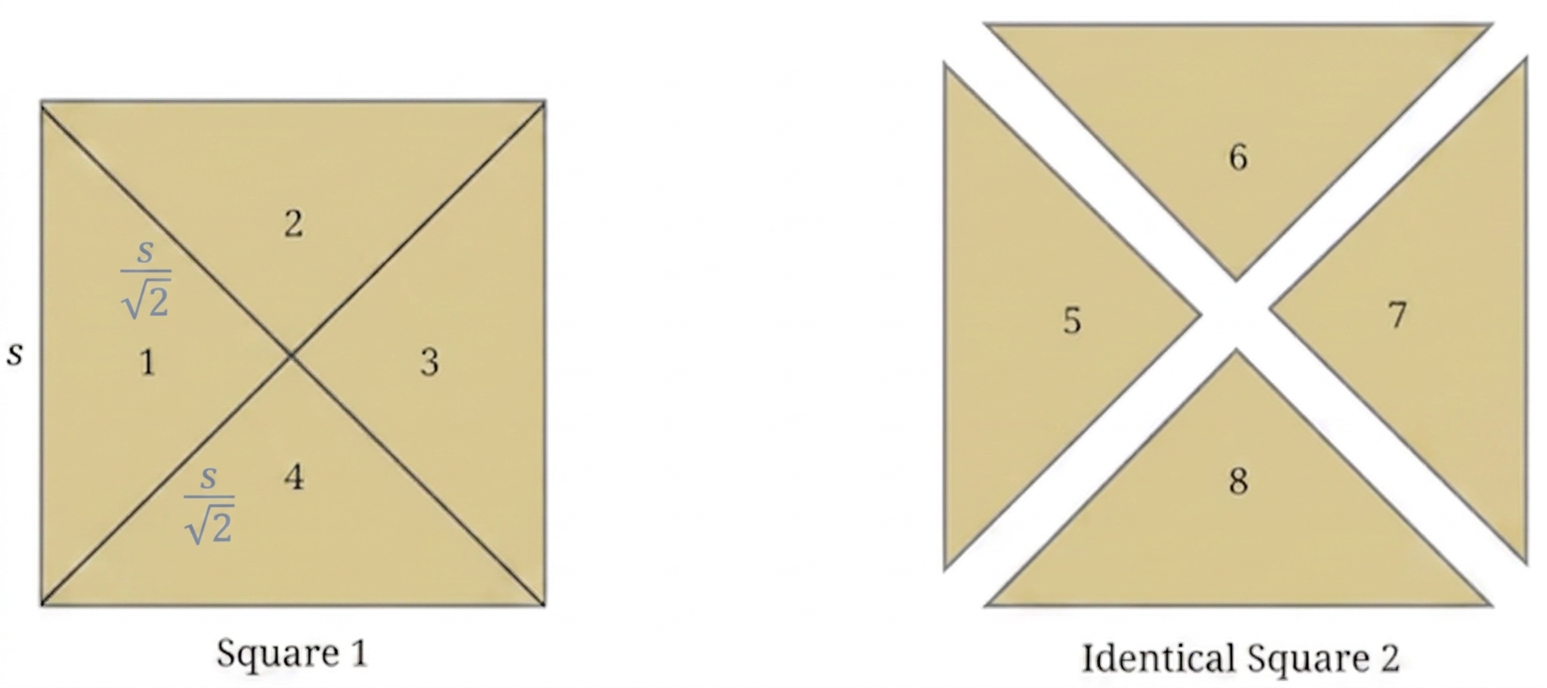
Place the hypotenuse (length ) of each triangle () along the four outer edges of Square 1.
The legs of the adjacent triangles align along the outer boundary to form each side of the new square:
Since all four sides are equal to and meet at right angles, the resulting figure is a square of area .
Placing the hypotenuse of each of the triangular pieces () along the four edges of Square 1 forms a new square with side length and area (double the area of Square 1).
- Side-Matching Error: Attempting to attach the legs of the triangles to Square 1 instead of their hypotenuses. Since the side of Square 1 is , only the hypotenuse (length ) matches its edges.
- Doubling Dimensions vs. Doubling Area: Assuming that doubling the area doubles the side length. Doubling the side length quadruples the area (), whereas doubling the area scales the side length by a factor of ().
More questions in A
Cut out two identical squares of paper. Draw, label, and cut as follows:
Now place the pieces 5, 6, 7, and 8 around Square 1 to get a square with double the area.
Halving a Square Using Paper
Cut out a square from a piece of paper. Now make a square whose area is half the area of the first square.
Will the square having half the sidelength have half the area? Why not? How many such squares will fill the original square?
Fold the square paper inward, as shown, such that the crease lines pass through the midpoints of the sides. is the required square with half the area.
There are 3 closed boxes—one containing only red balls, the second containing only blue balls and the third containing only green balls. The boxes are labelled RED, BLUE and GREEN such that ‘no’ box has the correct label. We need to find which label goes with which box. How can this be done if we are allowed to open only one box?