Question 1
Context: Queen Ratnamanjuri left a puzzle in her will for her son Khoisnam and 99 relatives. They are in a room with 100 lockers, numbered 1 to 100.
- Person 1 opens every locker.
- Person 2 toggles every 2nd locker (closes if open, opens if closed).
- Person 3 toggles every 3rd locker (3rd, 6th, 9th, ).
- Person 4 toggles every 4th locker (4th, 8th, 12th, ). This continues until all 100 get their turn.
Q. Before the process begins, Khoisnam realises that he already knows which lockers will be open at the end. How did he figure out the answer?
Hint: Find out how many times each locker is toggled.
- Each locker is initially closed and gets toggled whenever a person's number is a factor of the locker's number.
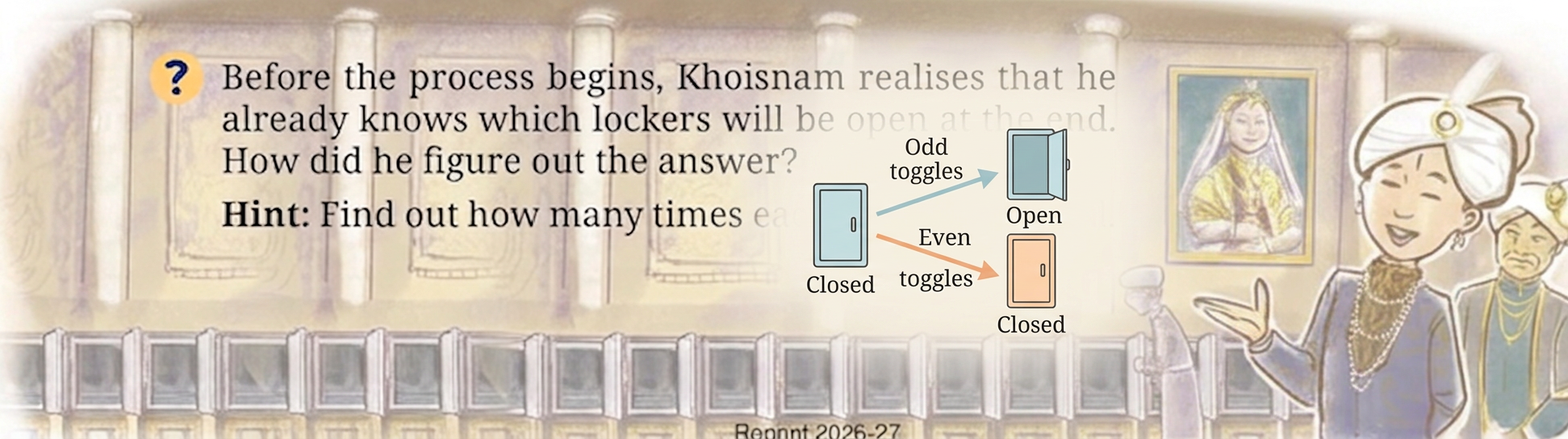
- A locker ends up open if it is toggled an odd number of times, and closed if toggled an even number of times.
- Factors of numbers generally come in distinct pairs, giving an even number of factors. Only perfect squares have a factor paired with itself (its square root), resulting in an odd number of factors.
- Therefore, only the lockers with numbers that are perfect squares will remain open at the end.
Step 1 · Relate Locker Toggles to Factors
A locker starts closed and changes state whenever it is toggled:
- Odd number of toggles: Locker remains open
- Even number of toggles: Locker remains closed
Person toggles locker if is a divisor (factor) of . Thus:
Step 2 · Identify Numbers with an Odd Number of Factors
Factors of any number naturally occur in pairs such that :
- Non-square numbers: Every factor has a distinct partner, giving an even number of factors.
- Perfect squares: The factor pairs with itself (), giving an odd number of distinct factors.
Thus, only lockers labeled with perfect squares are toggled an odd number of times and remain open.
Listing the perfect squares between and :
Khoisnam reasoned that a locker is toggled once for each of its factors. Only perfect squares have an odd number of factors and remain open.
The open lockers are:
- Assuming Primes Stay Open: Mistaking prime numbers as having an odd number of factors. Primes have exactly factors ( and itself), which is even, so prime-numbered lockers end up closed.
- Forgetting is a Square: Overlooking (), which has only factor and therefore stays open.
More questions in IT
Context: Queen Ratnamanjuri left a puzzle in her will for her son Khoisnam and 99 relatives. They are in a room with 100 lockers, numbered 1 to 100.
- Person 1 opens every locker.
- Person 2 toggles every 2nd locker (closes if open, opens if closed).
- Person 3 toggles every 3rd locker (3rd, 6th, 9th, ).
- Person 4 toggles every 4th locker (4th, 8th, 12th, ). This continues until all 100 get their turn.
Q. Before the process begins, Khoisnam realises that he already knows which lockers will be open at the end. How did he figure out the answer?
Hint: Find out how many times each locker is toggled.
Does every number have an even number of factors?
Can you use this insight to find more numbers with an odd number of factors?
Context: In a room with 100 lockers, only lockers whose numbers are square numbers remain open.
Q. Write the locker numbers that remain open.
Find the squares of the first 30 natural numbers and fill in the table below.
Context: Patterns and Properties of Perfect Squares
Find the squares of the first 30 natural numbers and fill in the table below.
Q. What patterns do you notice? Share your observations and make conjectures.
If a number ends in 0, 1, 4, 5, 6 or 9, is it always a square?
Write 5 numbers such that you can determine by looking at their units digit that they are not squares.
Let us consider square numbers ending in 6: , , , , , and . Which of the following numbers have the digit 6 in the units place?
(i) (ii) (iii) (iv) (v) (vi)
Find more such patterns by observing the numbers and their squares from the table you filled earlier.
If a number contains 3 zeros at the end, how many zeros will its square have at the end?
What do you notice about the number of zeros at the end of a number and the number of zeros at the end of its square? Will this always happen? Can we say that squares can only have an even number of zeros at the end?
What can you say about the parity of a number and its square?
Find how many numbers lie between two consecutive perfect squares. Do you notice a pattern?
How many square numbers are there between 1 and 100? How many are between 101 and 200? Using the table of squares you filled earlier, enter the values below, tabulating the number of squares in each block of 100. What is the largest square less than 1000?
Can you see any relation between triangular numbers and square numbers? Extend the pattern shown and draw the next term.
Find whether and are perfect squares using prime factorisation.
How many cubes of side make a cube of side ?
How many cubes of side will make a cube of side ?
Is 9 a cube?
Can you estimate the number of unit cubes in a cube with an edge length of 4 units?
Complete the table below.
What patterns do you notice in the table above?
We know that 0, 1, 4, 5, 6, 9 are the only last digits possible for squares. What are the possible last digits of cubes?
Similar to squares, can you find the number of cubes with 1 digit, 2 digits, and 3 digits? What do you observe?
Can a cube end with exactly two zeroes (00)? Explain.
The next two taxicab numbers after 1729 are 4104 and 13832. Find the two ways in which each of these can be expressed as the sum of two positive cubes.
Context: Look at the following pattern of consecutive odd numbers:
Later in this series, we get the following set of consecutive numbers:
Q. Can you tell what this sum is without doing the calculation?
Find the cube roots of these numbers:
(i)
(ii)
(iii)
Compute successive differences over levels for perfect cubes until all the differences at a level are the same. What do you notice?