Question 2
Take any 4 consecutive numbers. For example, 3, 4, 5, and 6. Place '' and '' signs in between the numbers. How many different possibilities exist? Write all of them.
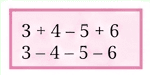
- Between any consecutive numbers, there are spaces where a sign can be placed.
- For each space, there are choices: either a plus sign () or a minus sign ().
- The total number of combinations is found by multiplying the choices for each position: .
Step 1 · Calculate the Number of Possibilities
For four numbers (such as ), there are spaces between them: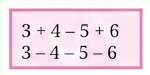
Each space has possible choices ( or ):
Step 2 · List All Possibilities
Systematically listing all sign combinations:
There are different possibilities:
- Placing signs in front: Mistakenly placing a sign before the first number , which would give spaces ( possibilities) instead of spaces between the numbers.
- Unsystematic listing: Listing combinations randomly, which often leads to duplicate entries or missed cases.
More questions in A
Anshu is exploring sums of consecutive numbers. He has written the following:
Now, he is wondering—
- "Can I write every natural number as a sum of consecutive numbers?"
- "Which numbers can I write as the sum of consecutive numbers in more than one way?"
- "Ohh, I know all odd numbers can be written as a sum of two consecutive numbers. Can we write all even numbers as a sum of consecutive numbers?"
- "Can I write 0 as a sum of consecutive numbers? Maybe I should use negative numbers."
Explore these questions and any others that may occur to you. Discuss them with the class.
Take any 4 consecutive numbers. For example, 3, 4, 5, and 6. Place '' and '' signs in between the numbers. How many different possibilities exist? Write all of them.