Divisibility and Multiples | A

Question 1

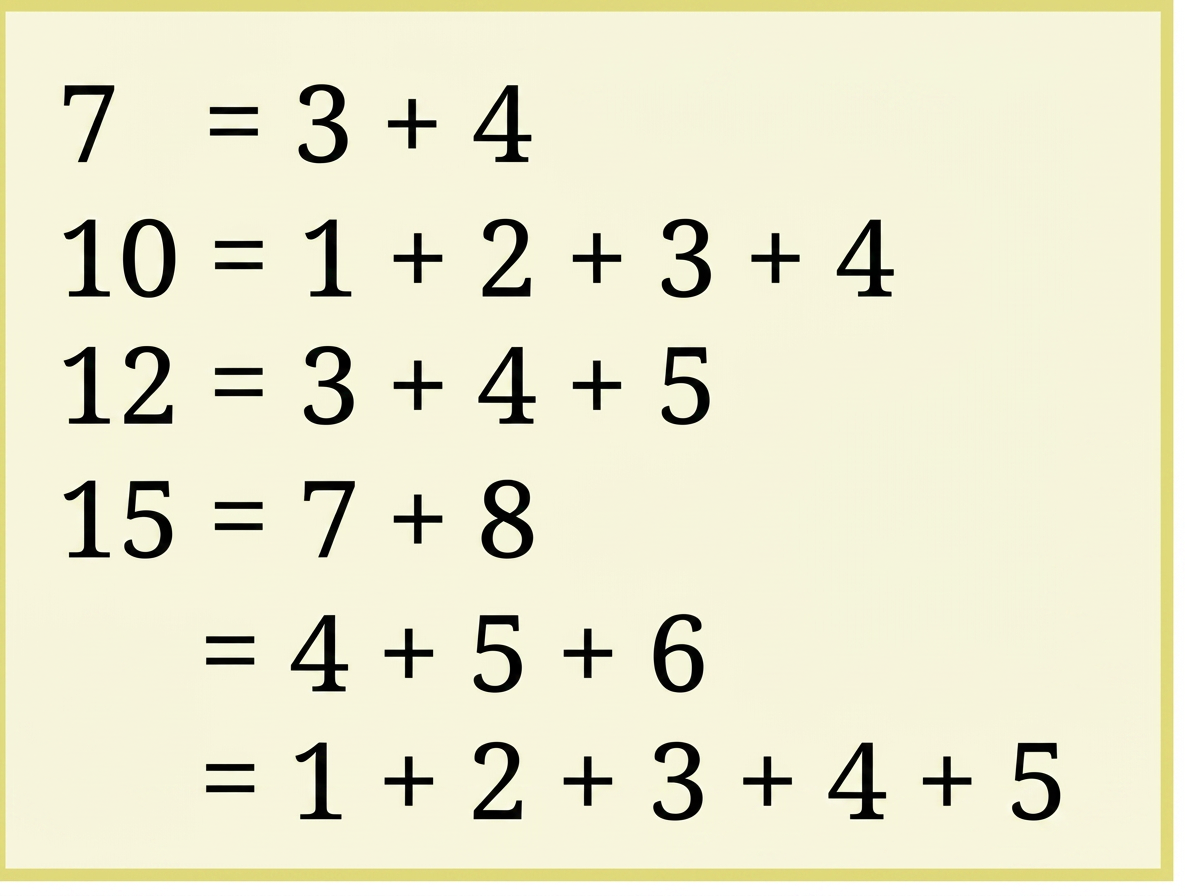
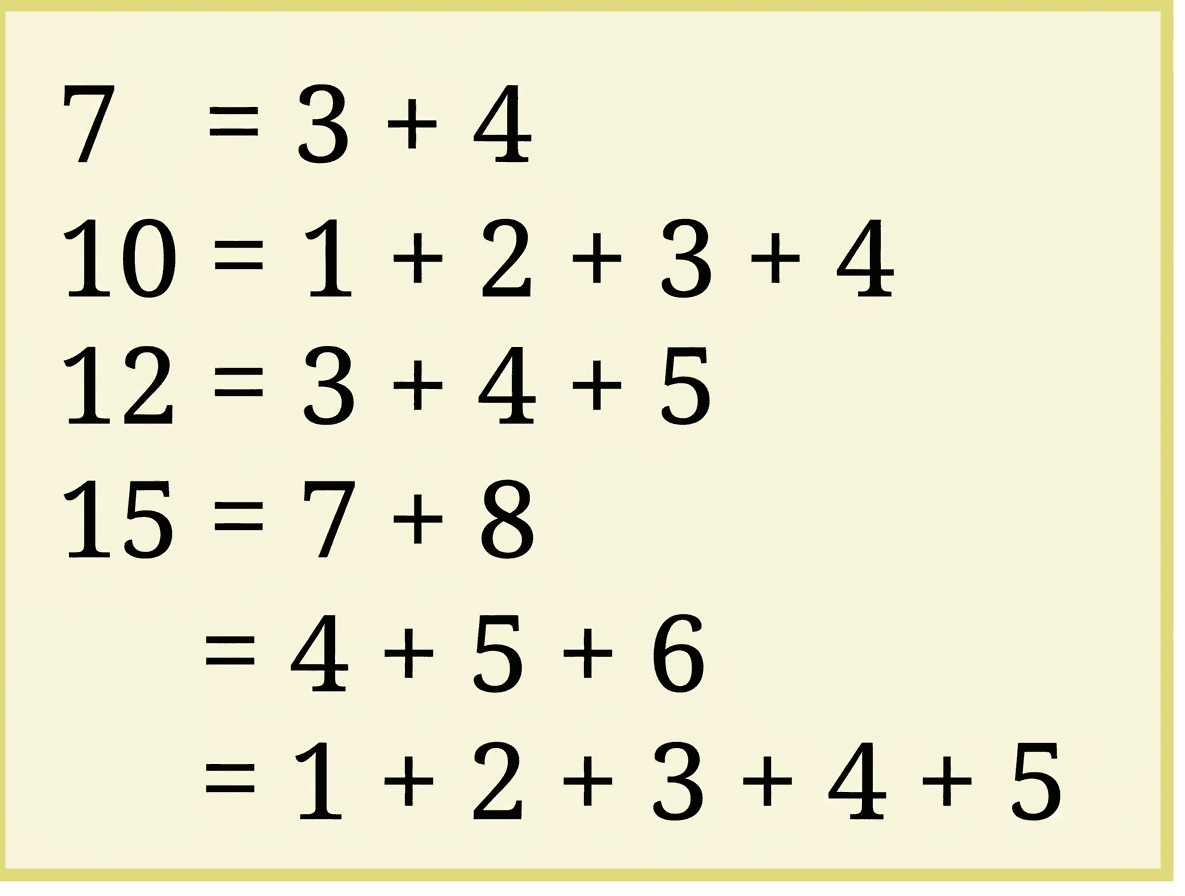
Anshu is exploring sums of consecutive numbers. He has written the following:

Now, he is wondering—

  • "Can I write every natural number as a sum of consecutive numbers?"
  • "Which numbers can I write as the sum of consecutive numbers in more than one way?"
  • "Ohh, I know all odd numbers can be written as a sum of two consecutive numbers. Can we write all even numbers as a sum of consecutive numbers?"
  • "Can I write 0 as a sum of consecutive numbers? Maybe I should use negative numbers."

Explore these questions and any others that may occur to you. Discuss them with the class.
Question diagram 1
Check your answer with HomiSolve it yourself, then let Homi check your steps and spot mistakes.
Solution

The sum of consecutive numbers can be explored using a general formula.

Step 1 — Understanding the Formula

Let the first number in a sequence of consecutive integers be aa. Let the number of terms in the sequence be nn. The sequence of numbers is a,a+1,a+2,,a+(n1)a, a+1, a+2, \dots, a+(n-1). The sum SS of these nn consecutive integers is given by the formula for an arithmetic progression: S=n2(first term+last term)S = \frac{n}{2}(\text{first term} + \text{last term}) S=n2(a+a+n1)S = \frac{n}{2}(a + a + n - 1) S=n2(2a+n1)S = \frac{n}{2}(2a + n - 1) To make it easier to work with, we can multiply both sides by 2: 2S=n(2a+n1)2S = n(2a + n - 1) Let's call the second factor YY. So, Y=2a+n1Y = 2a + n - 1. Now we have 2S=nY2S = nY. Consider the difference between YY and nn: Yn=(2a+n1)nY - n = (2a + n - 1) - n Yn=2a1Y - n = 2a - 1 Since aa is an integer, 2a2a is always an even integer. So, 2a12a - 1 is always an odd integer. This means that YY and nn must have different parities (one must be odd and the other must be even).

Step 2 — Can every natural number be written as a sum of consecutive numbers?

Anshu is exploring sums of consecutive numbers. The examples given use natural numbers (positive integers) and involve sums of two or more terms (n2n \ge 2). Let's assume this context. We know from Step 1 that 2S=nY2S = nY, where nn and YY have different parities. Consider natural numbers that are powers of 2, such as 1,2,4,8,16,1, 2, 4, 8, 16, \dots. Let S=2kS = 2^k for some integer k0k \ge 0. Then 2S=22k=2k+12S = 2 \cdot 2^k = 2^{k+1}. The factors of 2k+12^{k+1} are 1,2,4,,2k+11, 2, 4, \dots, 2^{k+1}. All these factors are even, except for 11. For nn and YY to have different parities, one of them must be 1.

  • Case 1: n=1n=1. This means the "sum" is just the number aa itself. For example, 7=77=7. This is not a sum of two or more terms.
  • Case 2: Y=1Y=1. This means 2a+n1=12a+n-1=1. Since we are looking for sums of natural numbers, a1a \ge 1. So 2a22a \ge 2. Since we are looking for sums of two or more terms, n2n \ge 2. So n11n-1 \ge 1. Therefore, 2a+n12+1=32a+n-1 \ge 2+1 = 3. This contradicts Y=1Y=1. So YY cannot be 1. Since neither n=1n=1 nor Y=1Y=1 leads to a valid sum of two or more consecutive natural numbers for powers of 2, we conclude that numbers that are powers of 2 cannot be written as a sum of two or more consecutive natural numbers. For example, 4 cannot be written as a+(a+1)a+(a+1) or a+(a+1)+(a+2)a+(a+1)+(a+2), etc., using natural numbers.

So, the answer to Anshu's first question is no.

Step 3 — Which numbers can be written in more than one way?

A natural number SS can be written as a sum of two or more consecutive natural numbers if and only if SS is not a power of 2. For SS to be written in more than one way, there must be multiple distinct pairs of (n,Y)(n, Y) factors for 2S2S that satisfy the conditions:

  1. n2n \ge 2 (sum of two or more terms)
  2. a1a \ge 1 (terms are natural numbers), which implies Y>nY > n (since Yn=2a11Y-n = 2a-1 \ge 1)
  3. nn and YY have different parities.

The number of ways to write SS as a sum of two or more consecutive natural numbers is equal to the number of odd factors of SS (including 1), minus 1. Let's call this τo(S)1\tau_o(S)-1. For SS to be written in more than one way, we need τo(S)1>1\tau_o(S)-1 > 1, which means τo(S)>2\tau_o(S) > 2. This means SS must have at least three odd factors (including 1). If we write S=2kMS = 2^k \cdot M, where MM is the odd part of SS, then τo(S)\tau_o(S) is the number of factors of MM. So, MM must have more than two factors. This means MM must be a composite number (not 1 and not a prime number). For example, S=9S=9. Its odd part is M=9M=9. The factors of 9 are 1,3,91, 3, 9. Since 99 is a composite number, S=9S=9 can be written in τo(9)1=31=2 ways\tau_o(9)-1 = 3-1 = \textbf{2 ways}: 9=4+59 = 4+5 9=2+3+49 = 2+3+4 Another example is S=15S=15. Its odd part is M=15M=15. The factors of 15 are 1,3,5,151, 3, 5, 15. Since 1515 is a composite number, S=15S=15 can be written in τo(15)1=41=3 ways\tau_o(15)-1 = 4-1 = \textbf{3 ways}: 15=7+815 = 7+8 15=4+5+615 = 4+5+6 15=1+2+3+4+515 = 1+2+3+4+5 So, numbers whose odd part is a composite number can be written as a sum of consecutive natural numbers in more than one way.

Step 4 — Odd numbers as sum of two consecutive numbers; Even numbers as sum of consecutive numbers?

  • "Ohh, I know all odd numbers can be written as a sum of two consecutive numbers." Let an odd number be NN. We want to write N=a+(a+1)N = a + (a+1). N=2a+1N = 2a + 1 Solving for aa: 2a=N12a = N - 1 a=N12a = \frac{N-1}{2} For aa to be a natural number (i.e., a1a \ge 1), we need N121\frac{N-1}{2} \ge 1. This means N12N-1 \ge 2, so N3N \ge 3. Therefore, all odd numbers greater than 1 can be written as a sum of two consecutive natural numbers. For example, 3=1+23 = 1+2, 5=2+35 = 2+3, 7=3+47 = 3+4. The number 11 cannot be written this way using natural numbers.

  • "Can we write all even numbers as a sum of consecutive numbers?" From Step 2, we found that powers of 2 (e.g., 2,4,8,16,2, 4, 8, 16, \dots) cannot be written as a sum of two or more consecutive natural numbers. Since these are even numbers, the answer is no. Not all even numbers can be written as a sum of two or more consecutive natural numbers. However, any even number that is not a power of 2 can be written as a sum of consecutive natural numbers. For example, 6=1+2+36 = 1+2+3, 10=1+2+3+410 = 1+2+3+4, 12=3+4+512 = 3+4+5.

Step 5 — Can 0 be written as a sum of consecutive numbers using negative numbers?

Anshu asks if 0 can be written as a sum of consecutive numbers if negative numbers are allowed. If we allow the terms to be any integers (positive, negative, or zero), then yes, 0 can be written as a sum of consecutive integers. Using our formula 2S=n(2a+n1)2S = n(2a+n-1), if S=0S=0: 0=n(2a+n1)0 = n(2a+n-1) Since nn (the number of terms) must be positive, n0n \ne 0. So, we must have 2a+n1=02a+n-1=0. 2a=1n2a = 1-n a=1n2a = \frac{1-n}{2} For aa to be an integer, 1n1-n must be an even number. This means nn must be an odd number.

  • If n=1n=1, then a=(11)/2=0a=(1-1)/2 = 0. The sum is just 0\textbf{0}.
  • If n=3n=3, then a=(13)/2=1a=(1-3)/2 = -1. The sum is (1)+0+1=0(-1) + 0 + 1 = \textbf{0}.
  • If n=5n=5, then a=(15)/2=2a=(1-5)/2 = -2. The sum is (2)+(1)+0+1+2=0(-2) + (-1) + 0 + 1 + 2 = \textbf{0}. So, yes, 0 can be written as a sum of consecutive integers in infinitely many ways, using any odd number of terms n1n \ge 1.

Step 6 — Other explorations: Can every integer be written as a sum of consecutive integers (allowing negative terms)?

If we allow the terms to be any integers (positive, negative, or zero), then every integer can be written as a sum of consecutive integers. The condition from Step 1 that nn and Y=2a+n1Y=2a+n-1 must have different parities still holds.

  • For any natural number SS (including powers of 2): Let SS be any natural number. We can choose n=2Sn=2S (which is an even number). Then Y=2S/n=2S/(2S)=1Y = 2S/n = 2S/(2S) = 1. Since n=2Sn=2S is even and Y=1Y=1 is odd, they have different parities. Now we find aa: a=Yn+12=12S+12=22S2=1Sa = \frac{Y-n+1}{2} = \frac{1-2S+1}{2} = \frac{2-2S}{2} = 1-S So, any natural number SS can be written as a sum of n=2Sn=2S consecutive integers starting from a=1Sa=1-S. For example, S=4S=4. We choose n=2(4)=8n=2(4)=8. Then a=14=3a=1-4=-3. The sum is (3)+(2)+(1)+0+1+2+3+4=4(-3)+(-2)+(-1)+0+1+2+3+4 = \textbf{4}.
  • For S=0S=0: We showed in Step 5 that 0 can be written as a sum of consecutive integers.
  • For any negative integer SS: Let S=XS = -X, where XX is a natural number. We can choose n=2Xn=2X (which is an even number). Then Y=2S/n=2(X)/(2X)=1Y = 2S/n = 2(-X)/(2X) = -1. Since n=2Xn=2X is even and Y=1Y=-1 is odd, they have different parities. Now we find aa: a=Yn+12=12X+12=2X2=Xa = \frac{Y-n+1}{2} = \frac{-1-2X+1}{2} = \frac{-2X}{2} = -X So, any negative integer S=XS=-X can be written as a sum of n=2Xn=2X consecutive integers starting from a=Xa=-X. For example, S=4S=-4. We choose n=2(4)=8n=2(4)=8. Then a=4a=-4. The sum is (4)+(3)+(2)+(1)+0+1+2+3=-4(-4)+(-3)+(-2)+(-1)+0+1+2+3 = \textbf{-4}. Therefore, every integer (positive, negative, or zero) can be written as a sum of consecutive integers if negative terms are allowed.

Answer

(i) No, not every natural number can be written as a sum of two or more consecutive natural numbers. Powers of 2 (like 1, 2, 4, 8, 16, ...) cannot be written in this way. (ii) Numbers whose odd part is a composite number can be written as a sum of consecutive natural numbers in more than one way. Examples include 9, 15, 18, 21, 25. (iii) All odd numbers greater than 1 can be written as a sum of two consecutive natural numbers. No, not all even numbers can be written as a sum of two or more consecutive natural numbers; specifically, powers of 2 cannot. (iv) Yes, 0 can be written as a sum of consecutive integers if negative numbers are allowed. For example, 0 = (-1) + 0 + 1\textbf{0 = (-1) + 0 + 1}. (v) If negative numbers are allowed, then every integer (positive, negative, or zero) can be written as a sum of consecutive integers.

More questions in A

Q1

Anshu is exploring sums of consecutive numbers. He has written the following:

Now, he is wondering—

  • "Can I write every natural number as a sum of consecutive numbers?"
  • "Which numbers can I write as the sum of consecutive numbers in more than one way?"
  • "Ohh, I know all odd numbers can be written as a sum of two consecutive numbers. Can we write all even numbers as a sum of consecutive numbers?"
  • "Can I write 0 as a sum of consecutive numbers? Maybe I should use negative numbers."

Explore these questions and any others that may occur to you. Discuss them with the class.

Q2

Take any 4 consecutive numbers. For example, 3, 4, 5, and 6. Place '+' and '-' signs in between the numbers. How many different possibilities exist? Write all of them.

← Back to Divisibility and Multiples