Question 20
For each pattern shown below,
(i) Draw the next figure in the sequence. (ii) How many basic units are there in Step 10? (iii) Write an expression to describe the number of basic units in Step y.
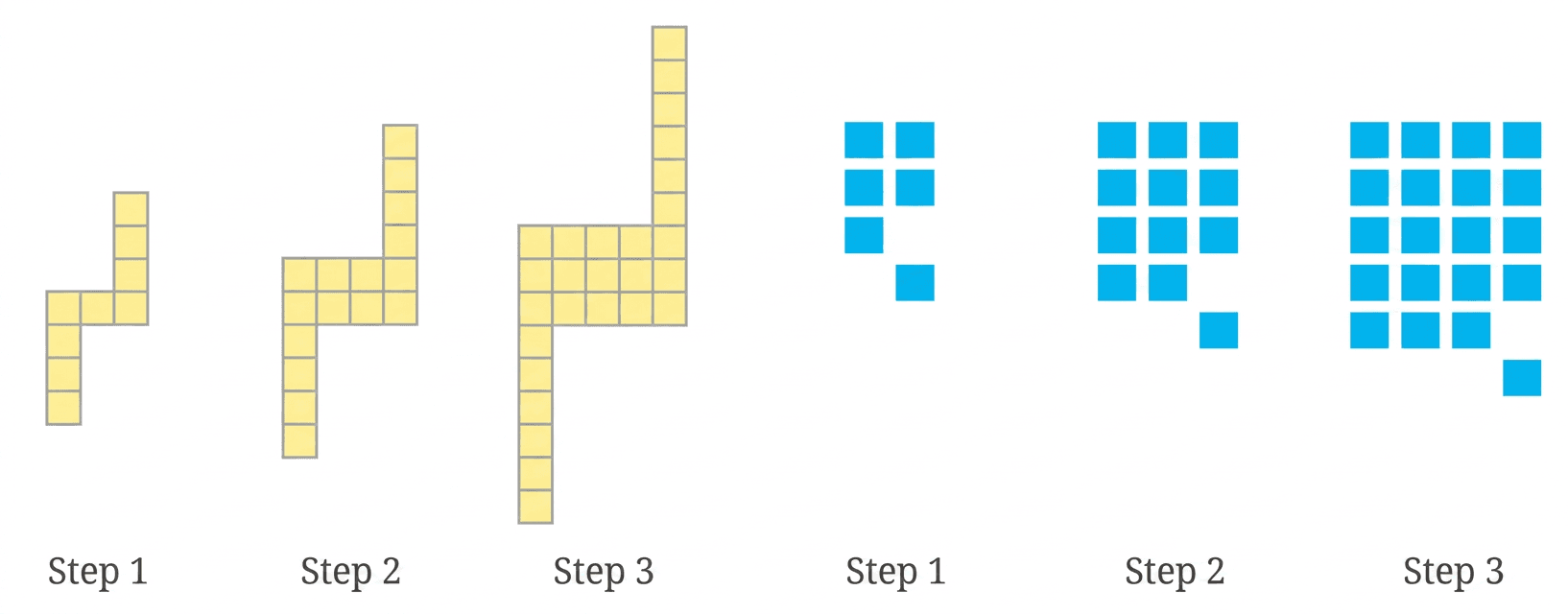
We will identify the growth pattern for each figure by counting the basic units in each step and then use these patterns to find the next figure, the number of units in Step 10, and a general expression.
Step 1 — Analyze the yellow pattern
Let us count the basic units in each step for the yellow pattern. We can see the figure is made of three parts: a bottom vertical column, a middle horizontal row, and a top vertical column.
For the bottom vertical column: Step 1 has 3 units. Step 2 has 5 units. Step 3 has 7 units. This is an arithmetic progression where each step adds 2 units. The number of units in Step is .
For the middle horizontal row: Step 1 has 2 units. Step 2 has 4 units. Step 3 has 6 units. This is an arithmetic progression where each step adds 2 units. The number of units in Step is .
For the top vertical column: Step 1 has 2 units. Step 2 has 6 units. Step 3 has 14 units. Let us find the differences between consecutive terms: , . The second differences are . This indicates a quadratic pattern of the form . We find , , . So, the number of units in Step is .
Now, let us find the total number of units for Step by adding the units from all three parts: Let us verify this formula: For Step 1: . For Step 2: . For Step 3: . The formula is correct.
Step 2 — Yellow pattern: Draw Step 4
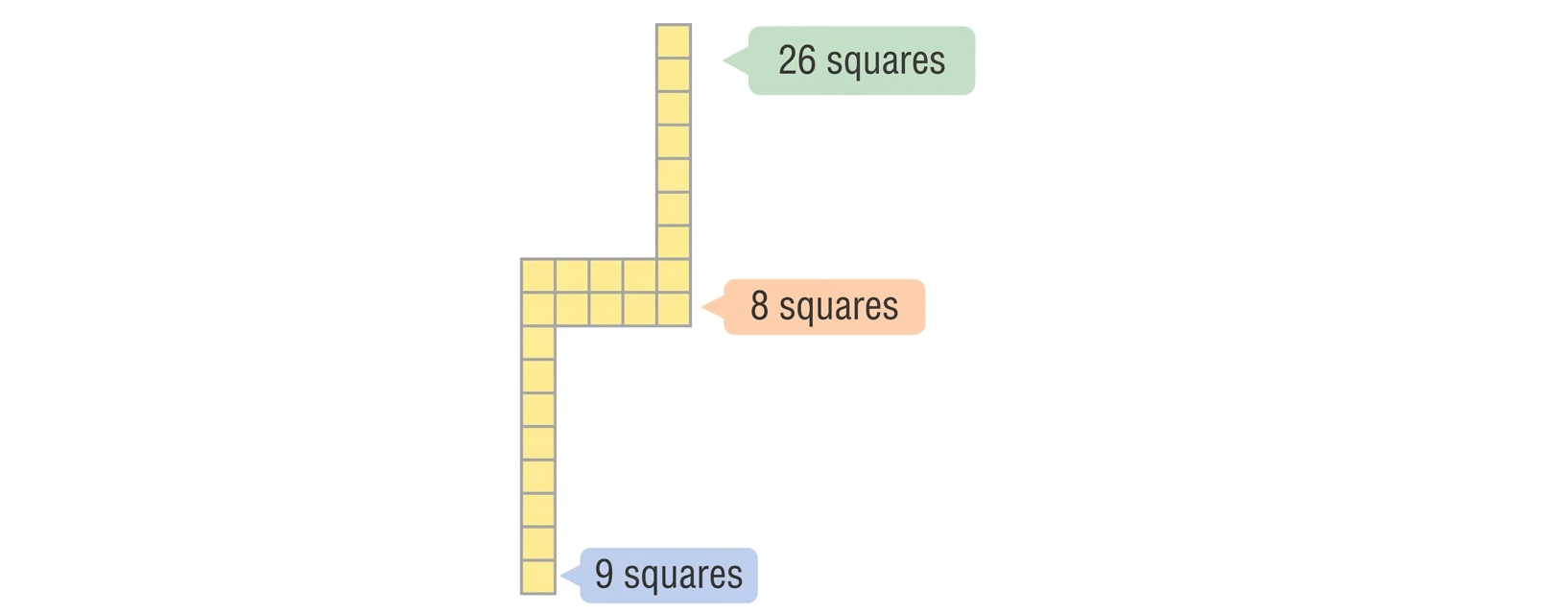
To draw Step 4, we use the formulas for each part: The bottom vertical column will have units. The middle horizontal row will have units. The top vertical column will have units. The total units in Step 4 will be units.
Step 3 — Yellow pattern: Units in Step 10
We use the formula for :
Step 4 — Yellow pattern: Expression for Step y
We replace with in our formula for the total number of units:
Step 5 — Analyze the blue pattern
Let us count the basic units in each step for the blue pattern. We can see the figure is a rectangle of squares with one square missing from the bottom-right corner.
For Step 1: The figure is a rectangle with 1 square missing. Number of units = .
For Step 2: The figure is a rectangle with 1 square missing. Number of units = .
For Step 3: The figure is a rectangle with 1 square missing. Number of units = .
We observe that for Step , the rectangle has rows and columns. The number of units in Step is . Let us expand this expression: Let us verify this formula: For Step 1: . For Step 2: . For Step 3: . The formula is correct.
Step 6 — Blue pattern: Draw Step 4
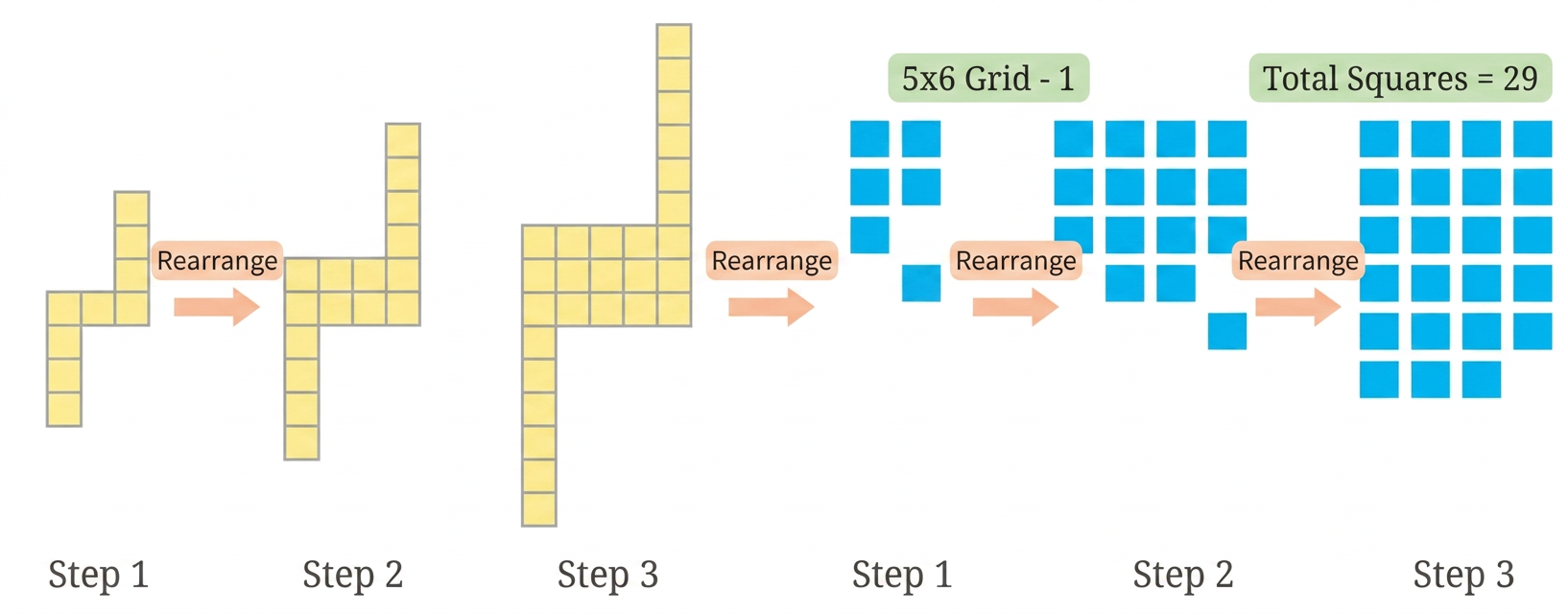
To draw Step 4, we use the pattern for the rectangle dimensions: The rectangle will have rows and columns. One square will be missing from the bottom-right corner. The total units in Step 4 will be units.
Step 7 — Blue pattern: Units in Step 10
We use the formula for :
Step 8 — Blue pattern: Expression for Step y
We replace with in our formula for the total number of units:
Answer
(i) For the yellow pattern, Step 4 consists of a bottom vertical column of 9 squares, a middle horizontal row of 8 squares extending from the top of the bottom column, and a top vertical column of 26 squares extending upwards from the end of the horizontal row. For the blue pattern, Step 4 is a grid of squares with the square at the bottom-right corner removed. (ii) For the yellow pattern, there are 223 basic units in Step 10. For the blue pattern, there are 131 basic units in Step 10. (iii) For the yellow pattern, the expression is . For the blue pattern, the expression is .
More questions in FIO
Observe the multiplication grid below. Each number inside the grid is formed by multiplying two numbers. If the middle number of a frame is given by the expression , as shown in the figure, write the expressions for the other numbers in the grid.
Expand the following products.
(i)
(ii)
(iii)
(iv)
(v)
(vi)
Find 3 examples where the product of two numbers remains unchanged when one of them is increased by 2 and the other is decreased by 4.
Expand:
(i)
(ii)
Expand:
(i)
(ii)
(iii)
Do you see a pattern? What would be the next identity in the pattern that you see? Can you check it by expanding?
Which is greater: or ? Justify your answer.
Express 100 as the difference of two squares.
Find , , , , and using the identities you have learnt so far.
Do Patterns 1 and 2 hold only for counting numbers? Do they hold for negative integers as well? What about fractions? Justify your answer.
Compute these products using the suggested identity.
(i) using Identity 1A for
(ii) using Identity 1C for
(iii) using Identity 1B for
(iv) using Identity 1C for
Use either a suitable identity or the distributive property to find each of the following products.
(i)
(ii)
(iii)
(iv)
(v)
(vi)
For each statement identify the appropriate algebraic expression(s).
(i) Two more than a square number.
(ii) The sum of the squares of two consecutive numbers
Consider any 2 by 2 square of numbers in a calendar, as shown in the figure.
Find products of numbers lying along each diagonal — , . Do this for the other 2 by 2 squares. What do you observe about the diagonal products? Explain why this happens.
Hint: Label the numbers in each 2 by 2 square as shown in the diagram.
Verify which of the following statements are true.
(i) is always 2.
(ii) is a multiple of 4.
(iii) Squares of even numbers are multiples of 4, and squares of odd numbers are 1 more than multiples of 8.
(iv) is 5 less than a square number.
A number leaves a remainder of 3 when divided by 7, and another number leaves a remainder of 5 when divided by 7. What is the remainder when their sum, difference, and product are divided by 7?
Choose three consecutive numbers, square the middle one, and subtract the product of the other two. Repeat the same with other sets of numbers. What pattern do you notice? How do we write this as an algebraic equation? Expand both sides of the equation to check that it is a true identity.
What is the algebraic expression describing the following steps—add any two numbers. Multiply this by half of the sum of the two numbers? Prove that this result will be half of the square of the sum of the two numbers.
Which is larger? Find out without fully computing the product.
(i) or
(ii) or
A tiny park is coming up in Dhauli. The plan is shown in the figure. The two square plots, each of area sq. ft., will have a green cover. All the remaining area is a walking path ft. wide that needs to be tiled. Write an expression for the area that needs to be tiled.
For each pattern shown below,
(i) Draw the next figure in the sequence. (ii) How many basic units are there in Step 10? (iii) Write an expression to describe the number of basic units in Step y.