Question 18
Suppose you write down all the numbers The tenth digit you write is '1' and the eleventh digit is '0', as part of the number 10.
(a) What would the 1000th digit be? At which number would it occur?
(b) What number would contain the millionth digit?
(c) When would you have written the digit '5' for the 5000th time?
- As we write consecutive positive integers , the total count of digits increases based on the number of digits in each number group:
- 1-digit numbers ( to ): digits
- 2-digit numbers ( to ): digits
- 3-digit numbers ( to ): digits
- -digit numbers: digits
- To find the position of any digit, determine which range it falls into, calculate how many complete numbers are covered, and inspect the remainder.
- For counting the frequency of a specific digit like '5' from to , each non-zero digit appears exactly times.
(a) What would the 1000th digit be? At which number would it occur?
Step 1 · Count Digits up to 2-Digit Numbers
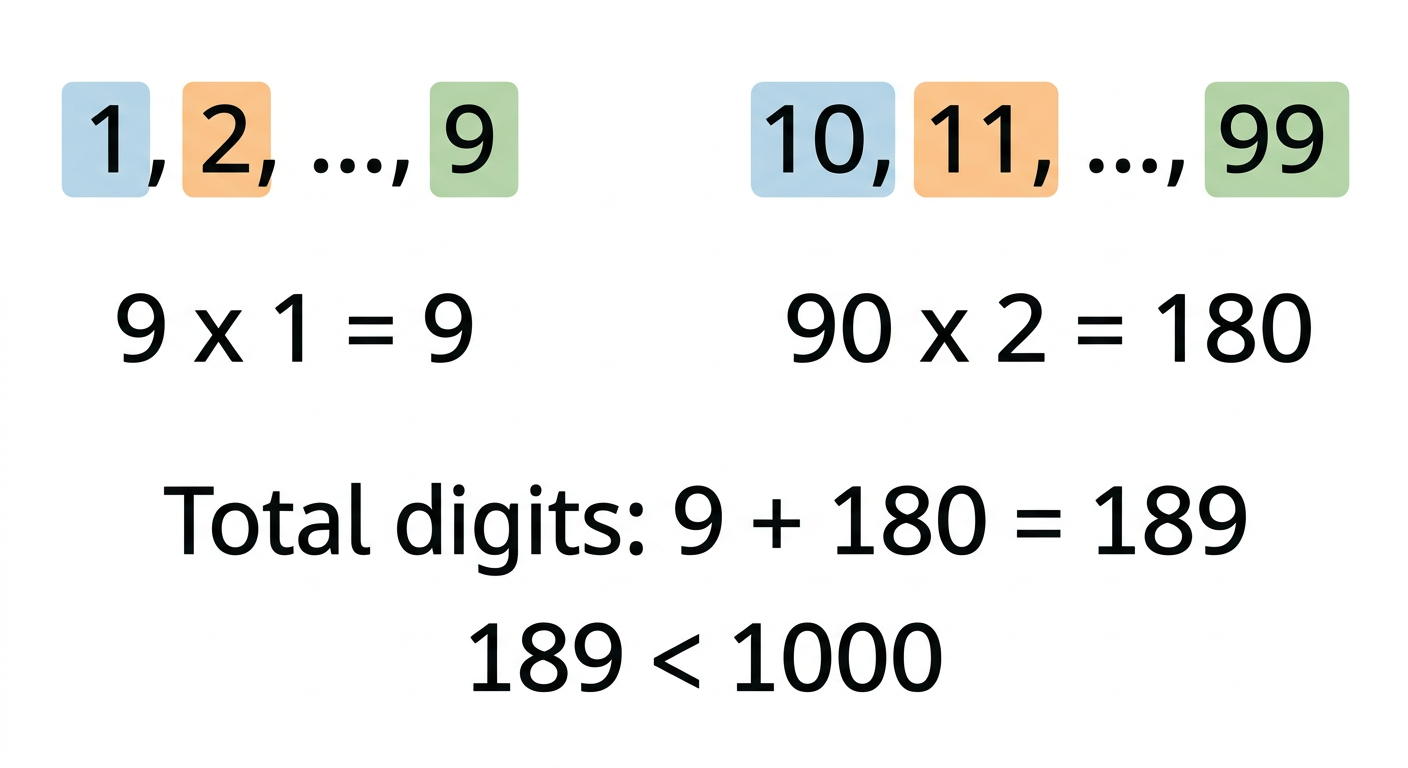
-
1-digit numbers ( to ):
-
2-digit numbers ( to ):
Total digits written up to :
Step 2 · Find the 1000th Digit in 3-Digit Numbers
Digits remaining to reach :
Since each 3-digit number uses digits, divide by :
This covers full 3-digit numbers starting from :
The digit is the digit of the next number, , which is '3'.
(a) The digit is '3', occurring in the number 370.
(b) What number would contain the millionth digit?
Step 1 · Count Digits up to 5-Digit Numbers
Calculate the total digits written up to :
- Up to :
- Up to :
- Up to :
- Up to :
- Up to :
Step 2 · Find the Millionth Digit in 6-Digit Numbers
Digits remaining to reach :
Divide by (since each 6-digit number uses digits):
This covers full 6-digit numbers starting from :
The millionth digit is the digit of the next number, which is 185185.
(b) The millionth digit is contained in the number 185185.
(c) When would you have written the digit '5' for the 5000th time?
Step 1 · Count Occurrences of '5' up to 9999
For numbers from to , the digit '5' appears times:
- From to ():
- From to ():
- From to ():
- From to ():
Total occurrences of '5' up to .
Step 2 · Count Remaining Occurrences of '5' in 5-Digit Numbers
Remaining occurrences needed:
In each block of numbers where the thousands digit is not (such as ), the digit '5' appears times in the last 3 places:
- to : times
- to : times
- to : times
Remaining '5's needed:
In each block of numbers (), the digit '5' appears times:
- to : times
- to : times
- to : times
- to : times
- to : times
Thus, the occurrence of '5' happens at the end of the range ending in 13499.
(c) The digit '5' is written for the time at the number 13499.
- Off-by-One in Block Counting: Forgetting that the number starting at is , not .
- Remainder Interpretation: A remainder of means the digit belongs to the first position of the next number, not the last digit of the current number.
- Digit Count vs Number Count: Conflating the total number of digits written with the value of the numbers themselves.
More questions in FIO
According to the 2011 Census, the population of the town of Chintamani was about 75,000. How much less than one lakh is 75,000?
The estimated population of Chintamani in the year 2024 is 1,06,000. How much more than one lakh is 1,06,000?
By how much did the population of Chintamani increase from 2011 to 2024?
For each number given below, write expressions for at least two different ways to obtain the number through button clicks. Think like Chitti and be creative.
(a) 8300
(b) 40629
(c) 56354
(d) 66666
(e) 367813
For the numbers in the previous exercise, find out how to get each number by making the smallest number of button clicks and write the expression.
Do you see any connection between each number and the corresponding smallest number of button clicks?
If you notice, the expressions for the least button clicks also give the Indian place value notation of the numbers. Think about why this is so.
Read the following numbers in Indian place value notation and write their number names in both the Indian and American systems:
(a) 4050678
(b) 48121620
(c) 20022002
(d) 246813579
(e) 345000543
(f) 1020304050
Write the following numbers in Indian place value notation:
(a) One crore one lakh one thousand ten
(b) One billion one million one thousand one
(c) Ten crore twenty lakh thirty thousand forty
(d) Nine billion eighty million seven hundred thousand six hundred
Compare and write '', '' or '':
(a) 30 thousand ______ 3 lakhs
(b) 500 lakhs ______ 5 million
(c) 800 thousand ______ 8 million
(d) 640 crore ______ 60 billion
Find quick ways to calculate these products:
(a)
(b) [Hint: ]
(c)
Calculate these products quickly.
(a) _______
(b) _______
(c) _______
(d) _______
(e) _______ _______
Using all digits from to exactly once (the first digit cannot be ) to create a -digit number, write the —
(a) Largest multiple of
(b) Smallest even number
The number 10,30,285 in words is Ten lakhs thirty thousand two hundred eighty five, which has 42 letters. Give a 7-digit number name which has the maximum number of letters.
Write a 9-digit number where exchanging any two digits results in a bigger number. How many such numbers exist?
Strike out 10 digits from the number 12345123451234512345 so that the remaining number is as large as possible.
The words 'zero' and 'one' share letters 'e' and 'o'. The words 'one' and 'two' share a letter 'o', and the words 'two' and 'three' also share a letter 't'. How far do you have to count to find two consecutive numbers which do not share an English letter in common?
Suppose you write down all the numbers The tenth digit you write is '1' and the eleventh digit is '0', as part of the number 10.
(a) What would the 1000th digit be? At which number would it occur?
(b) What number would contain the millionth digit?
(c) When would you have written the digit '5' for the 5000th time?
A calculator has only '+10,000' and '+100' buttons. Write an expression describing the number of button clicks to be made for the following numbers:
(a) 20,800
(b) 92,100
(c) 1,20,500
(d) 65,30,000
(e) 70,25,700
How many lakhs make a billion?
You are given two sets of number cards numbered from -. Place a number card in each box below to get the
(a) largest possible sum
(b) smallest possible difference of the two resulting numbers.
You are given some number cards; 4000, 13000, 3000, 70000, 150000, 20, 5. Using the cards get as close as you can to the numbers below using any operation you want. Each card can be used only once for making a particular number.
(a) 1,10,000: Closest I could make is
(b) 2,00,000:
(c) 5,80,000:
(d) 12,45,000:
(e) 20,90,800:
Find out how many coins should be stacked to match the height of the Statue of Unity. Assume each coin is 1 mm thick.
Grey-headed albatrosses have a roughly 7-feet wide wingspan. They are known to migrate across several oceans. Albatrosses can cover about 900 – 1000 km in a day. One of the longest single trips recorded is about 12,000 km. How many days would such a trip take to cross the Pacific Ocean approximately?
A bar-tailed godwit holds the record for the longest recorded non-stop flight. It travelled 13,560 km from Alaska to Australia without stopping. Its journey started on 13 October 2022 and continued for about 11 days. Find out the approximate distance it covered every day. Find out the approximate distance it covered every hour.
Bald eagles are known to fly as high as – above the ground level. Mount Everest is about high. Aeroplanes can fly as high as – . How many times bigger are these heights compared to Somu’s building?