Question 27
From the information given in the table, answer the following questions by approximation:
(i) What is your general observation about this data? Share it with the class.
(ii) What is an appropriate title for the above table?
(iii) How much is the population of Pune in 2011? Approximately, by how much has it increased compared to 2001?
(iv) Which city's population increased the most between 2001 and 2011?
(v) Are there cities whose population has almost doubled? Which are they?
(vi) By what number should we multiply Patna's population to get a number/population close to that of Mumbai?
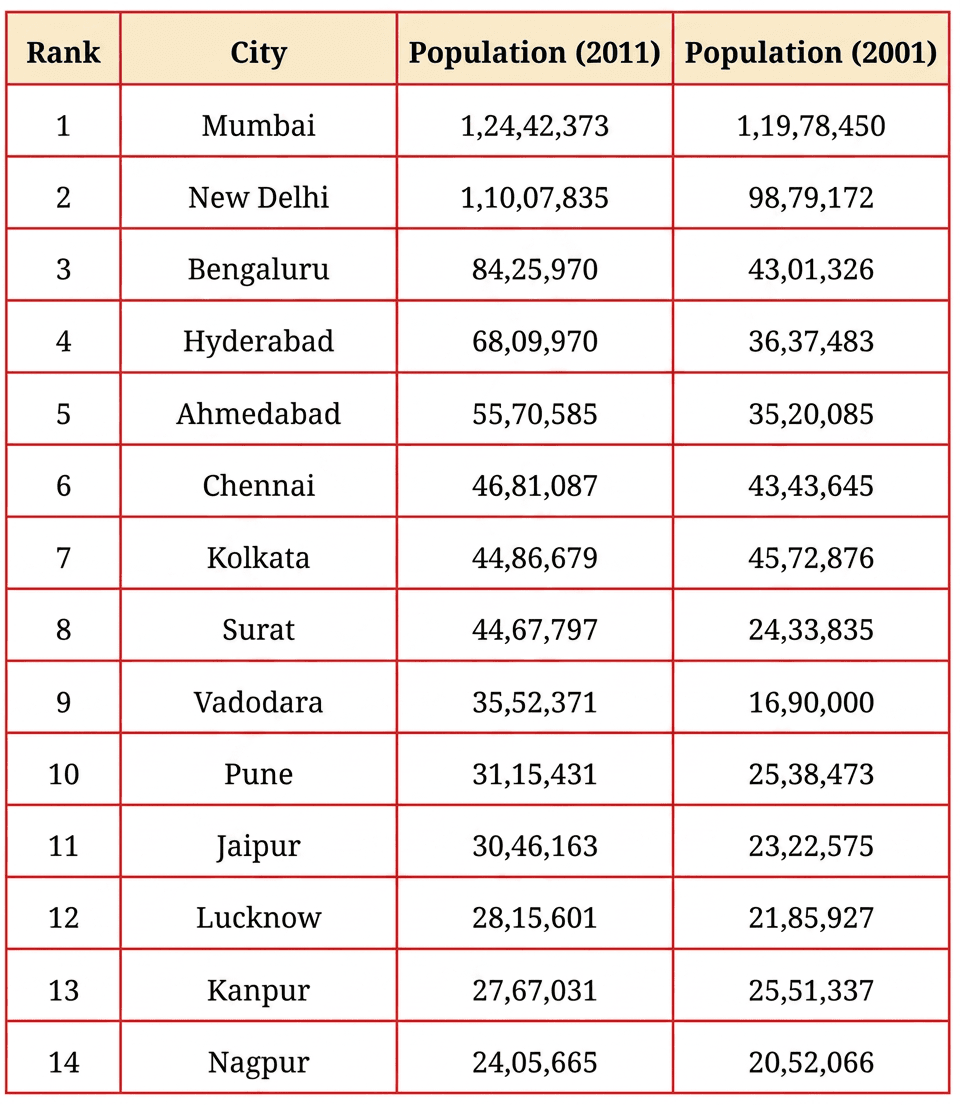
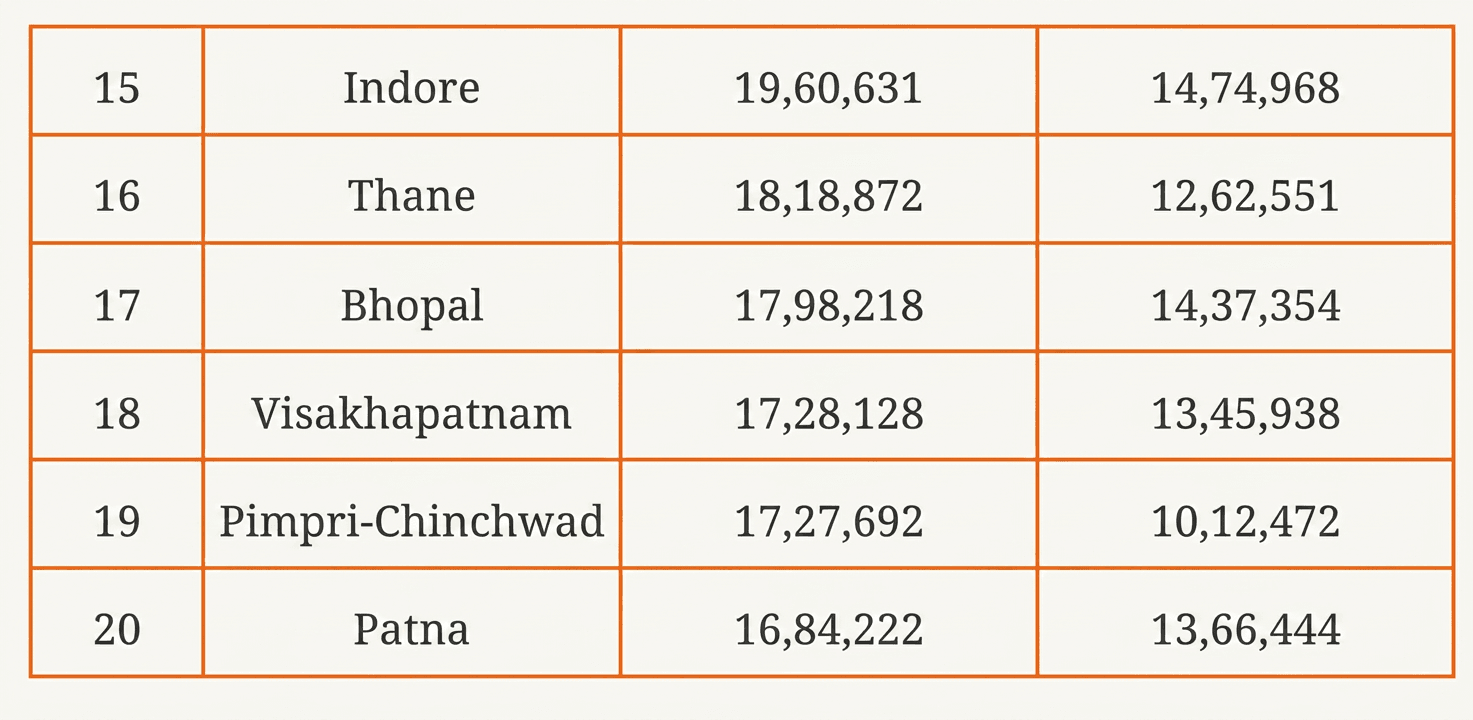
- We are given population data for major Indian cities in the years 2001 and 2011.
- Using basic operations (subtraction, comparison, multiplication, and division) along with estimation and approximation, we answer specific questions about population trends, increases, and ratios.


(i) What is your general observation about this data? Share it with the class.
Step 1 · Analyze Trends in the Data
Key observations from the data:
- Mumbai had the highest population in both and .
- Almost all cities experienced an increase in population over the -year period.
- Kolkata is the only city whose population decreased.
- Cities such as Bengaluru and Vadodara showed exceptionally rapid population growth.
(i) Most cities showed population growth from to , with Mumbai remaining the most populated and Kolkata being the only city with a population decrease.
(ii) What is an appropriate title for the above table?
Step 1 · Determine a Suitable Title
Since the table presents the population numbers of several major Indian cities across two census years ( and ), a descriptive title is:
(ii) Population of Major Indian Cities (2001 & 2011)
(iii) How much is the population of Pune in 2011? Approximately, by how much has it increased compared to 2001?
Step 1 · Calculate Pune's Population Increase
From the table:
Calculating the increase:
Approximating to the nearest thousand:
(iii) Pune's population in is 31,15,431, having increased by approximately 5,77,000 compared to .
(iv) Which city's population increased the most between 2001 and 2011?
Step 1 · Compare Population Increases
Calculate the increase for cities with notable growth:
- Bengaluru:
- Hyderabad:
- Ahmedabad:
- Surat:
Comparing the increases, Bengaluru has the highest increase ().
(iv) Bengaluru
(v) Are there cities whose population has almost doubled? Which are they?
Step 1 · Check for Doubling of Population
Compare the population with twice the population for high-growth cities:
- Bengaluru:
Since , Bengaluru's population almost doubled.
- Vadodara:
Since , Vadodara's population more than doubled.
(v) Yes, Bengaluru and Vadodara.
(vi) By what number should we multiply Patna's population to get a number/population close to that of Mumbai?
Step 1 · Estimate Multiplier from Patna to Mumbai
Given for :
Dividing the populations:
Testing :
(vi) Approximately 7
- Absolute vs. Percentage Growth: Bengaluru had the largest absolute increase in numbers (), while Vadodara had the highest percentage growth (more than increase).
- Approximation Errors: When estimating multipliers, round large numbers to friendly figures (e.g., ) to simplify mental calculations.
More questions in IT
Estu was surprised to know that there were about one lakh varieties of rice in this country. He wondered “One lakh! So far I have only tasted 3 varieties. If we tried a new variety each day, would we even come close to tasting all the varieties in a lifetime of 100 years?”
What do you think? Guess.
But how much is one lakh? Observe the pattern and fill in the boxes given below.
What if a person ate 3 varieties of rice every day? Will they be able to taste all the lakh varieties in a 100 year lifetime? Find out.
Context: If we ignore leap years, there are 365 days in a year. For years, the number of days is .
Q. Choose a number for . How close to one lakh is the number of days in years, for the of your choice?
Look at the picture on the right. Somu is 1 metre tall. If each floor is about four times his height, what is the approximate height of the building?
Context: The world's tallest statue is the 'Statue of Unity' in Gujarat depicting Sardar Vallabhbhai Patel. Its height is about 180 metres. Somu is 1 metre tall. If each floor of the building is about four times his height, the approximate height of the building is 40 metres.
Q. Which is taller — The Statue of Unity or this building? How much taller?
__________ m.
Context: Kunchikal waterfall in Karnataka is said to drop from a height of about 450 metres. Somu is 1 metre tall. If each floor of the building is about four times his height, the approximate height of the building is 40 metres.
Q. How much taller is the Kunchikal waterfall than Somu's building?
__________ m.
Context: Kunchikal waterfall in Karnataka is said to drop from a height of about 450 metres. Somu is 1 metre tall. If each floor of the building is about four times his height, the approximate height of the building is 40 metres.
Q. How many floors should Somu's building have to be as high as the waterfall?
__________ .
How do you view a lakh — is a lakh big or small?
Write each of the numbers given below in words:
(a)
(b)
(c)
(d)
Write the corresponding number in the Indian place value system for each of the following:
(a) One lakh twenty three thousand four hundred and fifty six
(b) Four lakh seven thousand seven hundred and four
(c) Fifty lakhs five thousand and fifty
(d) Ten lakhs two hundred and thirty five
- The Thoughtful Thousands only has a button. How many times should it be pressed to show:
(a)
(b)
(c)
- The Tedious Tens only has a button. How many times should it be pressed to show:
(a) Five hundred?
(b) ?
(c) ?
(d) ?
(e) ?
(f) One lakh?
(g) ________ ? times
- The Handy Hundreds only has a button. How many times should it be pressed to show:
(a) Four hundred? __________ times
(b) 3,700? __________
(c) 10,000? __________
(d) Fifty three thousand? __________
(e) 90,000? __________
(f) 97,600? __________
(g) 1,00,000? __________
(h) __________? 582 times
(i) How many hundreds are required to make ten thousand?
(j) How many hundreds are required to make one lakh?
(k) Handy Hundreds says, "There are some numbers which Tedious Tens and Thoughtful Thousands can't show but I can." Is this statement true? Think and explore.
- Creative Chitti is a different kind of calculator. It has the following buttons: , , , , , and . It always has multiple ways of doing things. “How so?”, you might ask. To get the number , it presses thirty two times and once. Will it get ? Alternatively, it can press two times and twelve times and once.
- Two of the many different ways to get 5072 are shown below: These two ways can be expressed as:
(a)
(b)
Q. Find a different way to get 5072 and write an expression for the same.
Creative Chitti has some questions for you —
(a) You have to make exactly 30 button presses. What is the largest 3-digit number you can make? What is the smallest 3-digit number you can make?
(b) 997 can be made using 25 clicks. Can you make 997 with a different number of clicks?
Create questions like these and challenge your classmates.
How can we get the numbers (a) 5072, (b) 8300 using as few button clicks as possible?
Find out which buttons should be clicked and how many times to get the desired numbers given in the table. The aim is to click as few buttons as possible.
Here is one way to get the number 5072. This method uses 23 button clicks in total. Is there another way to get 5072 using less than 23 button clicks? Write the expression for the same.
How many zeros does a thousand lakh have?
How many zeros does a hundred thousand have?
What do you think of this conversation? Have you read or heard such headlines or statements?
Think and share situations where it is appropriate to
(a) round up,
(b) round down,
(c) either rounding up or rounding down is okay and
(d) when exact numbers are needed.
I have a number for which all five nearest neighbours are 5,00,00,000. What could the number be? How many such numbers are there?
Roxie and Estu are estimating the values of simple expressions.
Roxie: “The sum is near and is more than .” Estu: “The sum is near and is less than .”
(a) Are these estimates correct? Whose estimate is closer to the sum?
(b) Will the sum be greater than or less than ? Why do you think so?
(c) Will the sum be greater than or less than ? Why do you think so?
(d) Exact value of 4,63,128 + 4,19,682 = \text{________}
Roxie: “The difference is near and is less than .” Estu: “The difference is near and is more than .”
(a) Are these estimates correct? Whose estimate is closer to the difference?
(b) Will the difference be greater than or less than ? Why do you think so?
(c) Will the difference be greater than or less than ? Why do you think so?
(d) Exact value of
From the information given in the table, answer the following questions by approximation:
(i) What is your general observation about this data? Share it with the class.
(ii) What is an appropriate title for the above table?
(iii) How much is the population of Pune in 2011? Approximately, by how much has it increased compared to 2001?
(iv) Which city's population increased the most between 2001 and 2011?
(v) Are there cities whose population has almost doubled? Which are they?
(vi) By what number should we multiply Patna's population to get a number/population close to that of Mumbai?
Using the meaning of multiplication and division, can you explain why multiplying by is the same as dividing by and multiplying by ?
How Long is the Product?
In each of the following boxes, the multiplications produce interesting patterns. Evaluate them to find the pattern. Extend the multiplications based on the observed pattern.
Observe the number of digits in the two numbers being multiplied and their product in each case. Is there any connection between the numbers being multiplied and the number of digits in their product?
Roxie says that the product of two 2-digit numbers can only be a 3- or a 4-digit number. Is she correct?
Should we try all possible multiplications with 2-digit numbers to tell whether Roxie’s claim is true? Or is there a better way to find out?
Can multiplying a 3-digit number with another 3-digit number give a 4-digit number?
Can multiplying a 4-digit number with a 2-digit number give a 5-digit number?
Observe the multiplication statements below. Do you notice any patterns? See if this pattern extends for other numbers as well.
Calculate the product to uncover the fact:
Read the resulting number in both Indian and American naming systems.
Also consider the questions:
- How many years did he live to compose so many songs?
- At what age did he start composing songs?
- If he composed songs, how many songs per year did he have to compose?
Calculate the product to uncover the fact:
Read the resulting number in both Indian and American naming systems.
Calculate the quotient to uncover the fact:
Calculate the quotient to uncover the fact:
The RMS Titanic ship carried about 2500 passengers. Can the population of Mumbai fit into 5000 such ships?
Inspired by this strange question, Roxie wondered, “If I could travel 100 kilometers every day, could I reach the Moon in 10 years?” (The distance between the Earth and the Moon is 3,84,400 km.)
- How far would she have travelled in a year?
- How far would she have travelled in 10 years?
- Is it not easier to perform these calculations in stages? You can use this method for all large calculations.
Find out if you can reach the Sun in a lifetime, if you travel 1000 kilometers every day. (You had written down the distance between the Earth and the Sun in a previous exercise.)
Make necessary reasonable assumptions and answer the questions below:
(a) If a single sheet of paper weighs 5 grams, could you lift one lakh sheets of paper together at the same time?
(b) If 250 babies are born every minute across the world, will a million babies be born in a day?
(c) Can you count 1 million coins in a day? Assume you can count 1 coin every second.
Think and create more such fun questions and share them with your class.