Question 27
Context: Consider the pairs of numbers: (a) 45, 105; (b) 275, 352; (c) 222, 370.
Q. Do you see that, in each case, the number by which the LCM is multiplied to get the product is actually the HCF?
- For any two positive integers, the product of the numbers is always equal to the product of their and :
- Dividing both sides by gives:
- Hence, the number by which the must be multiplied to obtain the product is always the . We verify this property for each given pair.
(a) 45, 105
Step 1 · Find HCF, LCM, and Product of 45 and 105
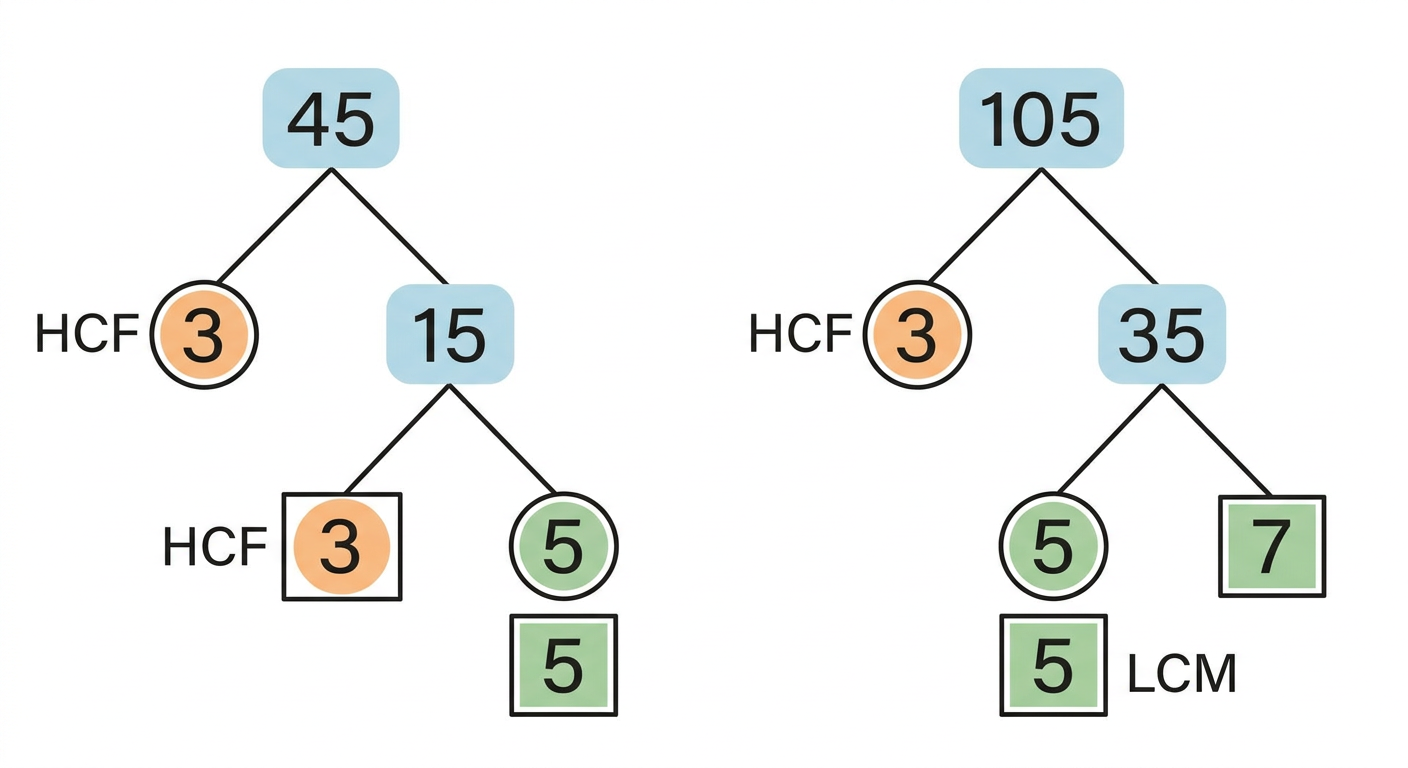
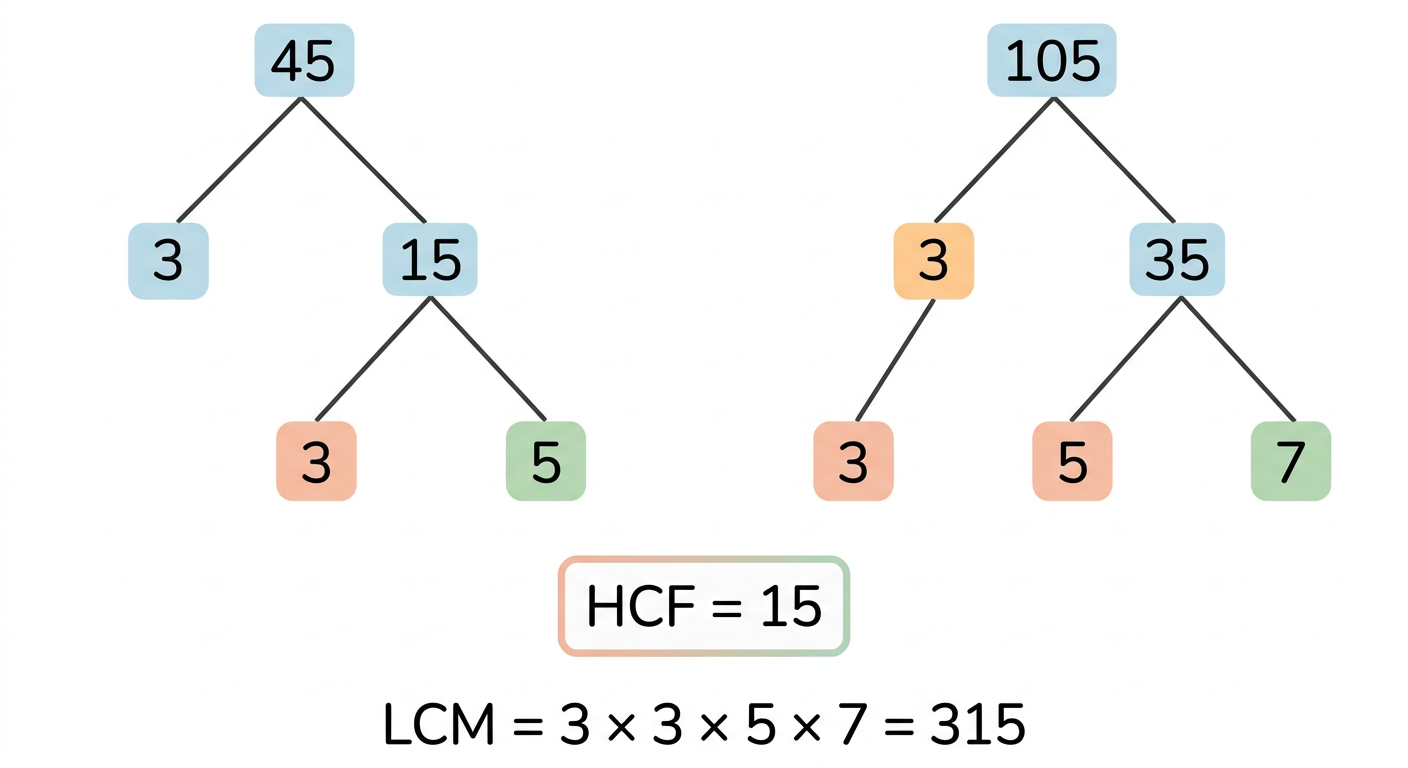
Prime factorisation:
Calculating the multiplier :
Since , the multiplier is indeed the .
(a) Yes, the multiplier is , which is the .
(b) 275, 352
Step 1 · Find HCF, LCM, and Product of 275 and 352
Prime factorisation:
Calculating the multiplier :
Since , the multiplier is indeed the .
(b) Yes, the multiplier is , which is the .
(c) 222, 370
Step 1 · Find HCF, LCM, and Product of 222 and 370
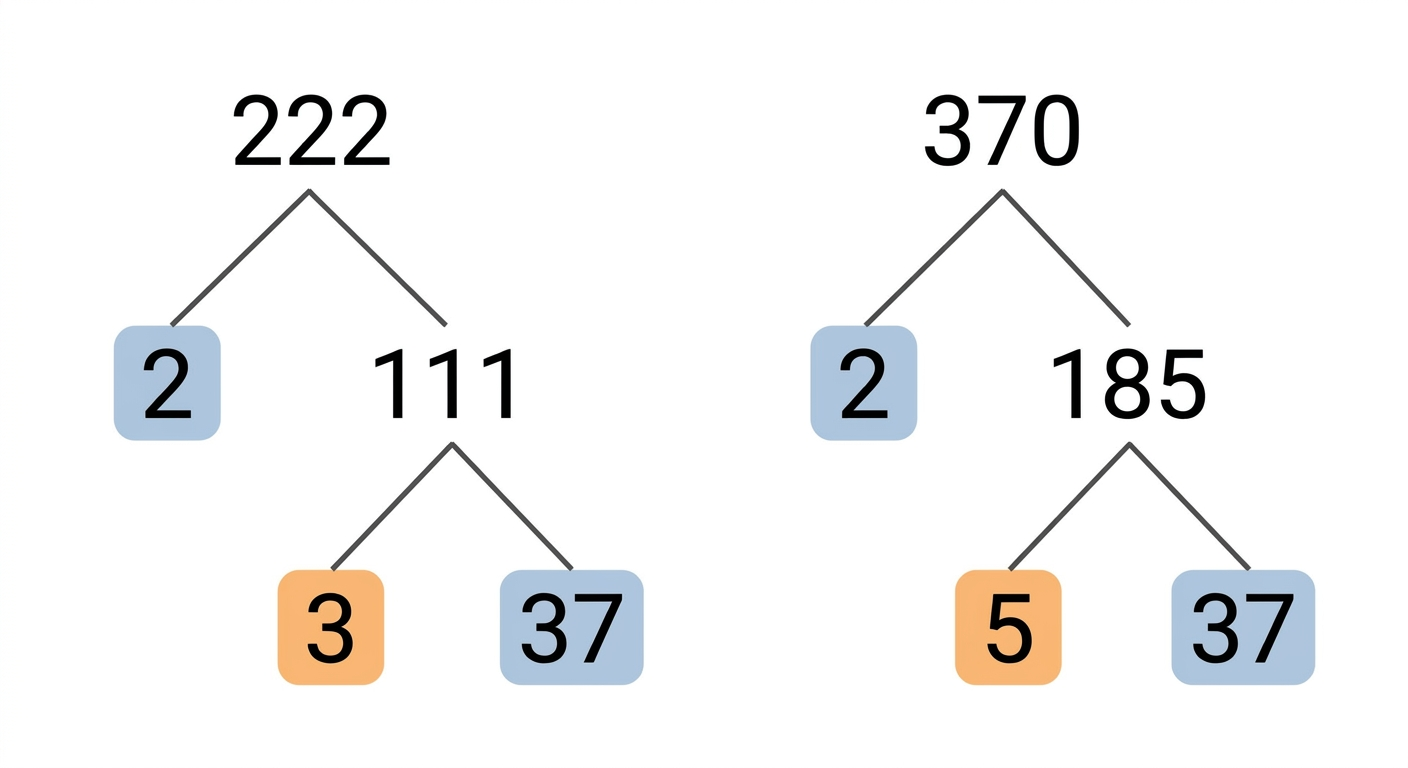
Prime factorisation:
Calculating the multiplier :
Since , the multiplier is indeed the .
(c) Yes, the multiplier is , which is the .
- Only for Two Numbers: The property applies strictly to pairs of numbers and is not valid for three or more numbers.
- Power Selection Error: Remember that uses the lowest powers of common prime factors, whereas uses the highest powers of all prime factors.
More questions in IT
Context: Sameeksha is building her new house. The main room of the house is by . She wants to cover the floor with square tiles of the same size, using as few tiles as possible, with the length of the tile being a whole number of feet. She needs tiles of size .
Q. How many tiles of this size should she purchase?
What if Sameeksha did not insist on the length of the tile to be a whole number of feet and the length could be a fractional number of feet? Would the answer change?
Context: Lekhana bought of rice from one farm and from another. She wants to pack them in bags of equal weight (whole number of ) using as few bags as possible. The common factors of and are , and .
Q. Which weight should she choose to minimise the number of bags?
Do you remember the ‘Jump Jackpot’ game from Grade 6 (see the chapter ‘Prime Time’)? Grumpy places a treasure on a number and Jumpy chooses a jump size and tries to collect the treasure. In each case below, the two numbers upon which treasures are kept are given. Find the longest jump size (starting from 0) using which Jumpy can land on both the numbers having the treasure.
(a) 14 and 30
(b) 7 and 11
(c) 30 and 50
(d) 28 and 42
Is the longest jump size for the numbers the same as their HCF? Explain why it is so.
Can this process be simplified? Can it be made more reliable?
Can you see what is happening below?
Can you write the prime factorisation of and using these two figures?
Try finding the prime factorisation of 1200 using the method above. If we had used the earlier method, our calculation would have been as follows:
Which calculation is easier to carry out?
Context: Consider the number 840 and its prime factorisation .
Q. Is a factor of 840?
Context: Consider the number 840 and its prime factorisation .
Q. If yes, what should it be multiplied by to get 840?
Context: Consider the number 840 and its prime factorization .
Similarly, is a factor of 840? Why or why not?
Is a factor of 840? Why or why not?
Is a factor of 840? Why or why not?
Can we use this idea to list down all the possible factors of a number using just its prime factors?
Context: The factors of 225 are found to be 1, 3, 5, 9, 15, 25, 45, 75, 225.
Q. Check that all the factors of 225 occur in this list.
Do you remember the ‘Idli-Vada’ game from Grade 6 (see chapter ‘Prime Time’)? Two numbers are chosen and whenever players come to their multiples, ‘idli’ or ‘vada’ should be called out depending on whose multiple the number is. If the number happens to be a common multiple, then ‘idli-vada’ should be called out. In each problem below, the two numbers corresponding to ‘idli’ and ‘vada’ are given. Find the first number for which ‘idli-vada’ will be called out:
(a) 4 and 6
(b) 7 and 11
(c) 14 and 30
(d) 15 and 55
Is the answer always the LCM of the two numbers? Explain.
Context: Consider the numbers 14 and 35, with prime factorisations and .
Q. Is also a common multiple?
Find more such number pairs where the HCF is one of the two numbers. How can we describe such pairs of numbers?
Context: If is a number, then any multiple of can be written as a positive integer multiplied by . For example, if we take and (short for ), then is a multiple of , and is a factor of . The HCF of and .
Q. For number pairs satisfying this property (i.e., one of the numbers is the HCF),
(a) if is a number, what could be the other number?
(b) if is a number, what could be the other number?
What happens to the HCF of two numbers if both numbers are doubled? Take some pairs of numbers and explore. Are you able to see why the HCF will also double?
Here are some more numbers where both numbers are multiples of the same number. Find their HCF:
(a) ,
(b) ,
(c) ,
(d) ,
In which of these cases is the HCF the same as the common multiplier, like problem (b) where the HCF is 10? Explore a few more examples of this type to understand when this happens.
Efficient Procedures for HCF and LCM
See the procedure on the right. Can you explain how it has been carried out?
How do we use this to find the HCF of 84 and 180? Explore.
[Hint: Observe that , and similar to prime factorisation]
Why are these the LCMs?
[Hint: Will the product of the factors marked as the LCM of 300 and 150 contain the prime factorisations of both 300 and 150? Is this the smallest such number?]
You can try this method for these pairs of numbers.
(a) 90 and 150
(b) 84 and 132
Property Involving both the HCF and the LCM
Which is greater — the LCM of two numbers or their product?
You could analyse the above statement using examples. Then try to reason or prove, why the LCM is never greater than the product of the numbers.
[Hint: Is the product also a common multiple of the two numbers?]
Explore whether the LCM is a factor of the product in the following cases. If yes, identify the number that the LCM should be multiplied by to get the product. Do you see any pattern? Use these numbers:
(a) 45, 105
(b) 275, 352
(c) 222, 370
Context: Consider the pairs of numbers: (a) 45, 105; (b) 275, 352; (c) 222, 370.
Q. Do you see that, in each case, the number by which the LCM is multiplied to get the product is actually the HCF?
Why does this happen? Can you give an explanation or proof?
[Hint: Consider the prime factorisation of the given numbers. Among their prime factors, some are common to both factorisations, and the rest occur in only one of them. Between the HCF and the LCM, see how the common and non-common prime factors get distributed. In the product, observe how these two kinds of prime factors occur. Compare them.]
Explore whether this property holds when 3 numbers are considered.
Context: The largest prime found so far has 4,10,24,320 digits! It was discovered on October 12, 2024.
Q. If I start writing this number, how long could it take me?