Question 22
Have you noticed how the colours change in a traffic signal? The sequence of colour changes is shown below. Find the colour at positions 90, 190, and 343. Write expressions to describe the positions for each colour.
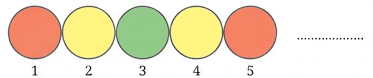
- The traffic signal lights follow a repeating 4-step pattern: Red Yellow Green Yellow.
- The cycle length is 4.
- To find the colour at any position , divide by and look at the remainder:
- Remainder Red
- Remainder Yellow
- Remainder Green
- Remainder Yellow
- General algebraic expressions represent the positions corresponding to each remainder.
(i) Find the colour at positions 90, 190, and 343.
Step 1 · Identify the Cycle and Pattern Rule
The repeating sequence of colours is Red, Yellow, Green, Yellow.
Remainder rules when dividing position by :
- Remainder
- Remainder
- Remainder
- Remainder
Step 2 · Find the Colour at Each Given Position
For position :
For position :
For position :
(i) Position : Yellow, Position : Yellow, Position : Green
(ii) Write expressions to describe the positions for each colour.
Step 1 · Formulate Algebraic Expressions
Red positions: Occurs at positions (remainder when divided by )
Green positions: Occurs at positions (remainder when divided by )
Yellow positions: Occurs at positions (all even numbers)
(ii) * Red: (where is a whole number)
- Green: (where is a whole number)
- Yellow: (where is a whole number)
- Overlooking Yellow's Frequency: Yellow appears twice in every 4-step cycle (at positions and ), meaning it occurs at all even numbers (), not just every step.
- Remainder 0 Confusion: A remainder of means the position is a multiple of , corresponding to the colour in the cycle (Yellow), not position .
- Index Shift in Variable : Forgetting that for , starts from (), whereas for , starts from ().
More questions in FIO
Write formulas for the perimeter of: (a) triangle with all sides equal. (b) a regular pentagon (as we have learnt last year, we use the word 'regular' to say that all sidelengths and angle measures are equal) (c) a regular hexagon
Munirathna has a long pipe. However, he wants a longer watering pipe for his garden. He joins another pipe of some length to this one. Give the expression for the combined length of the pipe. Use the letter-number '' to denote the length in meters of the other pipe.
What is the total amount Krithika has, if she has the following numbers of notes of ₹100, ₹200 and ₹5? Complete the following table:
Venkatalakshmi owns a flour mill. It takes 10 seconds for the roller mill to start running. Once it is running, each kg of grain takes 8 seconds to grind into powder. Which of the expressions below describes the time taken to complete grind kg of grain, assuming the machine is off initially?
(a)
(b)
(c)
(d)
(e)
Write algebraic expressions using letters of your choice.
(a) 5 more than a number
(b) 4 less than a number
(c) 2 less than 13 times a number
(d) 13 less than 2 times a number
Describe situations corresponding to the following algebraic expressions:
(a)
(b)
In a calendar month, if any grid full of dates is chosen as shown in the picture, write expressions for the dates in the blank cells if the bottom middle cell has date .
Add the numbers in each picture below. Write their corresponding expressions and simplify them. Try adding the numbers in each picture in a couple different ways and see that you get the same thing.
Simplify each of the following expressions:
(a) , ,
(b) ,
(c) ,
(d) ,
(e) ,
(f) ,
(g) ,
(h) ,
(i) ,
(j) ,
(k)
One plate of Jowar roti costs ₹30 and one plate of Pulao costs ₹20. If plates of Jowar roti and plates of pulao were ordered in a day, which expression(s) describe the total amount in rupees earned that day?
(a)
(b)
(c)
(d)
(e)
Pushpita sells two types of flowers on Independence day: champak and marigold. customers only bought champak, customers only bought marigold, and customers bought both. On the same day, she gave away a tiny national flag to every customer. How many flags did she give away that day?
(a)
(b)
(c)
(d)
(e)
(f)
A snail is trying to climb along the wall of a deep well. During the day it climbs up and during the night it slowly slips down . This happens for 10 days and 10 nights.
(a) Write an expression describing how far away the snail is from its starting position.
(b) What can we say about the snail’s movement if ?
Radha is preparing for a cycling race and practices daily. The first week she cycles 5 km every day. Every week she increases the daily distance cycled by . How many kilometers would Radha have cycled after 3 weeks?
In the following figure, observe how the expression becomes along one path. Fill in the blanks on the remaining paths. The ovals contain expressions and the boxes contain operations.
A local train from Yahapur to Vahapur stops at three stations at equal distances along the way. The time taken in minutes to travel from one station to the next station is the same and is denoted by . The train stops for 2 minutes at each of the three stations.
(a) If , what is the time taken to travel from Yahapur to Vahapur?
(b) What is the algebraic expression for the time taken to travel from Yahapur to Vahapur? [Hint: Draw a rough diagram to visualise the situation]
Simplify the following expressions:
(a)
(b)
(c)
(d)
(e)
(f)
Add the expressions given below:
(a) and
(b) and
(c) and
(d) and
(e) and
(f) and
Subtract the expressions given below:
(a) from
(b) from
(c) from
(d) from
(e) from
(f) from
Describe situations corresponding to the following algebraic expressions:
(a)
(b)
Imagine a straight rope. If it is cut once as shown in the picture, we get 2 pieces. If the rope is folded once and then cut as shown, we get 3 pieces. Observe the pattern and find the number of pieces if the rope is folded 10 times and cut. What is the expression for the number of pieces when the rope is folded times and cut?
Look at the matchstick pattern below. Observe and identify the pattern. How many matchsticks are required to make such squares. How many are required to make squares?
Have you noticed how the colours change in a traffic signal? The sequence of colour changes is shown below. Find the colour at positions 90, 190, and 343. Write expressions to describe the positions for each colour.
Observe the pattern below. How many squares will be there in Step 4, Step 10, Step 50? Write a general formula. How would the formula change if we want to count the number of vertices of all the squares?