Another Peek Beyond the Point | A
Question 2
Try solving the following Hidato puzzles.
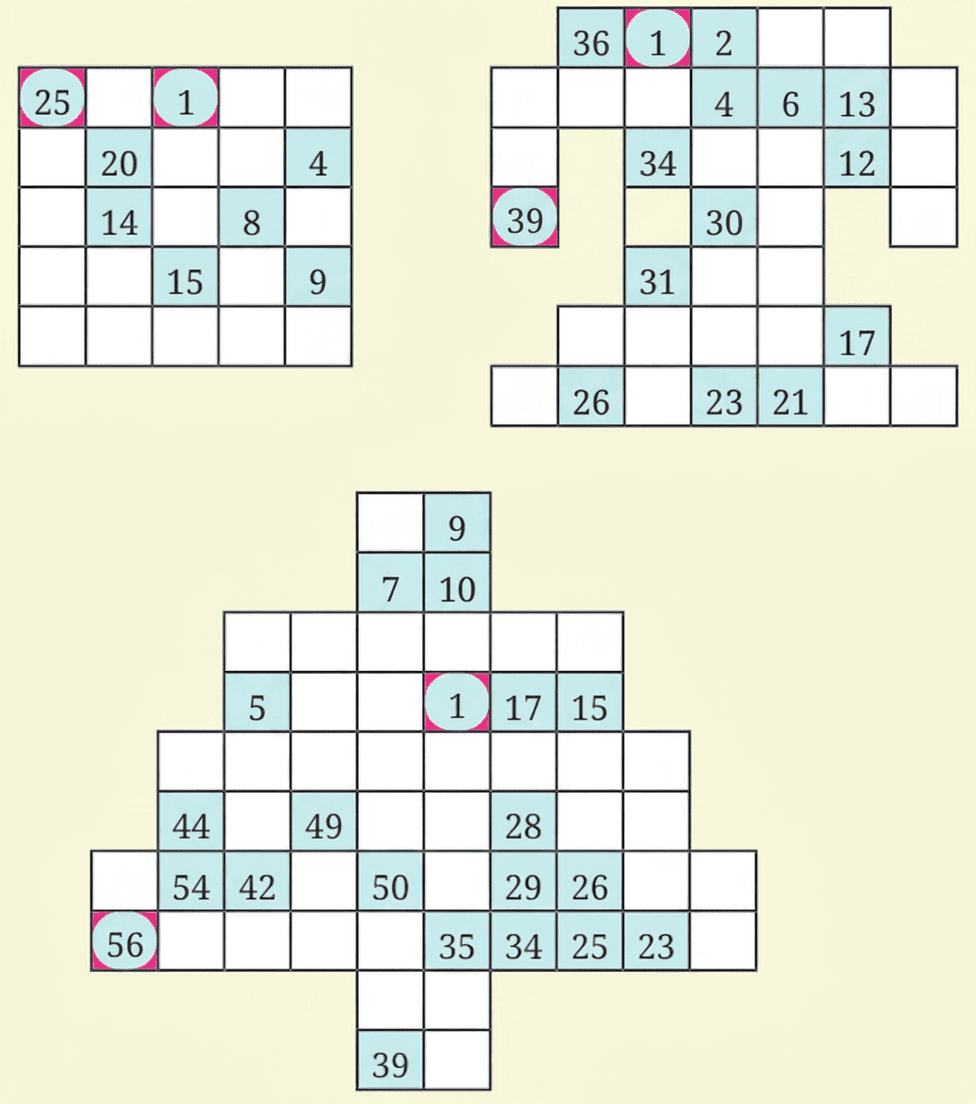
Solution
Understand the Question
- In a standard Hidato puzzle, all empty cells in a grid are filled with consecutive numbers from to , where is the total number of cells in the grid.
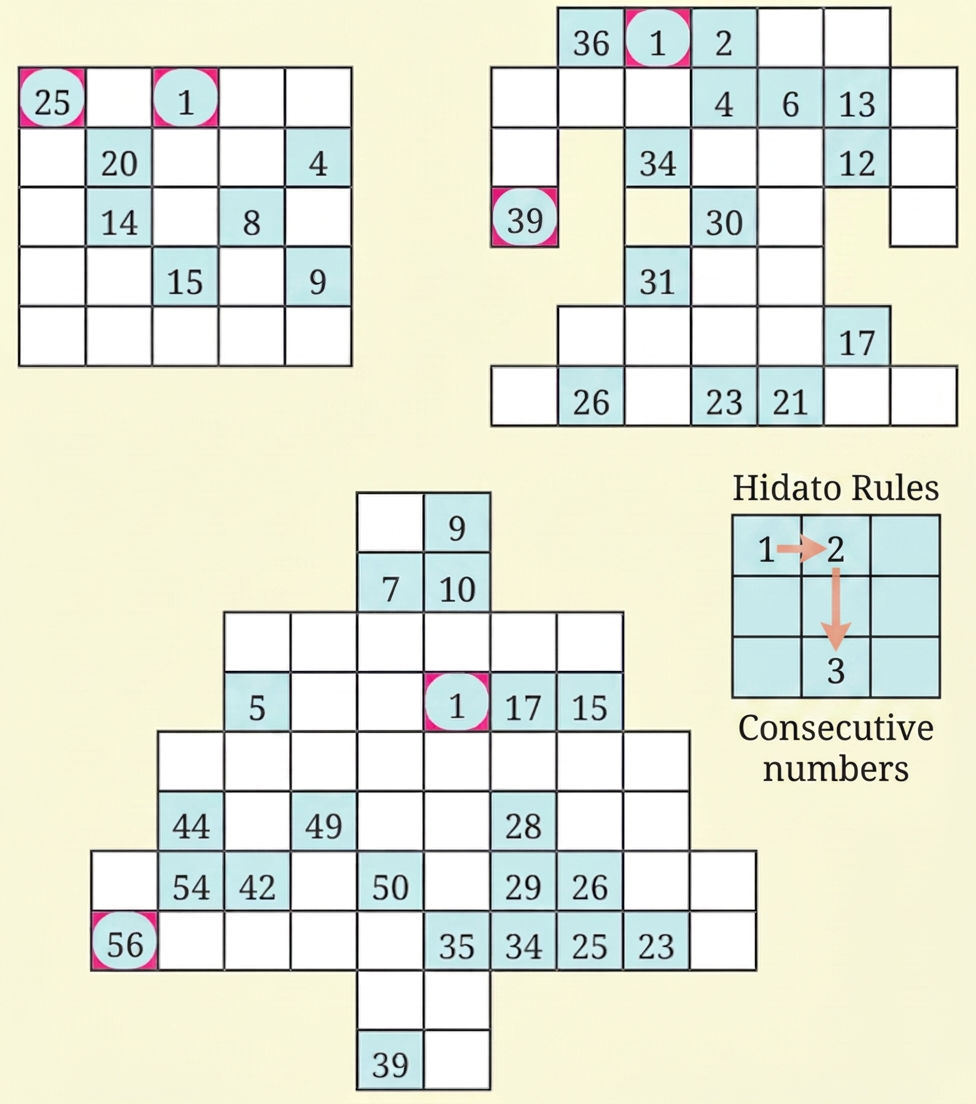
- Consecutive numbers must connect horizontally, vertically, or diagonally into adjacent cells.
- If any given number printed in the grid is greater than the total number of cells , the puzzle violates standard Hidato rules and cannot be solved.
(i) Solve Puzzle 1.
Step 1 · Count Cells and Compare Given Values
Total number of cells in the grid:
- A valid Hidato puzzle of cells must only contain numbers from to .
- The given numbers in the puzzle are: .
- The numbers and are greater than the total number of cells ().
Answer
(i) Puzzle 1 cannot be solved as a standard Hidato puzzle.
(ii) Solve Puzzle 2.
Step 1 · Count Cells and Compare Given Values
Count the number of cells in each row:
- Row 1: cells
- Row 2: cells
- Row 3: cells
- Row 4: cells
- Row 5: cells
- Row 6: cells
- Row 7: cells
Total number of cells:
- A valid Hidato puzzle of cells must only contain numbers from to .
- The given numbers are: .
- The number is greater than the total number of cells ().
Answer
(ii) Puzzle 2 cannot be solved as a standard Hidato puzzle.
(iii) Solve Puzzle 3.
Step 1 · Count Cells and Compare Given Values
Count the number of cells in each row:
- Row 1: cell
- Row 2: cells
- Row 3: cells
- Row 4: cells
- Row 5: cells
- Row 6: cells
- Row 7: cells
- Row 8: cell
Total number of cells:
- A valid Hidato puzzle of cells must only contain numbers from to .
- The given numbers are: .
- The numbers are all greater than the total number of cells ().
Answer
(iii) Puzzle 3 cannot be solved as a standard Hidato puzzle.
Common Mistakes
- Assuming Missing Numbers: Trying to force a path without first verifying that the largest given number does not exceed the total cell count .
- Miscounting Irregular Grids: Multiplying overall width by height instead of summing the individual cells in non-rectangular grids.