Question 1
Investigate how traditional calendars in India managed to consistently align the days in the calendar with astronomical events like the Earth going around the Sun or even the positions of the stars in the sky accurately.
- Traditional Indian calendars use a lunisolar system, balancing both solar and lunar cycles.
- A solar year is approximately , while lunar months total only , creating an annual difference of about .
- To prevent the calendar from drifting away from the solar seasons, an extra month called Adhik Maas is periodically added, and celestial coordinates are tracked using star clusters called Nakshatras.
Step 1 · Observe Solar and Lunar Cycles
Timekeeping in traditional Indian astronomy is based on cyclical observations of the Sun, Moon, and stars.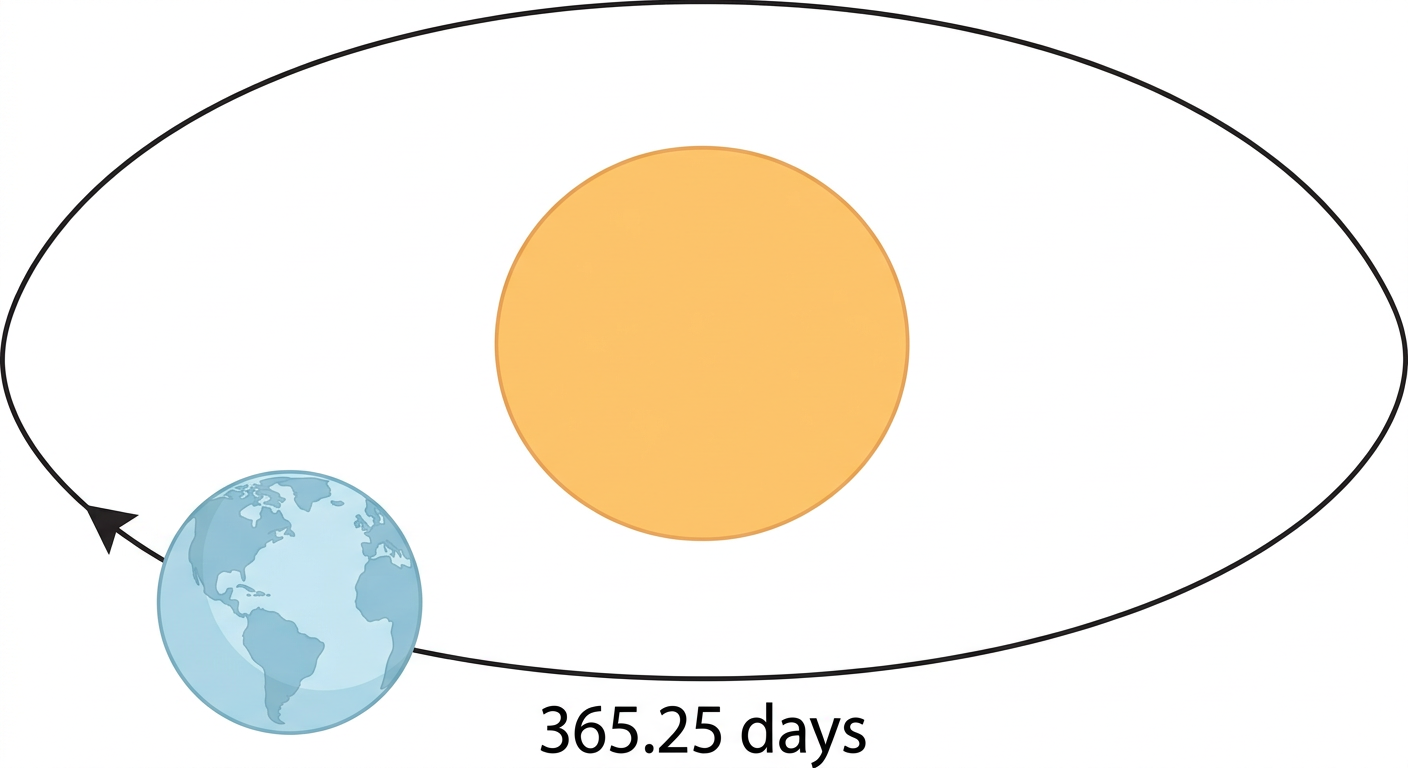
- Solar Year: The time taken by Earth to orbit the Sun once is approximately , which governs the seasons.
- Lunar Month: The time from one new moon to the next is approximately .
Step 2 · Calculate the Difference Between Solar and Lunar Years
Total days in lunar months:
Difference between the solar year and lunar months:
Without correction, this difference of per year would cause months to drift out of sync with the actual seasons.
Step 3 · Synchronise Seasons with Adhik Maas
To reconcile the lunar year with the solar year, an intercalary month called Adhik Maas (additional month) is inserted roughly every to years.
This periodic adjustment brings the lunar calendar back in harmony with the solar cycle and seasonal changes.
Step 4 · Track Celestial Positions Using Nakshatras
Ancient astronomers divided the ecliptic path into distinct star groups called Nakshatras.
Tracking the Moon's movement through these Nakshatras enabled precise daily positioning and accurate prediction of astronomical events.
Traditional Indian calendars use a lunisolar system that periodically adds an extra month (Adhik Maas) every to years to bridge the annual difference between solar and lunar years, while tracking Nakshatras for precise star-based positioning.
- Assuming a Purely Solar or Lunar Calendar: Traditional Indian calendars are lunisolar, combining lunar dates (Tithis) with solar months and seasons.
- Overlooking Annual Drift: Forgetting that lunar months () fall short of a solar year () by , which is why the intercalary month (Adhik Maas) is required.