Question 24
Do you wonder how people figured out that the Earth completes one revolution around the Sun in exactly 364.2422 days?
- The Earth completes one full revolution around the Sun in .
- The decimal portion () can be converted into standard units of time (hours, minutes, and seconds) using the conversion factors , , and .
- We can also round the period to standard decimal places and calculate the accumulated time drift over multiple years.
Step 1 · Round the Revolution Period
To round to the nearest hundredth, observe the digit in the thousandths place (). Since , the digit at the hundredths place remains unchanged.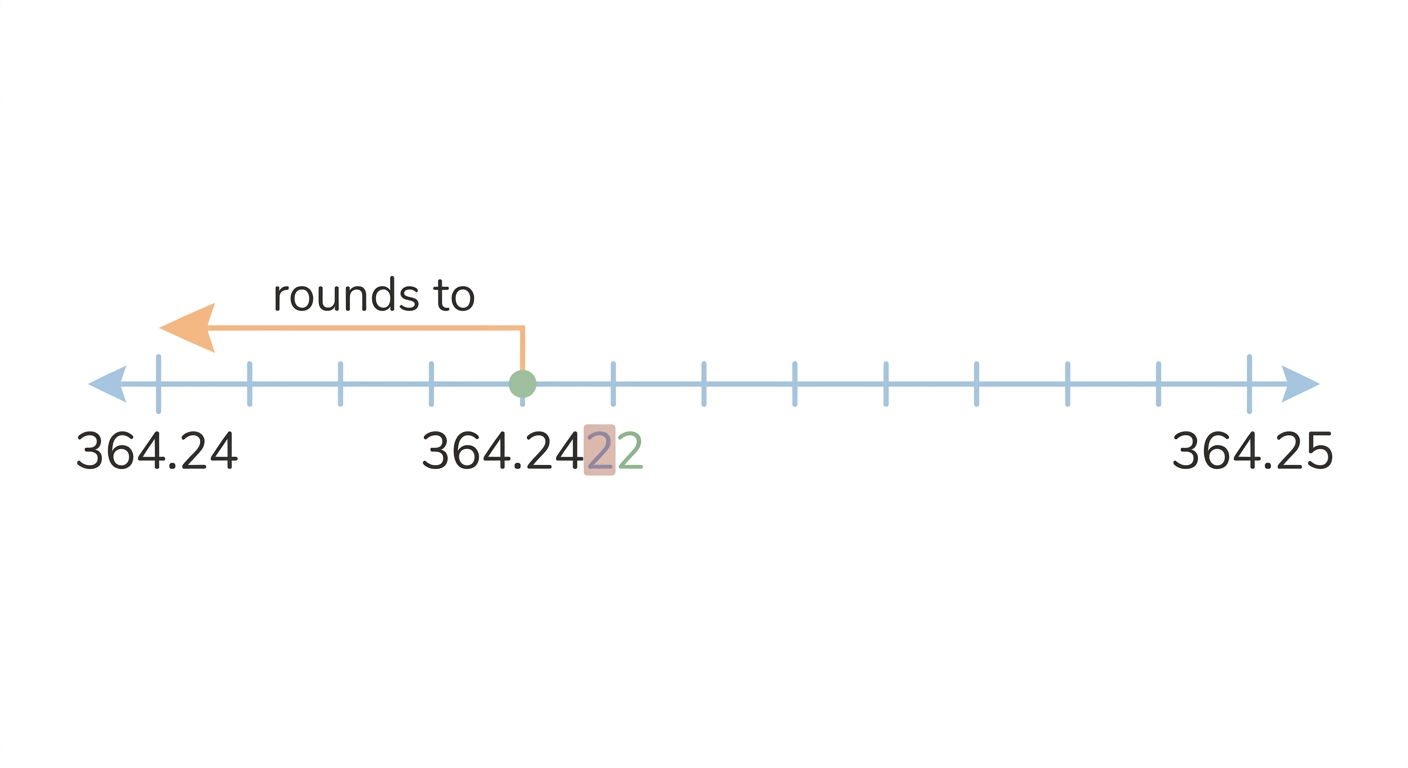
Step 2 · Convert the Decimal Part to Hours, Minutes, and Seconds
The decimal part of the revolution is .
Convert days to hours ():
Convert decimal hours to minutes ():
Convert decimal minutes to seconds ():
Therefore, .
Step 3 · Calculate the Calendar Difference over 10 Years
Difference between the actual revolution period and a calendar year:
Total difference after :
(i) Rounded value: (ii) Decimal part in time units: (iii) difference:
- Decimal Time Conversion: Incorrectly multiplying the decimal fraction by or instead of the time base factors ( for hours and for minutes/seconds).
- Rounding Rules: Checking the wrong decimal place when rounding to the nearest hundredth (the thousandths digit must be checked).
More questions in IT
Jonali and Pallabi play a game. Jonali says a fraction and Pallabi gives the equivalent decimal. Write Pallabi's answer in the blank spaces.
Jonali goes to the market to buy spices. She purchases of Cinnamon, of Cumin seeds, of Cardamom and of Pepper. Express each of the quantities in kilograms by writing them in terms of fractions as well as decimals.
Write the following fractions as a sum of fractions and also as decimals:
Can you give a simple rule to divide any number by a number of the form 1 followed by zeroes — 10, 100, 1000, etc.? For example, , or ? Look for a pattern in the previous problems.
Can the product of two decimals be a natural number?
Can the product of a decimal and a natural number be a natural number?
Observe the number of digits after the decimal point in the multiplier, the multiplicand and the product. Also note the number of zeroes in the denominator.
Suppose we know that , can you immediately write down the product of ?
Context: Observe the number of digits after the decimal point in the multiplier, the multiplicand and the product. Also note the number of zeroes in the denominator.
Q. By looking at the above examples, can you frame a rule to multiply two decimals?
When is the product of two decimals greater than both the numbers? When is it less than both the numbers?
What is in centimetres and millimetres?
Complete the table by dividing the decimals:
Can you find the quotients of , and ?
Context: Let us consider the number that arose when dividing by . Multiply by numbers from to .
Q. What are the products? What do you notice?
Multiply by . What do you observe?
To find one such number, you can find in decimal, and use the repeating block of digits.
Will the quotient be always greater than the dividend when the divisor is a decimal? Try it out with different values of the divisor.
Describe the relationship between the dividend, divisor, and the quotient. Create a table for capturing this relationship in different situations, like we did for multiplication.
What pattern do you observe? Why are 2 and 5 related in this way?
Do you know which month has this extra day?
With this new scheme of adding one extra day every 4th year, what is the number of days in 100 calendar years? Can you write an expression to calculate that number?
How many years are divisible by 4 in 100 years?
Can you form different expressions for the same question?
Context: The calendar designers decided that they will not add 1 extra day in every hundredth year.
Q. Can you write an expression for the number of days in 100 calendar years with this new adjustment?
With this final scheme of leap years can you calculate the number of calendar days in 10,000 years and the number of actual days the Earth will take to make 10,000 revolutions around the Sun? What is the difference? If there is a big difference, can you suggest a way to fix this problem?
Do you wonder how people figured out that the Earth completes one revolution around the Sun in exactly 364.2422 days?