Question 3
Shortest Path in a Box!
There is a spider in a corner of a box. It wants to reach the farthest opposite corner (marked in the figure). Since it cannot fly, it can reach the opposite point only by walking on the surfaces of the box. What is the shortest path it can take?
Take a cardboard box and mark the path that you think is the shortest from one corner to its opposite corner. Compare the length of this path with that of the paths made by your friends.
Hint:
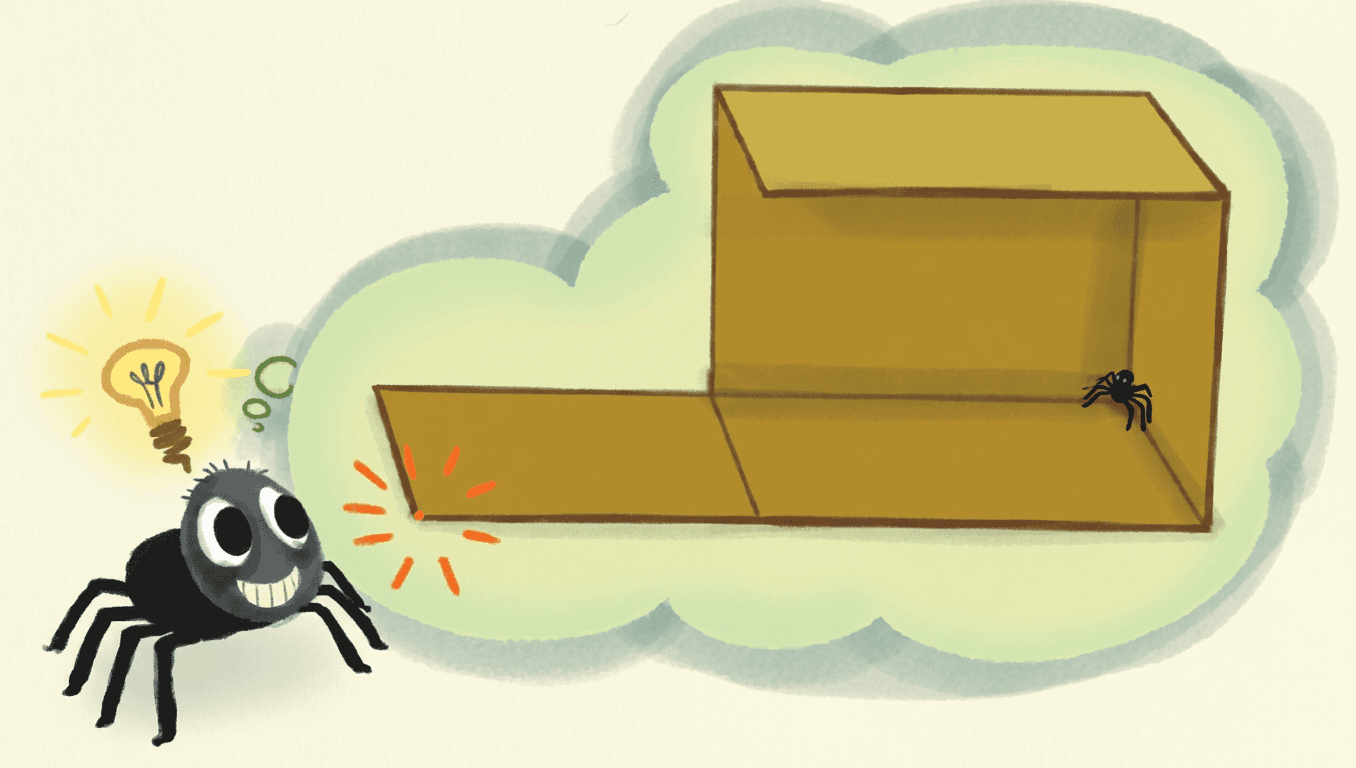
- A spider walking on the outer surface of a box cannot fly through the 3D space, so its path must lie entirely on the faces.
- The shortest distance between two points on a surface is a straight line on the unfolded flat net of the box.
- By unfolding two adjacent faces into a flat plane, the straight path forms the hypotenuse of a right-angled triangle.
- Depending on which pair of adjacent faces is crossed, there are three possible path lengths for a box of length , width , and height :
- The shortest possible route is the minimum of these three values.
Step 1 · Unfold the Box to Create a 2D Net
Let the box have length , width , and height .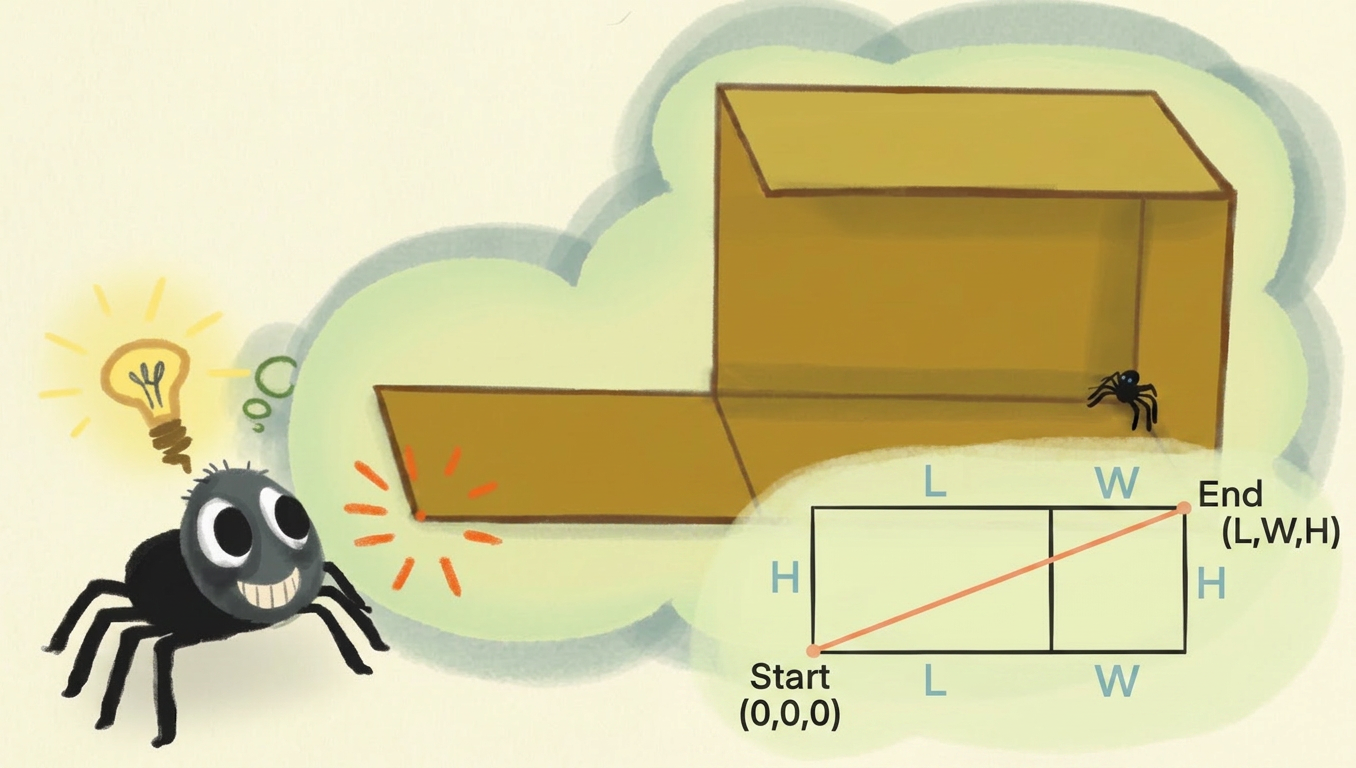
To find the shortest surface path from one corner to the farthest opposite corner, unfold two adjacent faces so they lie flat on the same plane. The shortest path across the flat surface is a straight line connecting the two points, which forms the hypotenuse of a right-angled triangle.
Step 2 · Formulate the Three Possible Path Lengths
There are three distinct pairs of adjacent faces the spider can cross:
Path Option 1: Across the length and height faces
Path Option 2: Across the length and width faces
Path Option 3: Across the width and height faces
The shortest path is the minimum of , , and .
Step 3 · Evaluate with an Example
For a box with dimensions , , and :
Comparing the values:
Therefore, gives the shortest path.
The shortest path is a straight line across two unfolded adjacent faces, with length equal to .
- Walking along edges: Walking strictly along the edges () is much longer than taking a straight diagonal line across the unfolded surfaces.
- Using 3D space diagonal: The interior space diagonal assumes flying through the air inside the box, which a walking spider cannot do.
- Checking only one face pair: Assuming any random unfolding gives the shortest route; you must always test all three combinations since the smallest sum of two dimensions combined gives the shortest distance.
More questions in A
Cut out a paper triangle. Fix one of the sides as the base. Fold it in such a way that the resulting crease is an altitude from the top vertex to the base. Justify why the crease formed should be perpendicular to the base.
Shortest Path in a Box!
There is a spider in a corner of a box. It wants to reach the farthest opposite corner (marked in the figure). Since it cannot fly, it can reach the opposite point only by walking on the surfaces of the box. What is the shortest path it can take?
Take a cardboard box and mark the path that you think is the shortest from one corner to its opposite corner. Compare the length of this path with that of the paths made by your friends.
Hint: