Question 2
Cut out a paper triangle. Fix one of the sides as the base. Fold it in such a way that the resulting crease is an altitude from the top vertex to the base. Justify why the crease formed should be perpendicular to the base.
- An altitude of a triangle is a line segment drawn from a vertex perpendicular to the opposite side (base).
- Folding a straight edge (line segment) onto itself divides the straight angle () at the fold into two equal angles of , creating a line perpendicular to the edge.
- By adjusting the fold so that the crease passes through the top vertex, we obtain the altitude to the base.
Step 1 · Define Triangle and the Goal
Let the paper triangle be with side as the base and vertex as the opposite (top) vertex.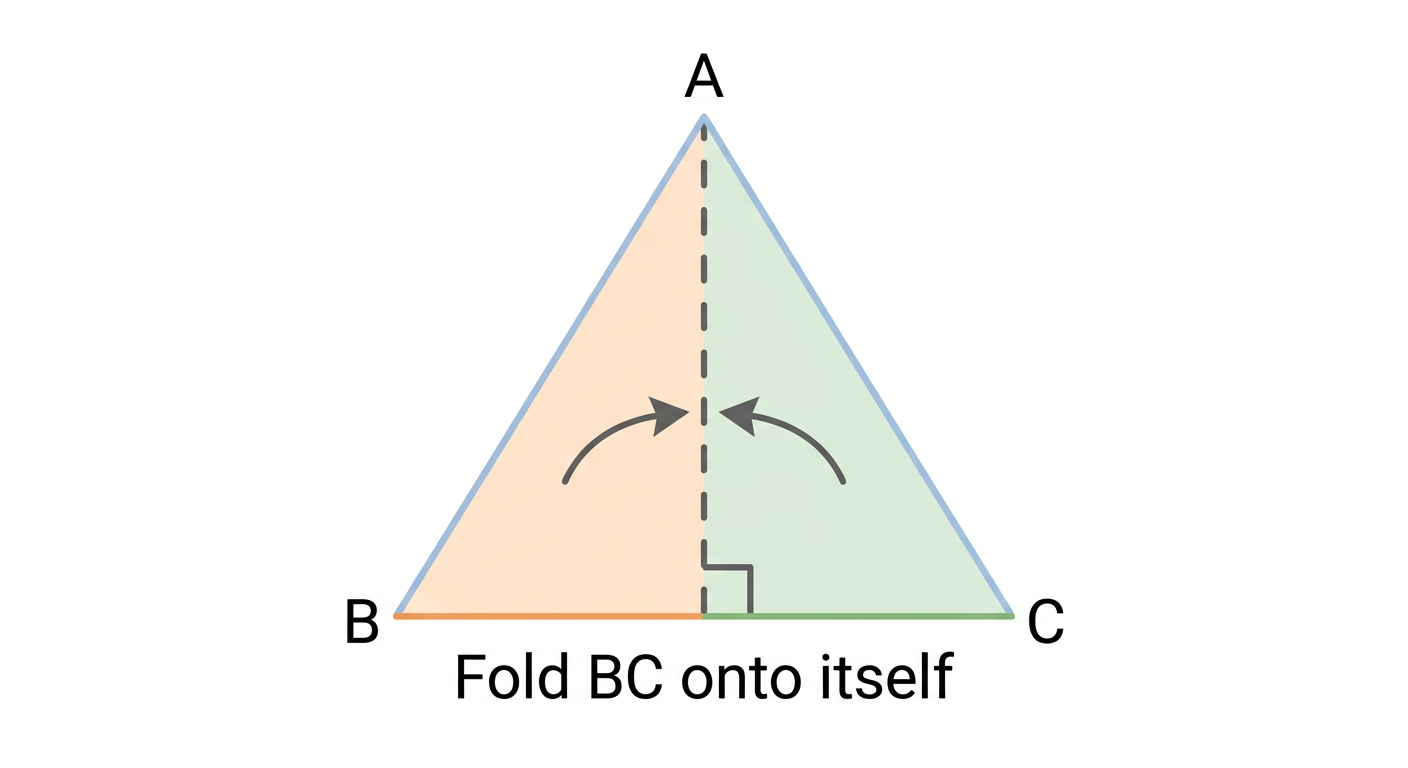
An altitude is a line segment drawn from a vertex perpendicular to the opposite side. Thus, the fold line (crease) must:
- Pass through vertex .
- Be perpendicular to the base .
Step 2 · Fold the Base Onto Itself and Justification
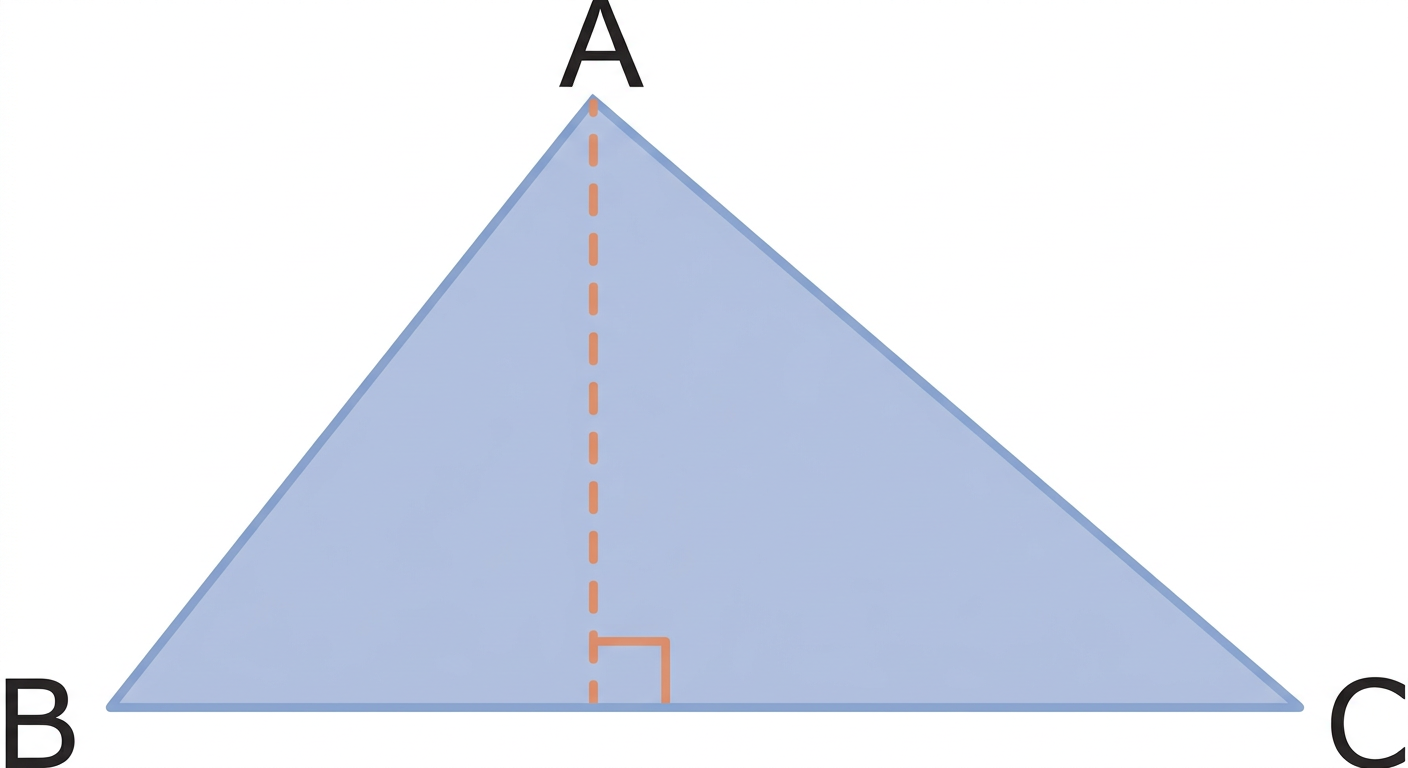
- Fold the paper so that the line segment along base lies directly on top of itself.
- When a straight line segment folds onto itself along a crease, the straight angle of along the edge is divided into two equal adjacent angles on either side of the crease:
- Hence, the crease line is perpendicular to .
Step 3 · Align Crease Through Vertex A
- While keeping the base folded onto itself, slide the paper until the crease line passes exactly through vertex .
- Press the paper to form the sharp crease.
- Since this crease passes through vertex and meets base at , it forms the altitude from vertex to base .
The crease is perpendicular to the base because folding line segment onto itself divides the straight angle () into two equal adjacent angles of , creating the altitude through vertex .
- Confusing Altitude with Median / Perpendicular Bisector: Folding vertex directly onto vertex creates the perpendicular bisector of , which may not pass through vertex unless the triangle is isosceles or equilateral.
- Not Keeping the Edge Aligned: If the edge does not lie exactly on itself during the fold, the resulting crease will not meet the base at .
More questions in A
Cut out a paper triangle. Fix one of the sides as the base. Fold it in such a way that the resulting crease is an altitude from the top vertex to the base. Justify why the crease formed should be perpendicular to the base.
Shortest Path in a Box!
There is a spider in a corner of a box. It wants to reach the farthest opposite corner (marked in the figure). Since it cannot fly, it can reach the opposite point only by walking on the surfaces of the box. What is the shortest path it can take?
Take a cardboard box and mark the path that you think is the shortest from one corner to its opposite corner. Compare the length of this path with that of the paths made by your friends.
Hint: