Question 33
Complete the grids to make the required border sum:
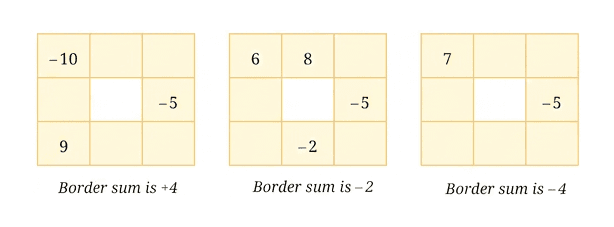
- The border sum of a grid is the total of all numbers located along the outer border, excluding the center cell.
- To find the border sum, add all the positive integers together, add all the negative integers together, and then combine the two sums.
(i) Calculate the border sum for Grid 1.
Step 1 · Calculate Border Sum for Grid 1
The numbers in the border cells surrounding the center cell () are .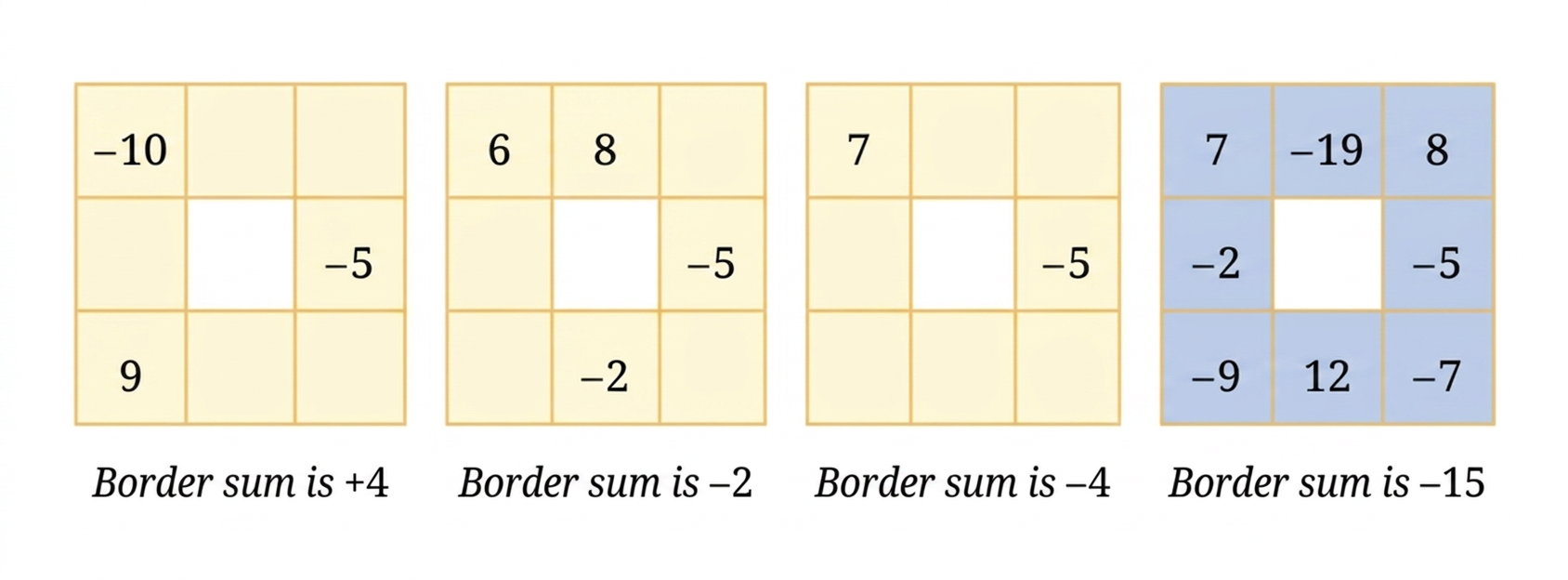
Sum of all border numbers:
Sum of positive numbers:
Sum of negative numbers:
Total border sum:
(i)
(ii) Calculate the border sum for Grid 2.
Step 1 · Calculate Border Sum for Grid 2
The numbers in the border cells surrounding the center cell () are .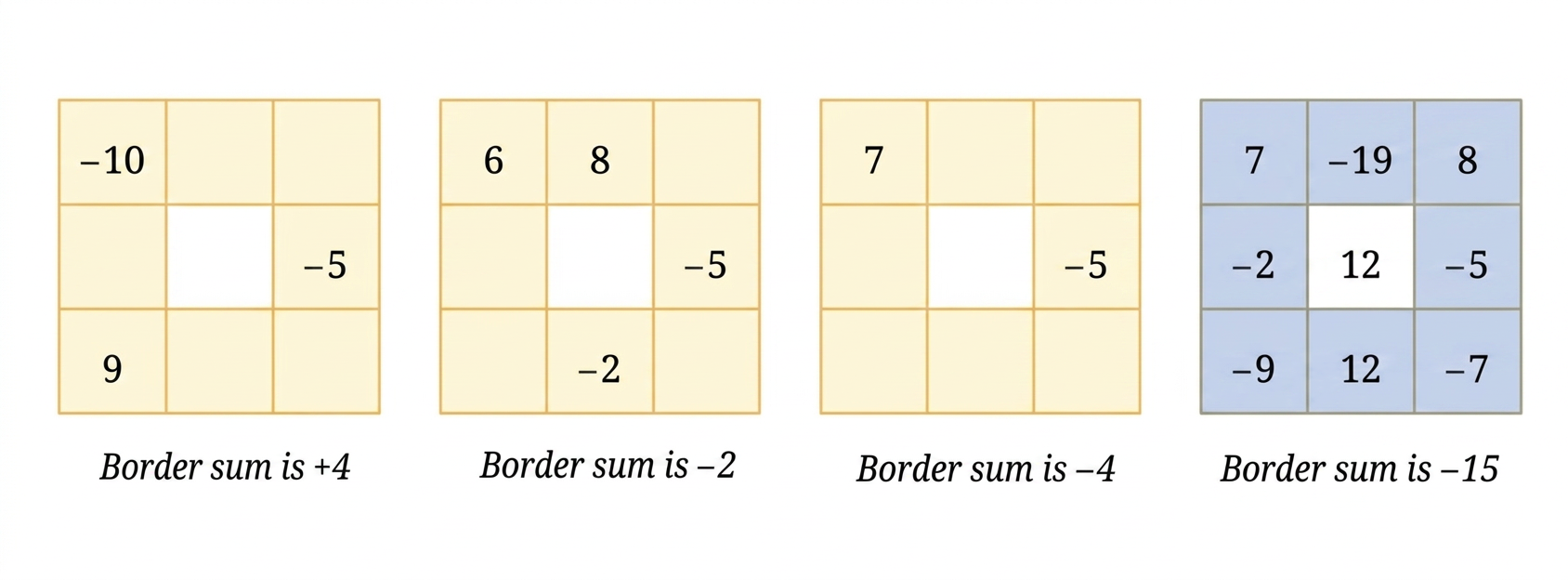
Sum of all border numbers:
Sum of positive numbers:
Sum of negative numbers:
Total border sum:
(ii)
- Including the Center Cell: Accidentally adding the middle cell's value into the border sum calculation.
- Sign Errors: Making mistakes when grouping and adding positive and negative integers together.
More questions in FIO
You start from Floor and press in the lift. Where will you reach? Write an expression for this movement.
Evaluate these expressions (you may think of them as Starting Floor + Movement by referring to the Building of Fun).
Starting from different floors, find the movements required to reach Floor . For example, if I start at Floor , I must press to reach Floor . The expression is .
Find more such starting positions and the movements needed to reach Floor and write the expressions.
Evaluate these expressions by thinking of them as the resulting movement of combining button presses:
Compare the following numbers using the Building of Fun and fill in the boxes with or .
Imagine the Building of Fun with more floors. Compare the numbers and fill in the boxes with or :
If Floor A , Floor D and Floor E in the building shown on the right as a line, find the numbers of Floors B, C, F, G, and H.
Mark the following floors of the building shown on the right.
a. b. c. d.
Complete these expressions. You may think of them as finding the movement needed to reach the Target Floor from the Starting Floor.
Complete these expressions.
Try evaluating the following expressions by similarly drawing or imagining a suitable lift:
a.
b.
c.
d.
e.
f.
g.
h.
Mark 3 positive numbers and 3 negative numbers on the number line above.
Write down the above 3 marked negative numbers in the following boxes:
Is ? Why? Is ? Why?
What are:
(a)
(b)
(c)
(d)
(e)
(f) ?
Complete the additions using tokens.
a.
b.
c.
d.
Cancel the zero pairs in the following two sets of tokens. On what floor is the lift attendant in each case? What is the corresponding addition statement in each case?
Evaluate the following differences using tokens. Check that you get the same result as with other methods you now know:
a.
b.
c.
d.
e.
f.
Complete the subtractions:
a.
b.
c.
d.
e.
f.
Try to subtract: .
How many zero pairs will you have to put in? What is the result?
Evaluate the following using tokens.
a.
b.
c.
d.
e.
f.
Suppose you start with ₹0 in your bank account, and then you have credits of ₹30, ₹40, and ₹50, and debits of ₹40, ₹50, and ₹60. What is your bank account balance now?
Suppose you start with ₹0 in your bank account, and then you have debits of ₹1, 2, 4, 8, 16, 32, 64, and 128, and then a single credit of ₹256. What is your bank account balance now?
Why is it generally better to try and maintain a positive balance in your bank account? What are circumstances under which it may be worthwhile to temporarily have a negative balance?
Looking at the geographical cross section, fill in the respective heights:
Which is the highest point in this geographical cross section? Which is the lowest point?
Can you write the points in a sequence of decreasing order of heights? Can you write the points in a sequence of increasing order of heights?
What is the highest point above sea level on Earth? What is its height?
What is the lowest point with respect to sea level on land or on the ocean floor? What is its height? (This height should be negative).
Do you know that there are some places in India where temperatures can go below ? Find out the places in India where temperatures sometimes go below . What is common among these places? Why does it become colder there and not in other places?
Leh in Ladakh gets very cold during the winter. The following is a table of temperature readings taken during different times of the day and night in Leh on a day in November. Match the temperature with the appropriate time of the day and night.
Do the calculations for the second grid above and find the border sum.
Complete the grids to make the required border sum:
For the last grid above, find more than one way of filling the numbers to get border sum .
Which other grids can be filled in multiple ways? What could be the reason?
Make a border integer square puzzle and challenge your classmates.
Try afresh, choose different numbers this time. What sum did you get? Was it different from the first time? Try a few more times!
Play the same game with the grids below. What answer did you get?
What could be so special about these grids? Is the magic in the numbers or the way they are arranged or both? Can you make more such grids?
Write all the integers between the given pairs, in increasing order.
(a) and
(b) and
(c) and
(d) and
Give three numbers such that their sum is .
There are two dice whose faces have these numbers: . The smallest possible sum upon rolling these dice is and the largest possible sum is . Some numbers between and are not possible to get by adding numbers on these two dice. Find those numbers.
Solve these:
Find the years below. a. From the present year, which year was it 150 years ago?
b. From the present year, which year was it 2200 years ago?
c. What will be the year 320 years after 680 BCE?
Hint: Recall that there was no year 0.
Complete the following sequences:
Here are six integer cards: .
You can pick any of these and make an expression using addition(s) and subtraction(s).
Here is an expression: which gives a value . Now, pick cards and make an expression such that its value is closer to .
The sum of two positive integers is always positive but a (positive integer) - (positive integer) can be positive or negative. What about
a. (positive) - (negative)
b. (positive) + (negative)
c. (negative) + (negative)
d. (negative) - (negative)
e. (negative) - (positive)
f. (negative) + (positive)
This string has a total of 100 tokens arranged in a particular pattern. What is the value of the string?
Can you explain each of Brahmagupta's rules in terms of Bela's Building of Fun, or in terms of a number line?
Give your own examples of each rule.