Question 9
Think and mark the positions as directed—
a. Mark 'A' at the point where Akshi will be after she ran 250 m. b. Mark 'B' at the point where Akshi will be after she ran 500 m. c. Now, Akshi ran 1000 m. How many full rounds has she finished running around her track? Mark her position as 'C'. d. Mark 'X' at the point where Toshi will be after she ran 250 m. e. Mark 'Y' at the point where Toshi will be after she ran 500 m. f. Now, Toshi ran 1000 m. How many full rounds has she finished running around her track? Mark her position as 'Z'.
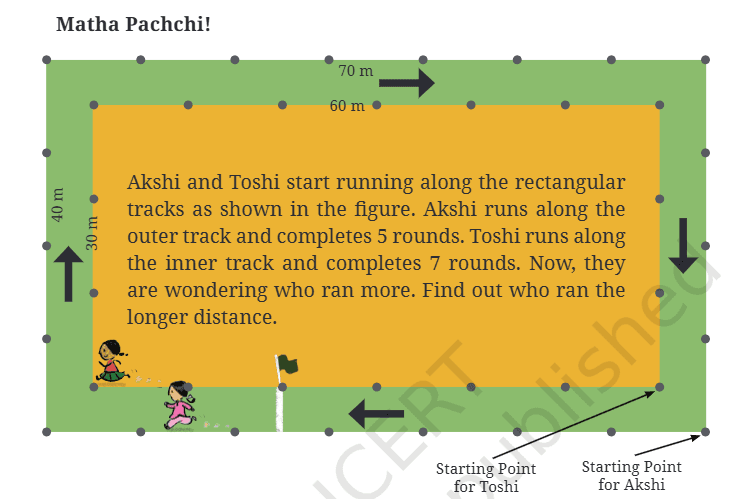
- Perimeter of Akshi's outer track (): So, full round for Akshi .
- Perimeter of Toshi's inner track (): So, full round for Toshi .
- Both runners start at the bottom-right corner and run clockwise along the perimeter of their respective rectangular tracks.
- To find each runner's position, find how many complete rounds they ran and how many metres remain from the starting point.
(a) Mark 'A' at the point where Akshi will be after she ran 250 m.
Step 1 · Find Akshi's Position after 250 m (Point A)
Akshi runs on a track of perimeter .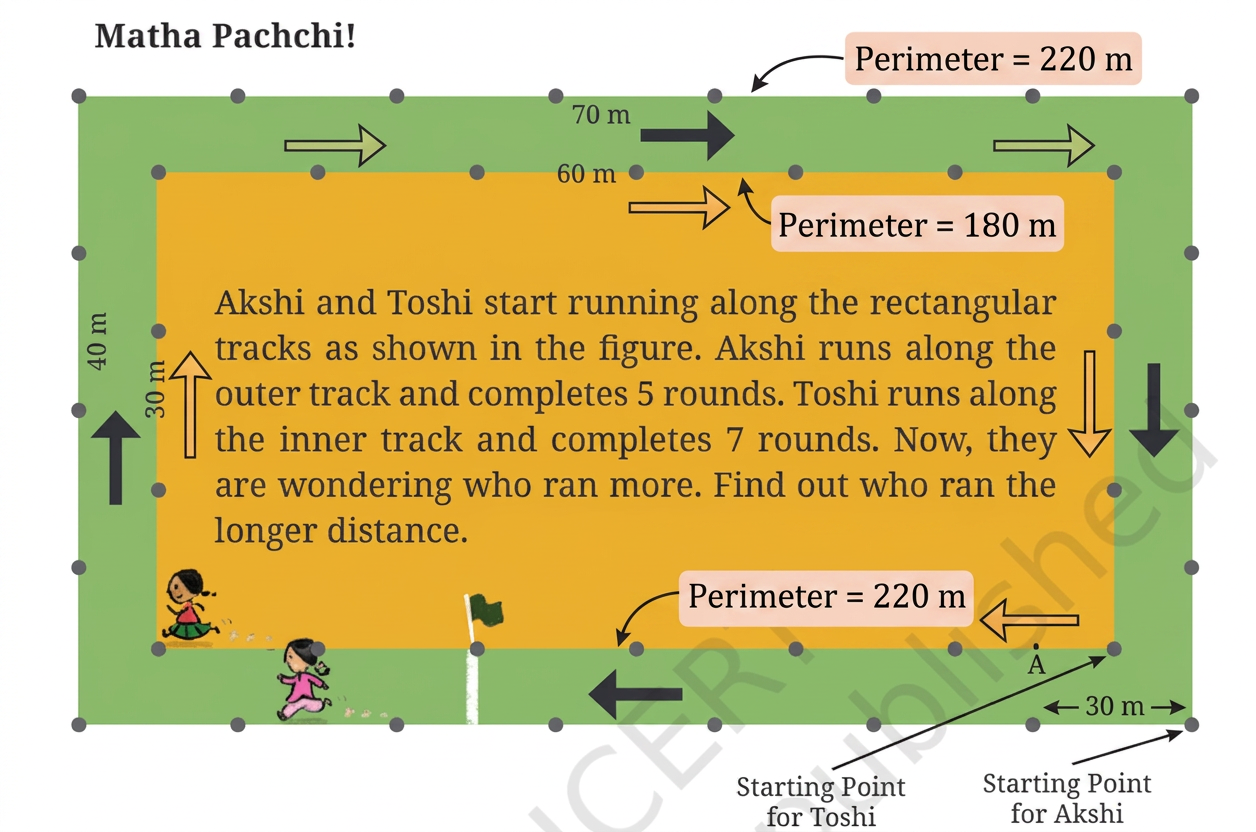
Distance covered in full round:
Remaining distance:
Starting from the bottom-right corner and moving clockwise, point 'A' is on the bottom side, away from the starting corner.
(a) Point 'A' is on the bottom side, from the starting point.
(b) Mark 'B' at the point where Akshi will be after she ran 500 m.
Step 1 · Find Akshi's Position after 500 m (Point B)
Akshi runs on a track of perimeter .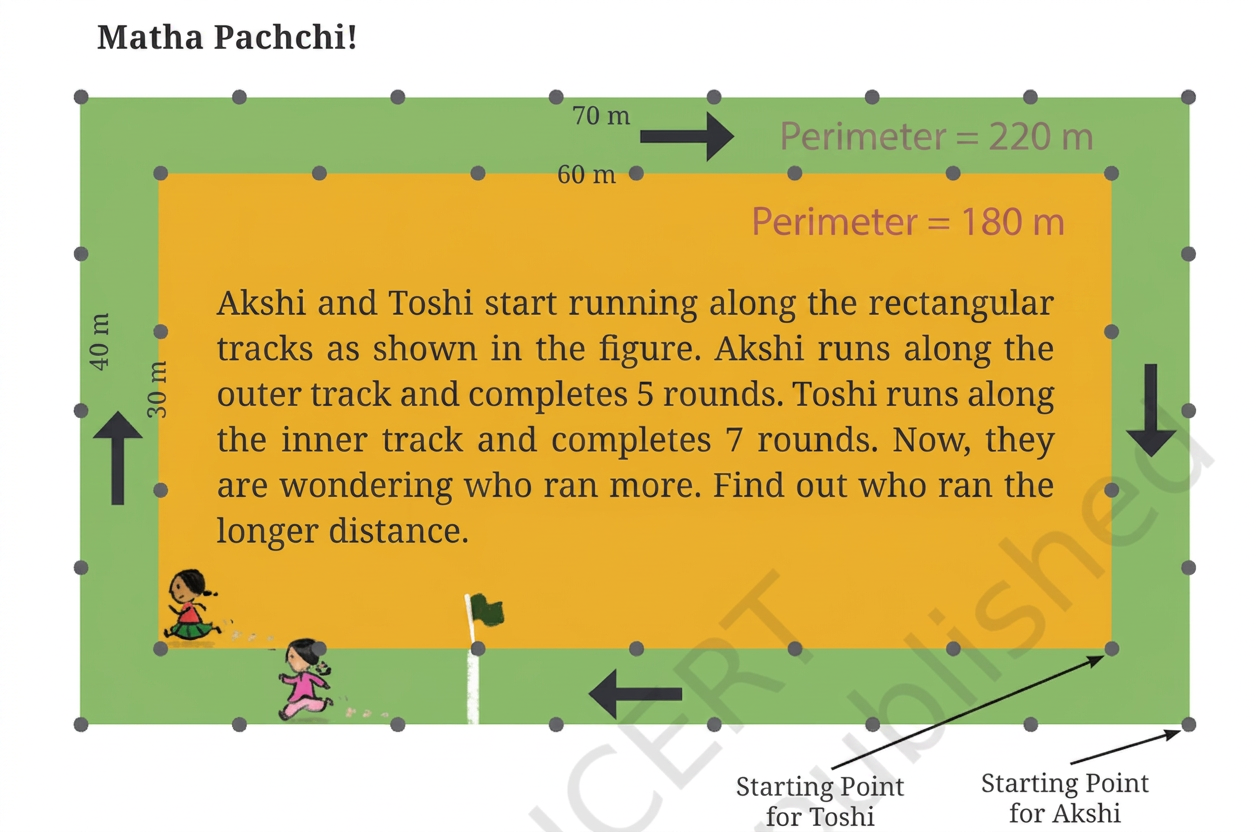
Distance covered in full rounds:
Remaining distance:
Point 'B' is on the bottom side, from the starting corner.
(b) Point 'B' is on the bottom side, from the starting point.
(c) Now, Akshi ran 1000 m. How many full rounds has she finished running around her track? Mark her position as 'C'.
Step 1 · Find Akshi's Full Rounds and Position after 1000 m (Point C)
Akshi runs on a track of perimeter .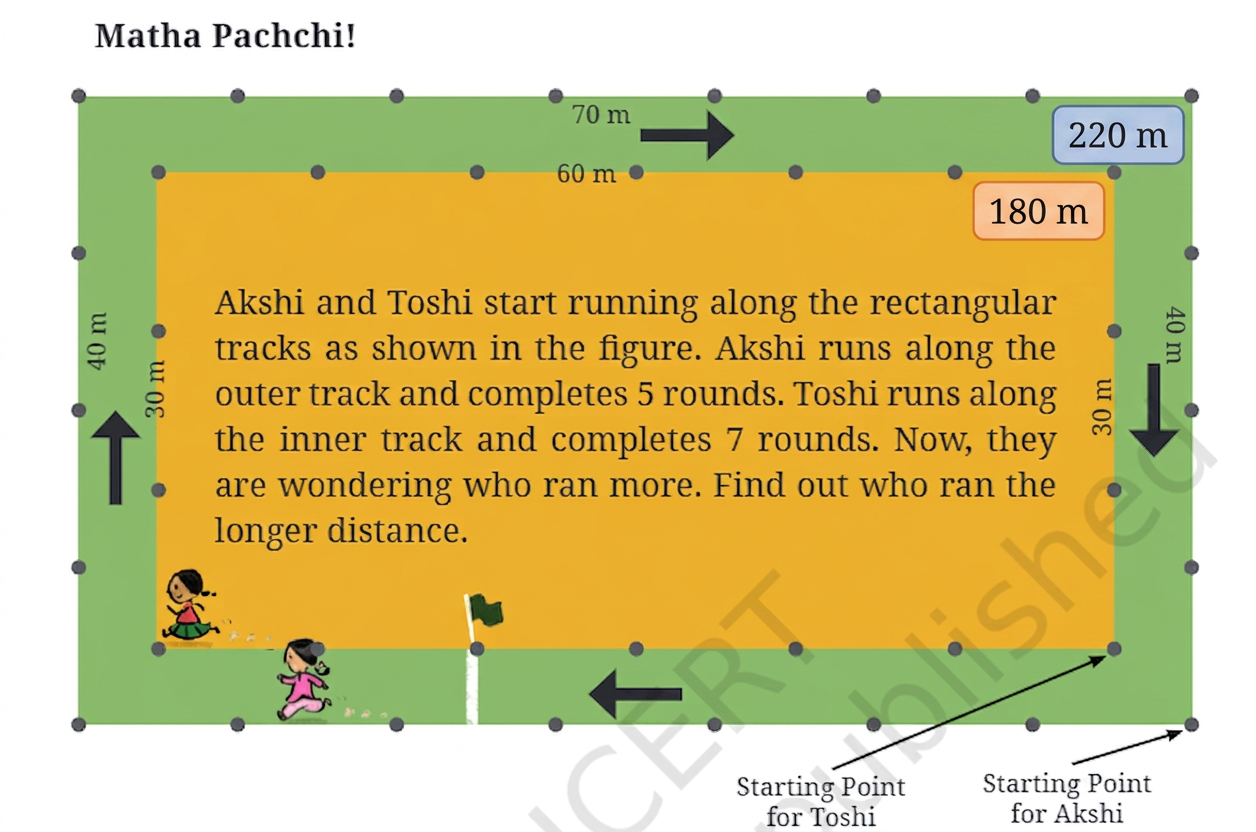
Akshi finishes full rounds.
Distance in rounds:
Remaining distance:
Tracing clockwise from start:
- Bottom side
- Left side
- Distance covered along bottom and left sides
- Distance on the top side
Point 'C' is on the top side, from the top-left corner.
(c) Akshi finishes full rounds. Position 'C' is on the top side, from the top-left corner ( from the start).
(d) Mark 'X' at the point where Toshi will be after she ran 250 m.
Step 1 · Find Toshi's Position after 250 m (Point X)
Toshi runs on the inner track of perimeter .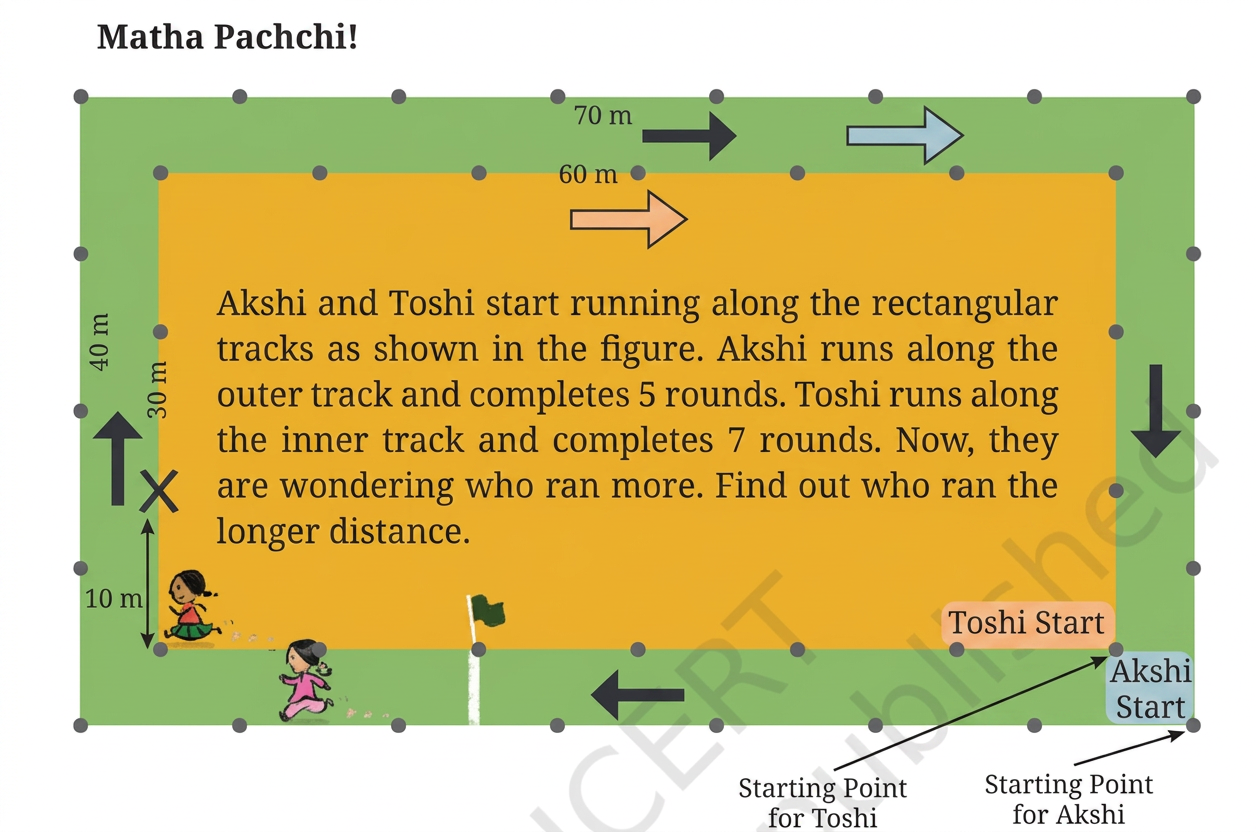
Distance covered in round:
Remaining distance:
Tracing clockwise from the bottom-right corner:
- Bottom side
- Distance along the left side
Point 'X' is on the left side, from the bottom-left corner.
(d) Point 'X' is on the left side, from the bottom-left corner ( from the start).
(e) Mark 'Y' at the point where Toshi will be after she ran 500 m.
Step 1 · Find Toshi's Position after 500 m (Point Y)
Toshi runs on the inner track of perimeter .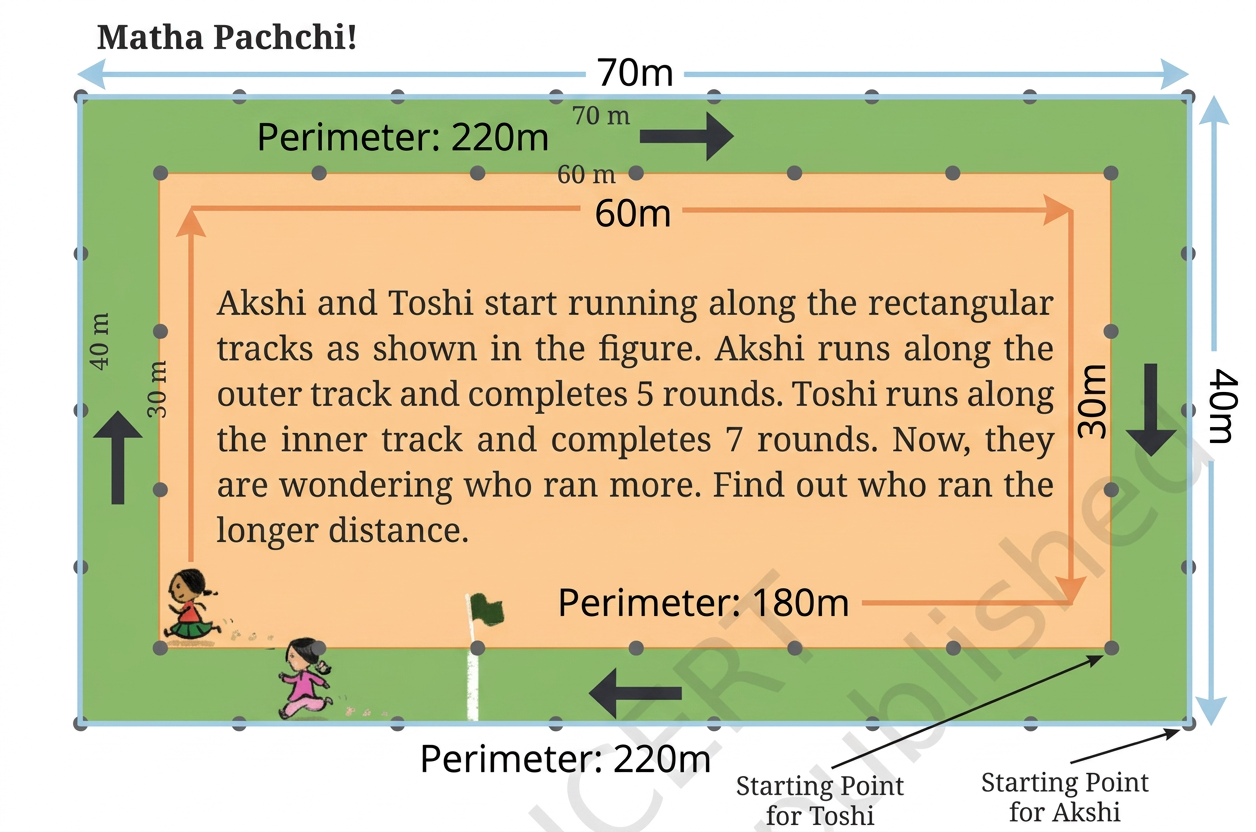
Distance covered in rounds:
Remaining distance:
Tracing clockwise from the bottom-right corner:
- Bottom side
- Left side
- Distance along bottom and left sides
- Distance along the top side
Point 'Y' is on the top side, from the top-left corner.
(e) Point 'Y' is on the top side, from the top-left corner ( from the start).
(f) Now, Toshi ran 1000 m. How many full rounds has she finished running around her track? Mark her position as 'Z'.
Step 1 · Find Toshi's Full Rounds and Position after 1000 m (Point Z)
Toshi runs on the inner track of perimeter .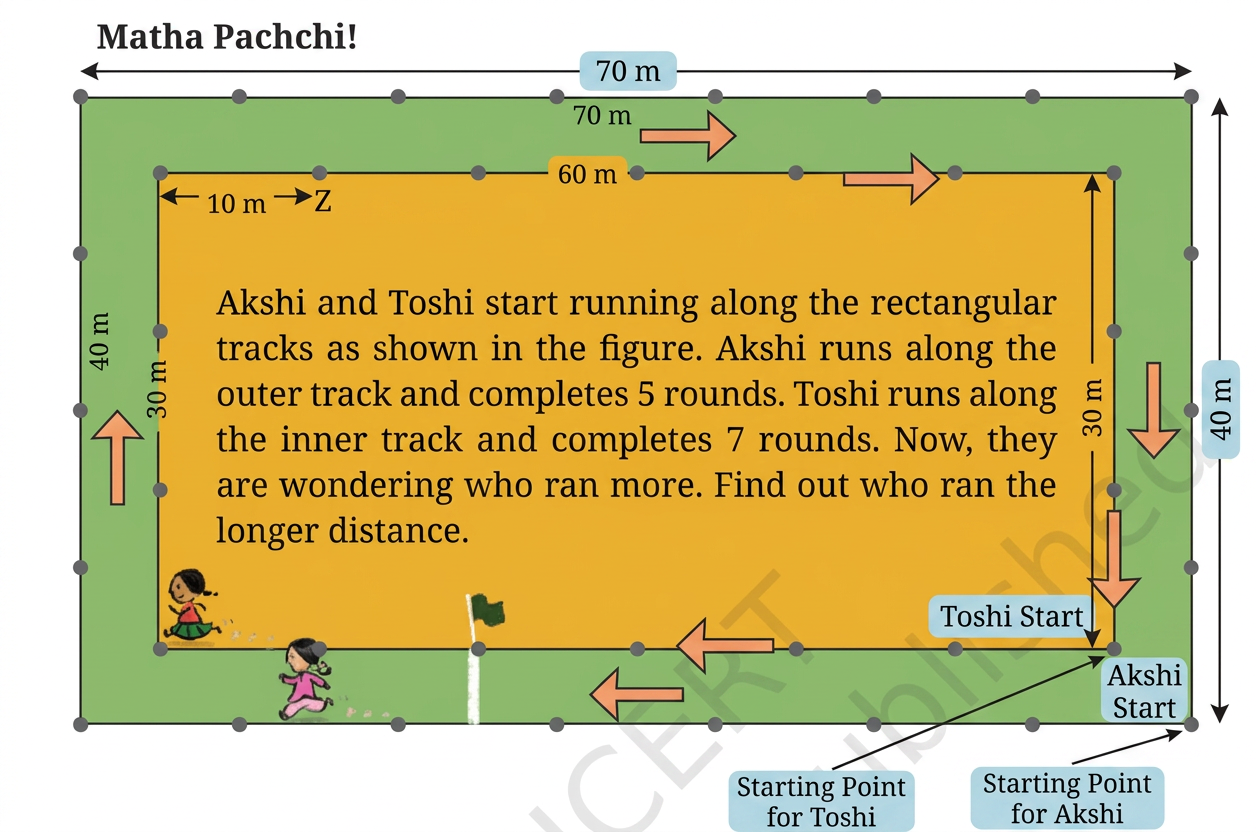
Toshi finishes full rounds.
Distance in rounds:
Remaining distance:
Tracing clockwise from the bottom-right corner:
- Bottom side
- Left side
- Distance along bottom and left sides
- Distance along the top side
Point 'Z' is on the top side, from the top-left corner.
(f) Toshi finishes full rounds. Position 'Z' is on the top side, from the top-left corner ( from the start).
- Mixing Track Perimeters: Akshi runs on the outer track (), while Toshi runs on the inner track (). Using the wrong perimeter leads to incorrect round counts and positions.
- Not Subtracting Side Lengths: For remaining distances greater than the first side, remember to subtract each side successively (bottom side, then left side) to locate the exact position on the correct edge.
- Direction Error: Ensure points are measured in the clockwise direction from the starting bottom-right corner.
More questions in FIO
Find the missing terms:
a. Perimeter of a rectangle = 14 cm; breadth = 2 cm; length = ?.
b. Perimeter of a square = 20 cm; side of a length = ?.
c. Perimeter of a rectangle = 12 m; length = 3 m; breadth = ?.
A rectangle having sidelengths and is made using a piece of wire. If the wire is straightened and then bent to form a square, what will be the length of a side of the square?
Find the length of the third side of a triangle having a perimeter of 55 cm and having two sides of length 20 cm and 14 cm, respectively.
What would be the cost of fencing a rectangular park whose length is 150 m and breadth is 120 m, if the fence costs ₹40 per metre?
A piece of string is long. What will be the length of each side, if it is used to form:
a. A square,
b. A triangle with all sides of equal length, and
c. A hexagon (a six sided closed figure) with sides of equal length?
A farmer has a rectangular field having length and breadth . He wants to fence it with 3 rounds of rope as shown. What is the total length of rope needed?
Find out the total distance Akshi has covered in 5 rounds.
Find out the total distance Toshi has covered in 7 rounds. Who ran a longer distance?
Think and mark the positions as directed—
a. Mark 'A' at the point where Akshi will be after she ran 250 m. b. Mark 'B' at the point where Akshi will be after she ran 500 m. c. Now, Akshi ran 1000 m. How many full rounds has she finished running around her track? Mark her position as 'C'. d. Mark 'X' at the point where Toshi will be after she ran 250 m. e. Mark 'Y' at the point where Toshi will be after she ran 500 m. f. Now, Toshi ran 1000 m. How many full rounds has she finished running around her track? Mark her position as 'Z'.
The area of a rectangular garden long is . What is the width of the garden?
What is the cost of tiling a rectangular plot of land long and wide at the rate of per hundred ?
A rectangular coconut grove is 100 m long and 50 m wide. If each coconut tree requires 25 sq m, what is the maximum number of trees that can be planted in this grove?
By splitting the following figures into rectangles, find their areas (all measures are given in metres).
a. b.
Explore and figure out how many pieces have the same area.
How many times bigger is Shape D as compared to Shape C? What is the relationship between Shapes C, D and E?
Which shape has more area: Shape D or F? Give reasons for your answer.
Which shape has more area: Shape F or G? Give reasons for your answer.
What is the area of Shape A as compared to Shape G? Is it twice as big? Four times as big?
Hint: In the tangram pieces, by placing the shapes over each other, we can find out that Shapes A and B have the same area, Shapes C and E have the same area. You would have also figured out that Shape D can be exactly covered using Shapes C and E, which means Shape D has twice the area of Shape C or shape E, etc.
Can you now figure out the area of the big square formed with all seven pieces in terms of the area of Shape C?
Arrange these 7 pieces to form a rectangle. What will be the area of this rectangle in terms of the area of Shape C now? Give reasons for your answer.
Are the perimeters of the square and the rectangle formed from these 7 pieces different or the same? Give an explanation for your answer.
Find the areas of the figures below by dividing them into rectangles and triangles.
Give the dimensions of a rectangle whose area is the sum of the areas of these two rectangles having measurements: and .
The area of a rectangular garden that is long is . Find the width of the garden.
The floor of a room is long and wide. A square carpet whose sides are in length is laid on the floor. Find the area that is not carpeted.
Four flower beds having sides 2 m long and 1 m wide are dug at the corners of a garden that is 15 m long and 12 m wide. How much area is now available for laying down a lawn?
Shape A has an area of 18 square units and Shape B has an area of 20 square units. Shape A has a longer perimeter than Shape B. Draw two such shapes satisfying the given conditions.
On a page in your book, draw a rectangular border that is 1 cm from the top and bottom and 1.5 cm from the left and right sides. What is the perimeter of the border?
Draw a rectangle of size . Draw another rectangle inside it, without touching the outer rectangle that occupies exactly half the area.
A square piece of paper is folded in half. The square is then cut into two rectangles along the fold. Regardless of the size of the square, one of the following statements is always true. Which statement is true here?
a. The area of each rectangle is larger than the area of the square. b. The perimeter of the square is greater than the perimeters of both the rectangles added together. c. The perimeters of both the rectangles added together is always times the perimeter of the square. d. The area of the square is always three times as large as the areas of both rectangles added together.