Question 2
Can you find four different fractional units that add up to 1?
It turns out that this problem has six solutions! Can you find at least one of them? Can you find them all? You can try using similar reasoning as in the cases of two and three fractional units—or find your own method!
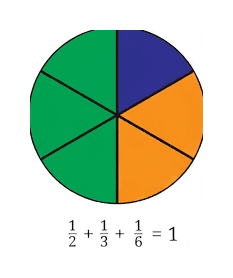
Once you find one solution, try to divide a circle into parts like in the figure above to visualise it!
- A fractional unit (or unit fraction) is a fraction with a numerator of , written as where is a positive integer.
- We want to find four distinct positive integers such that:
- By systematically choosing the smallest denominators and solving for the remaining unit fractions, we find all unique combinations.
Step 1 · Determine the Largest Unit Fraction
Let the four distinct unit fractions be with .
If the smallest denominator is , the maximum possible sum of four distinct unit fractions starting from is:
Since this sum is strictly less than , the largest unit fraction must have , so the first fraction is .
Step 2 · Find Solutions with Second Fraction
Subtracting from :
Choosing gives:
Now, test values of :
-
For :
-
For :
-
For :
-
For :
(Note: gives which is not a unit fraction, and gives , which violates distinctness).
Step 3 · Find Solutions with Second Fraction
Choosing gives:
Now, test values of with :
-
For :
-
For :
(Note: gives which is not a unit fraction, and gives duplicate denominators).
Step 4 · Check and Higher Values
If :
Testing candidates for :
- (yields the duplicate set ).
- (not a unit fraction).
No new solutions exist, confirming there are exactly solutions.
Step 5 · Visualise a Solution Using a Circle
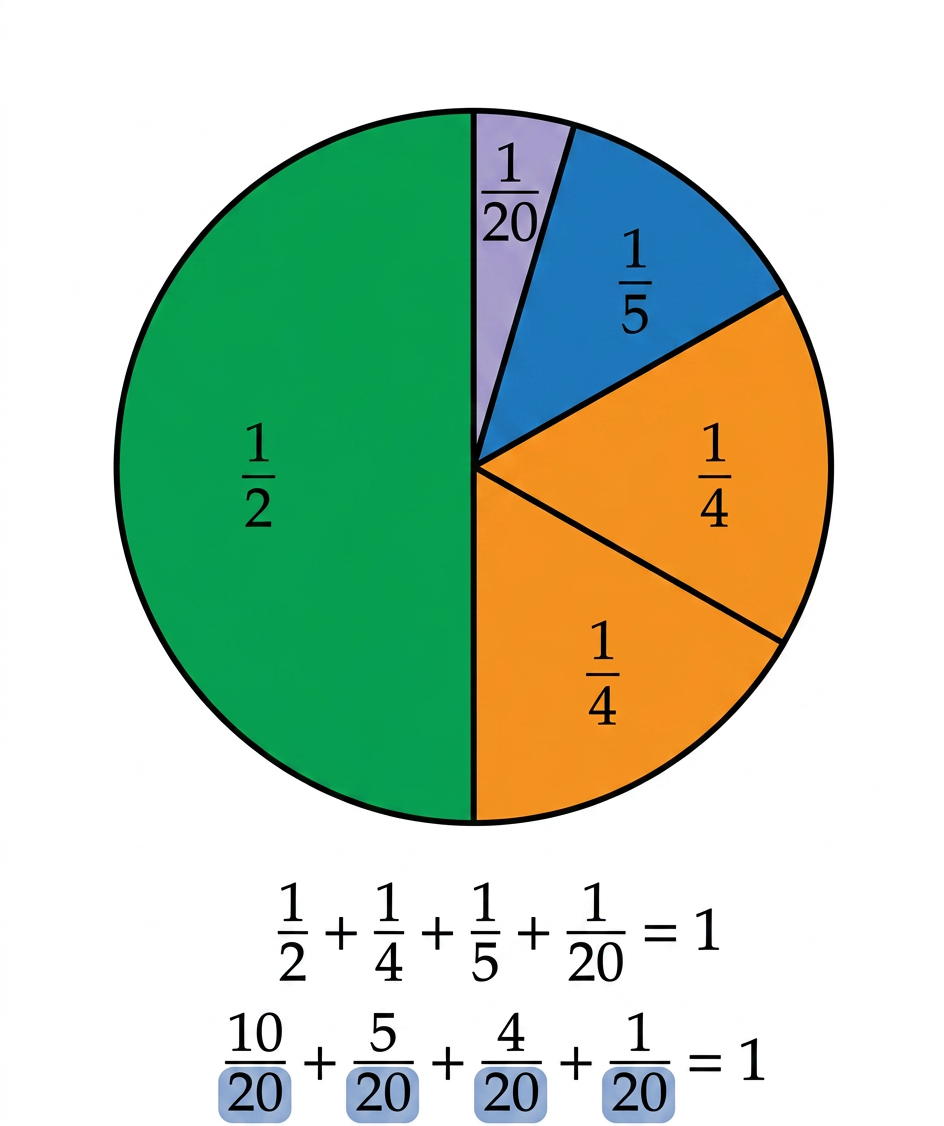
Visualising by dividing a circle into equal sectors:
- ( sectors)
- ( sectors)
- ( sectors)
- ( sector)
Total sectors ( whole circle).
The solutions are:
- Repeated Fractions: Forgetting the condition that all four unit fractions must be distinct (e.g., is invalid because is repeated).
- Non-Unit Fractions: Ending up with a fraction where the numerator is not after simplification (e.g., ) and forgetting to check that the numerator must reduce to .
More questions in A
Find out and discuss the words for fractions that are used in the different languages spoken in your home, city, or state. Ask your grandparents, parents, teachers, and classmates what words they use for different fractions, such as for one and a half, three quarters, one and a quarter, half, quarter, and two and a half, and write them here:
Can you find four different fractional units that add up to 1?
It turns out that this problem has six solutions! Can you find at least one of them? Can you find them all? You can try using similar reasoning as in the cases of two and three fractional units—or find your own method!
Once you find one solution, try to divide a circle into parts like in the figure above to visualise it!