Question 1
Write the names of a few trees you see around you. When you observe a tree on the way from your home to school (or while walking from one place to another place), record the data and fill in the following table:
(a) Which tree was found in the greatest number?
(b) Which tree was found in the smallest number?
(c) Were there any two trees found in the same numbers?
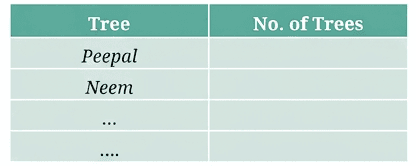
- This is an observational activity where you record the count of various trees seen on the way from home to school.
- Data is organized into a frequency table to easily compare counts.
- Example of recorded data:

(a) Which tree was found in the greatest number?
Step 1 · Identify the Tree with the Greatest Number
From the recorded data, compare the counts:
The highest count is , which corresponds to Mango.
(a) Mango (based on sample data; answers will vary based on your observation)
(b) Which tree was found in the smallest number?
Step 1 · Identify the Tree with the Smallest Number
From the recorded data, compare the counts:
The lowest count is , which corresponds to Banyan.
(b) Banyan (based on sample data; answers will vary based on your observation)
(c) Were there any two trees found in the same numbers?
Step 1 · Identify Trees with Equal Counts
Check for repeating numbers in the counts:
The number appears twice, corresponding to Neem and Gulmohar.
(c) Yes, Neem and Gulmohar were found in equal numbers ( each).
- Activity-Based Variations: Realize that answers depend directly on individual observations; numbers and tree types will differ from student to student.
- Row Mismatch: Be careful when reading tabular data so you do not pair a tree name with an adjacent row's count.
More questions in A
Write the names of a few trees you see around you. When you observe a tree on the way from your home to school (or while walking from one place to another place), record the data and fill in the following table:
(a) Which tree was found in the greatest number?
(b) Which tree was found in the smallest number?
(c) Were there any two trees found in the same numbers?
Take a blank piece of paper and paste any small news item from a newspaper. Each student may use a different article. Now, prepare a table on the piece of paper as given below. Count the number of each of the letters ‘c’, ‘e’, ‘i’, ‘r’, and ‘x’ in the words of the news article, and fill in the table.
a. The letter found the most number of times is _______.
b. The letter found the least number of times is _______.
c. List the five letters ‘c’, ‘e’, ‘i’, ‘r’, ‘x’ in ascending order of frequency. Now, compare the order of your list with that of your classmates. Is your order the same or nearly the same as theirs? (Almost everyone is likely to get the order ‘x, c, r, i, e’.) Why do you think this is the case?
d. Write the process you followed to complete this task.
e. Discuss with your friends the processes they followed.
f. If you do this task with another news item, what process would you follow?