Question 2
Take a blank piece of paper and paste any small news item from a newspaper. Each student may use a different article. Now, prepare a table on the piece of paper as given below. Count the number of each of the letters ‘c’, ‘e’, ‘i’, ‘r’, and ‘x’ in the words of the news article, and fill in the table.
a. The letter found the most number of times is _______.
b. The letter found the least number of times is _______.
c. List the five letters ‘c’, ‘e’, ‘i’, ‘r’, ‘x’ in ascending order of frequency. Now, compare the order of your list with that of your classmates. Is your order the same or nearly the same as theirs? (Almost everyone is likely to get the order ‘x, c, r, i, e’.) Why do you think this is the case?
d. Write the process you followed to complete this task.
e. Discuss with your friends the processes they followed.
f. If you do this task with another news item, what process would you follow?
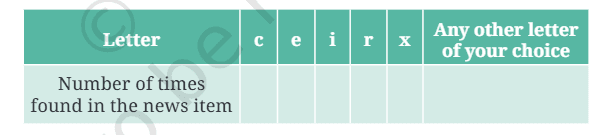
- This is an activity on Data Handling and Presentation where we collect data by counting how frequently specific letters appear in a given text.
- We use a sample news article to record the counts of letters 'c', 'e', 'i', 'r', 'x', and a letter of choice ('s') in a frequency table.
Sample News Item:
"The recent discovery of a new species of insect in the Amazon rainforest has excited many scientists. Researchers believe this tiny creature could provide crucial insights into ecosystem health and biodiversity. Conservation efforts are now being considered to protect its unique habitat. Experts are hopeful that this finding will encourage more research and conservation actions across the globe."

Letter Counts:
- 'c': recent (1), discovery (1), species (1), insect (1), creature (1), could (1), crucial (1), ecosystem (1), Conservation (1), considered (1), encourage (1), research (1), conservation (1), actions (1), across (1)
- 'e': The (1), recent (2), species (2), insect (1), the (1), Amazon (1), rainforest (1), excited (1), many (1), scientists (1), Researchers (2), believe (2), creature (2), provide (1), ecosystem (2), health (1), biodiversity (1), Conservation (1), efforts (2), being (1), considered (2), protect (1), unique (1), Experts (2), hopeful (1), encourage (1), research (1), conservation (1), globe (1)
- 'i': discovery (1), species (1), insect (1), in (1), rainforest (1), scientists (2), believe (1), this (1), tiny (1), insights (2), into (1), biodiversity (2), finding (1), will (1)
- 'r': The (1), recent (1), discovery (1), rainforest (2), Researchers (2), creature (1), provide (1), crucial (1), research (1), conservation (1), across (1)
- 'x': excited (1), Experts (1)
- 's' (chosen letter): species (2), insect (1), Amazon (1), rainforest (1), has (1), excited (1), scientists (2), Researchers (1), this (1), insights (1), ecosystem (1), its (1), Experts (1), this (1), actions (1), across (1)

a. The letter found the most number of times is _______.
Step 1 · Identify the Most Frequent Letter
From the frequency table, the letter with the highest count is 'e' with occurrences.
a. e
b. The letter found the least number of times is _______.
Step 1 · Identify the Least Frequent Letter
From the frequency table, the letter with the lowest count is 'x' with occurrences.
b. x
c. List the five letters ‘c’, ‘e’, ‘i’, ‘r’, ‘x’ in ascending order of frequency. Now, compare the order of your list with that of your classmates. Is your order the same or nearly the same as theirs? (Almost everyone is likely to get the order ‘x, c, r, i, e’.) Why do you think this is the case?
Step 1 · Order Frequencies in Ascending Order
Arranging the letter counts from lowest to highest:
Ascending order of frequency:
- Comparison: The order is almost identical to classmates' lists.
- Reason: In standard English vocabulary, letters like 'e' and 'i' are extremely common vowels used in almost every sentence, whereas 'x' is rarely used. This relative letter frequency holds true across most English texts.
c. x, r, c, i, e (The pattern is consistent because natural letter frequencies in the English language remain broadly similar across different texts.)
d. Write the process you followed to complete this task.
Step 1 · Summarize the Process Followed
The step-by-step process followed:
- Pasted a short news article onto a sheet of paper.
- Drew a frequency table for letters 'c', 'e', 'i', 'r', 'x', and an additional chosen letter ('s').
- Read through the text carefully word-by-word and tallied each occurrence (counting both lowercase and uppercase letters).
- Entered the total counts into the table and used the data to answer the questions.
d. Pasted a news item, prepared a table, systematically counted occurrences of each specified letter, filled in the counts, and analyzed the results.
e. Discuss with your friends the processes they followed.
e. Discussed counting strategies with classmates (such as using tally marks or highlighting letters) and compared final frequency orders to see similarities across different articles.
f. If you do this task with another news item, what process would you follow?
f. Follow the same systematic method: select the new article, set up the frequency table, count each target letter carefully using tally marks, and analyze the resulting frequencies.
- Case Sensitivity Error: Forgetting to count capital letters (e.g. counting 'e' but missing 'E' in Experts).
- Order Confusion: Confusing ascending order (least frequent to most frequent: ) with descending order (most to least).
- Skipping Letters: Skimming too quickly and missing letters inside compound or longer words. Using tally marks helps maintain accuracy.
More questions in A
Write the names of a few trees you see around you. When you observe a tree on the way from your home to school (or while walking from one place to another place), record the data and fill in the following table:
(a) Which tree was found in the greatest number?
(b) Which tree was found in the smallest number?
(c) Were there any two trees found in the same numbers?
Take a blank piece of paper and paste any small news item from a newspaper. Each student may use a different article. Now, prepare a table on the piece of paper as given below. Count the number of each of the letters ‘c’, ‘e’, ‘i’, ‘r’, and ‘x’ in the words of the news article, and fill in the table.
a. The letter found the most number of times is _______.
b. The letter found the least number of times is _______.
c. List the five letters ‘c’, ‘e’, ‘i’, ‘r’, ‘x’ in ascending order of frequency. Now, compare the order of your list with that of your classmates. Is your order the same or nearly the same as theirs? (Almost everyone is likely to get the order ‘x, c, r, i, e’.) Why do you think this is the case?
d. Write the process you followed to complete this task.
e. Discuss with your friends the processes they followed.
f. If you do this task with another news item, what process would you follow?