Pair of Linear Equations in Two Variables | Exercise 3.1

Question 4

  1. Which of the following pairs of linear equations are consistent/inconsistent? If consistent, obtain the solution graphically:

(i) x+y=5x + y = 5, 2x+2y=102x + 2y = 10

(ii) xy=8x - y = 8, 3x3y=163x - 3y = 16

(iii) 2x+y6=02x + y - 6 = 0, 4x2y4=04x - 2y - 4 = 0

(iv) 2x2y2=02x - 2y - 2 = 0, 4x4y5=04x - 4y - 5 = 0

Check your answer with HomiSolve it yourself, then let Homi check your steps and spot mistakes.
Solution

We classify linear equation pairs as consistent or inconsistent. If consistent, we find the solution by graphing.

Step 1 — Check consistency for (i) Let's write the equations in standard form. The first equation is x+y5=0x + y - 5 = 0. The second equation is 2x+2y10=02x + 2y - 10 = 0. We compare coefficients a1,b1,c1a_1, b_1, c_1 with a2,b2,c2a_2, b_2, c_2. For the first equation, a1=1a_1 = \mathbf{1}, b1=1b_1 = \mathbf{1}, c1=5c_1 = \mathbf{-5}. For the second equation, a2=2a_2 = \mathbf{2}, b2=2b_2 = \mathbf{2}, c2=10c_2 = \mathbf{-10}. Let's find the ratios of the coefficients.

a1a2=12\frac{a_1}{a_2} = \frac{1}{2}

b1b2=12\frac{b_1}{b_2} = \frac{1}{2}

c1c2=510\frac{c_1}{c_2} = \frac{-5}{-10}

=12= \frac{1}{2} We see that all ratios are equal. a1a2=b1b2=c1c2\frac{a_1}{a_2} = \frac{b_1}{b_2} = \frac{c_1}{c_2}

Consistent (infinitely many solutions)\boxed{\text{Consistent (infinitely many solutions)}}

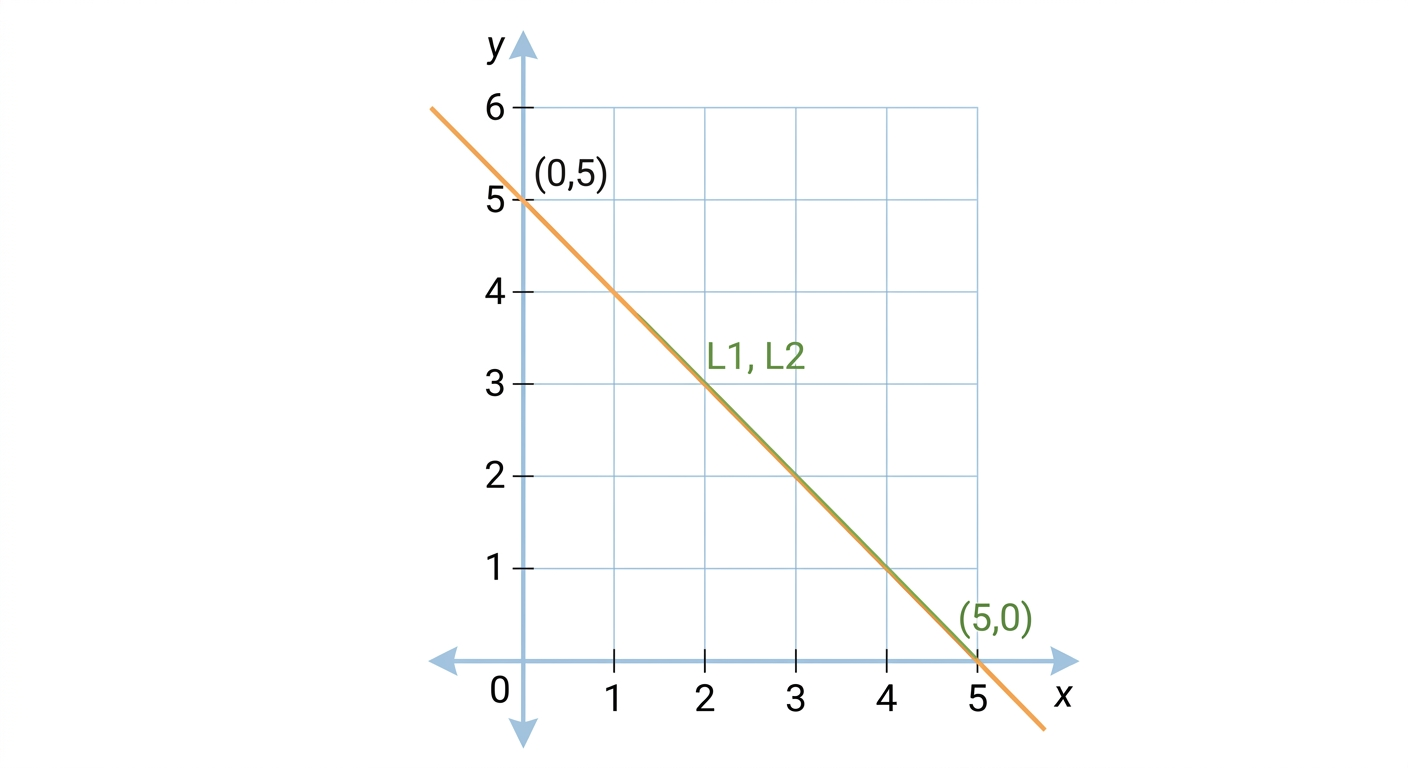
Step 2 — Graph for (i) The equations represent coincident lines. We can use the first equation x+y=5x + y = 5. Let's find two points for this line. If x=0x = \mathbf{0}, then y=5y = \mathbf{5}. So, point A is (0, 5). If y=0y = \mathbf{0}, then x=5x = \mathbf{5}. So, point B is (5, 0). Let's plot these points and draw the line. The second equation 2x+2y=102x + 2y = 10 is the same line. Divide by 2\mathbf{2} to get x+y=5x + y = 5. All points on this line are solutions.

Diagram 1

Step 3 — Check consistency for (ii) Let's write the equations in standard form. The first equation is xy8=0x - y - 8 = 0. The second equation is 3x3y16=03x - 3y - 16 = 0. For the first equation, a1=1a_1 = \mathbf{1}, b1=1b_1 = \mathbf{-1}, c1=8c_1 = \mathbf{-8}. For the second equation, a2=3a_2 = \mathbf{3}, b2=3b_2 = \mathbf{-3}, c2=16c_2 = \mathbf{-16}. Let's find the ratios of the coefficients.

a1a2=13\frac{a_1}{a_2} = \frac{1}{3}

b1b2=13\frac{b_1}{b_2} = \frac{-1}{-3}

=13= \frac{1}{3}

c1c2=816\frac{c_1}{c_2} = \frac{-8}{-16}

=12= \frac{1}{2} We see that the first two ratios are equal, but not the third. a1a2=b1b2c1c2\frac{a_1}{a_2} = \frac{b_1}{b_2} \neq \frac{c_1}{c_2}

Inconsistent (no solution)\boxed{\text{Inconsistent (no solution)}}

Step 4 — Check consistency for (iii) Let's use the given equations. The first equation is 2x+y6=02x + y - 6 = 0. The second equation is 4x2y4=04x - 2y - 4 = 0. For the first equation, a1=2a_1 = \mathbf{2}, b1=1b_1 = \mathbf{1}, c1=6c_1 = \mathbf{-6}. For the second equation, a2=4a_2 = \mathbf{4}, b2=2b_2 = \mathbf{-2}, c2=4c_2 = \mathbf{-4}. Let's find the ratios of the coefficients.

a1a2=24\frac{a_1}{a_2} = \frac{2}{4}

=12= \frac{1}{2}

b1b2=12\frac{b_1}{b_2} = \frac{1}{-2}

=12= -\frac{1}{2} We see that the first two ratios are not equal. a1a2b1b2\frac{a_1}{a_2} \neq \frac{b_1}{b_2}

Consistent (unique solution)\boxed{\text{Consistent (unique solution)}}

Step 5 — Graph for (iii) We need to find points for each line. For the first equation 2x+y6=0    y=62x2x + y - 6 = 0 \implies y = 6 - 2x. If x=0x = \mathbf{0}, y=6y = \mathbf{6}. Point A: (0, 6). If x=3x = \mathbf{3}, y=0y = \mathbf{0}. Point B: (3, 0).

For the second equation 4x2y4=0    y=2x24x - 2y - 4 = 0 \implies y = 2x - 2. If x=0x = \mathbf{0}, y=2y = \mathbf{-2}. Point C: (0, -2). If x=1x = \mathbf{1}, y=0y = \mathbf{0}. Point D: (1, 0). Let's plot these points and draw the lines. The lines intersect at point (2, 2). This is our unique solution.

Step 6 — Check consistency for (iv) Let's use the given equations. The first equation is 2x2y2=02x - 2y - 2 = 0. The second equation is 4x4y5=04x - 4y - 5 = 0. For the first equation, a1=2a_1 = \mathbf{2}, b1=2b_1 = \mathbf{-2}, c1=2c_1 = \mathbf{-2}. For the second equation, a2=4a_2 = \mathbf{4}, b2=4b_2 = \mathbf{-4}, c2=5c_2 = \mathbf{-5}. Let's find the ratios of the coefficients.

a1a2=24\frac{a_1}{a_2} = \frac{2}{4}

=12= \frac{1}{2}

b1b2=24\frac{b_1}{b_2} = \frac{-2}{-4}

=12= \frac{1}{2}

c1c2=25\frac{c_1}{c_2} = \frac{-2}{-5}

=25= \frac{2}{5} We see that the first two ratios are equal, but not the third. a1a2=b1b2c1c2\frac{a_1}{a_2} = \frac{b_1}{b_2} \neq \frac{c_1}{c_2}

Inconsistent (no solution)\boxed{\text{Inconsistent (no solution)}}

Answer

(i) Consistent, infinitely many solutions. Graphically, the lines are coincident. (ii) Inconsistent, no solution. (iii) Consistent, unique solution. Graphically, the solution is (2, 2). (iv) Inconsistent, no solution.

More questions in Exercise 3.1

Q1

Form the pair of linear equations in the following problems, and find their solutions graphically.

(i) 10 students of Class X took part in a Mathematics quiz. If the number of girls is 4 more than the number of boys, find the number of boys and girls who took part in the quiz.

(ii) 5 pencils and 7 pens together cost ₹ 50, whereas 7 pencils and 5 pens together cost ₹ 46. Find the cost of one pencil and that of one pen.

Q2
  1. On comparing the ratios a1a2\frac{a_1}{a_2}, b1b2\frac{b_1}{b_2} and c1c2\frac{c_1}{c_2}, find out whether the lines representing the following pairs of linear equations intersect at a point, are parallel or coincident:

(i) 5x4y+8=05x - 4y + 8 = 0 7x+6y9=07x + 6y - 9 = 0

(ii) 9x+3y+12=09x + 3y + 12 = 0 18x+6y+24=018x + 6y + 24 = 0

(iii) 6x3y+10=06x - 3y + 10 = 0 2xy+9=02x - y + 9 = 0

Q3
  1. On comparing the ratios a1a2\frac{a_1}{a_2}, b1b2\frac{b_1}{b_2} and c1c2\frac{c_1}{c_2}, find out whether the following pair of linear equations are consistent, or inconsistent.

(i) 3x+2y=53x + 2y = 5; 2x3y=72x - 3y = 7

(ii) 2x3y=82x - 3y = 8; 4x6y=94x - 6y = 9

(iii) 32x+53y=7\frac{3}{2}x + \frac{5}{3}y = 7; 9x10y=149x - 10y = 14

(iv) 5x3y=115x - 3y = 11; 10x+6y=22-10x + 6y = -22

(v) 43x+2y=8\frac{4}{3}x + 2y = 8; 2x+3y=122x + 3y = 12

Q4
  1. Which of the following pairs of linear equations are consistent/inconsistent? If consistent, obtain the solution graphically:

(i) x+y=5x + y = 5, 2x+2y=102x + 2y = 10

(ii) xy=8x - y = 8, 3x3y=163x - 3y = 16

(iii) 2x+y6=02x + y - 6 = 0, 4x2y4=04x - 2y - 4 = 0

(iv) 2x2y2=02x - 2y - 2 = 0, 4x4y5=04x - 4y - 5 = 0

Q5
  1. Half the perimeter of a rectangular garden, whose length is 4 m4\text{ m} more than its width, is 36 m36\text{ m}. Find the dimensions of the garden.
Q6
  1. Given the linear equation 2x+3y8=02x + 3y - 8 = 0, write another linear equation in two variables such that the geometrical representation of the pair so formed is:

(i) intersecting lines

(ii) parallel lines

(iii) coincident lines

Q7
  1. Draw the graphs of the equations xy+1=0x - y + 1 = 0 and 3x+2y12=03x + 2y - 12 = 0. Determine the coordinates of the vertices of the triangle formed by these lines and the xx-axis, and shade the triangular region.
← Back to Pair of Linear Equations in Two Variables