Introduction to Trigonometry | Exercise 8.2

Question 4

State whether the following are true or false. Justify your answer.

(i) sin(A+B)=sinA+sinB\sin (A + B) = \sin A + \sin B.

(ii) The value of sinθ\sin \theta increases as θ\theta increases.

(iii) The value of cosθ\cos \theta increases as θ\theta increases.

(iv) sinθ=cosθ\sin \theta = \cos \theta for all values of θ\theta.

(v) cotA\cot A is not defined for A=0A = 0^\circ.

Check your answer with HomiSolve it yourself, then let Homi check your steps and spot mistakes.
Solution

We will check each statement using trigonometric definitions and specific angle values.

Step 1 — Check statement (i)

Let's look at the first statement. It says sin(A+B)=sinA+sinB\sin (A + B) = \sin A + \sin B. We need to see if this is always true. Counterexample method: To prove a statement is false, we only need one specific case where it fails.

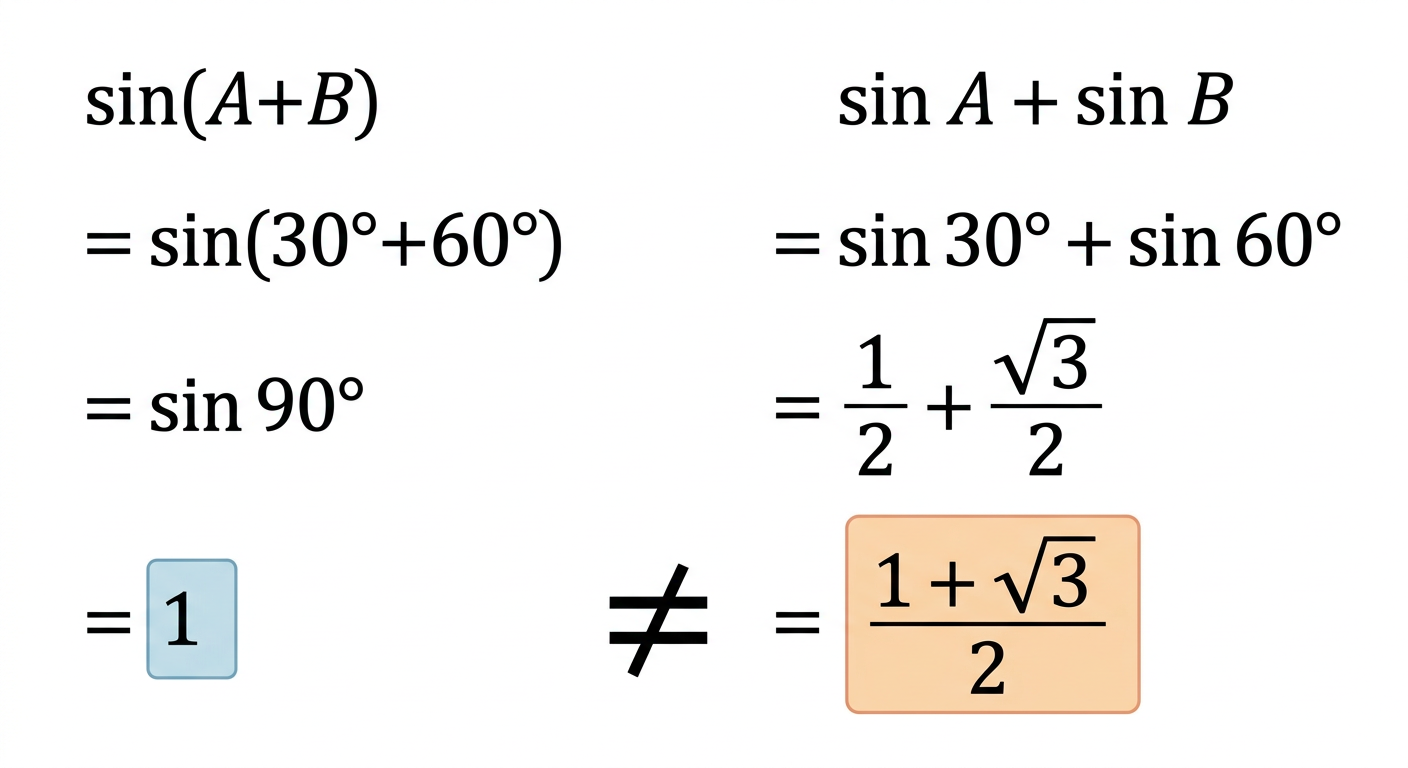
Let's pick some angles for A\mathbf{A} and B\mathbf{B}. Let A=30\mathbf{A = 30^\circ} and B=60\mathbf{B = 60^\circ}. First, we find sin(A+B)\sin (A + B).

sin(A+B)=sin(30+60)\sin (A + B) = \sin (30^\circ + 60^\circ)

=sin90= \sin 90^\circ

1\boxed{1}

Next, we find sinA+sinB\sin A + \sin B.

sinA+sinB=sin30+sin60\sin A + \sin B = \sin 30^\circ + \sin 60^\circ

=12+32= \frac{1}{2} + \frac{\sqrt{3}}{2}

=1+32= \frac{1 + \sqrt{3}}{2}

1+32\boxed{\frac{1 + \sqrt{3}}{2}}

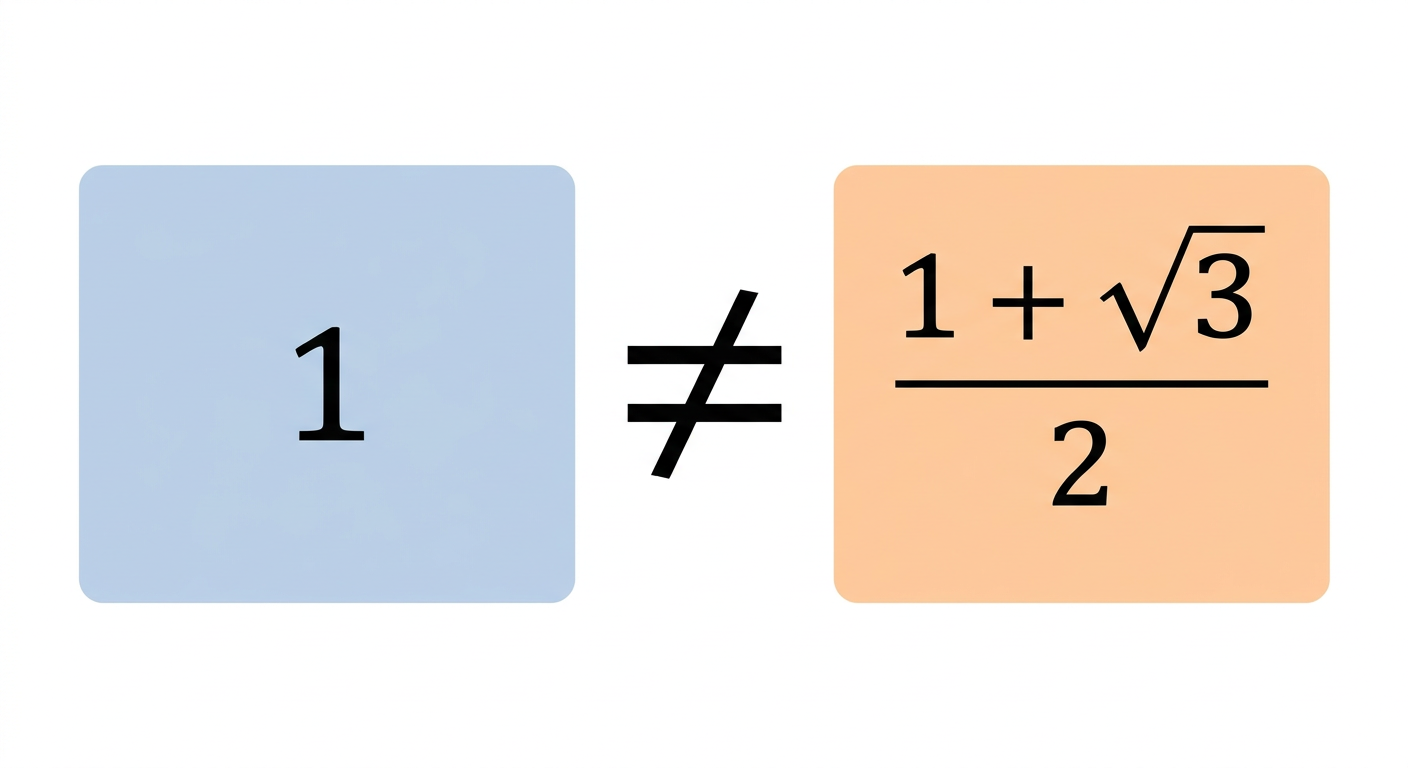
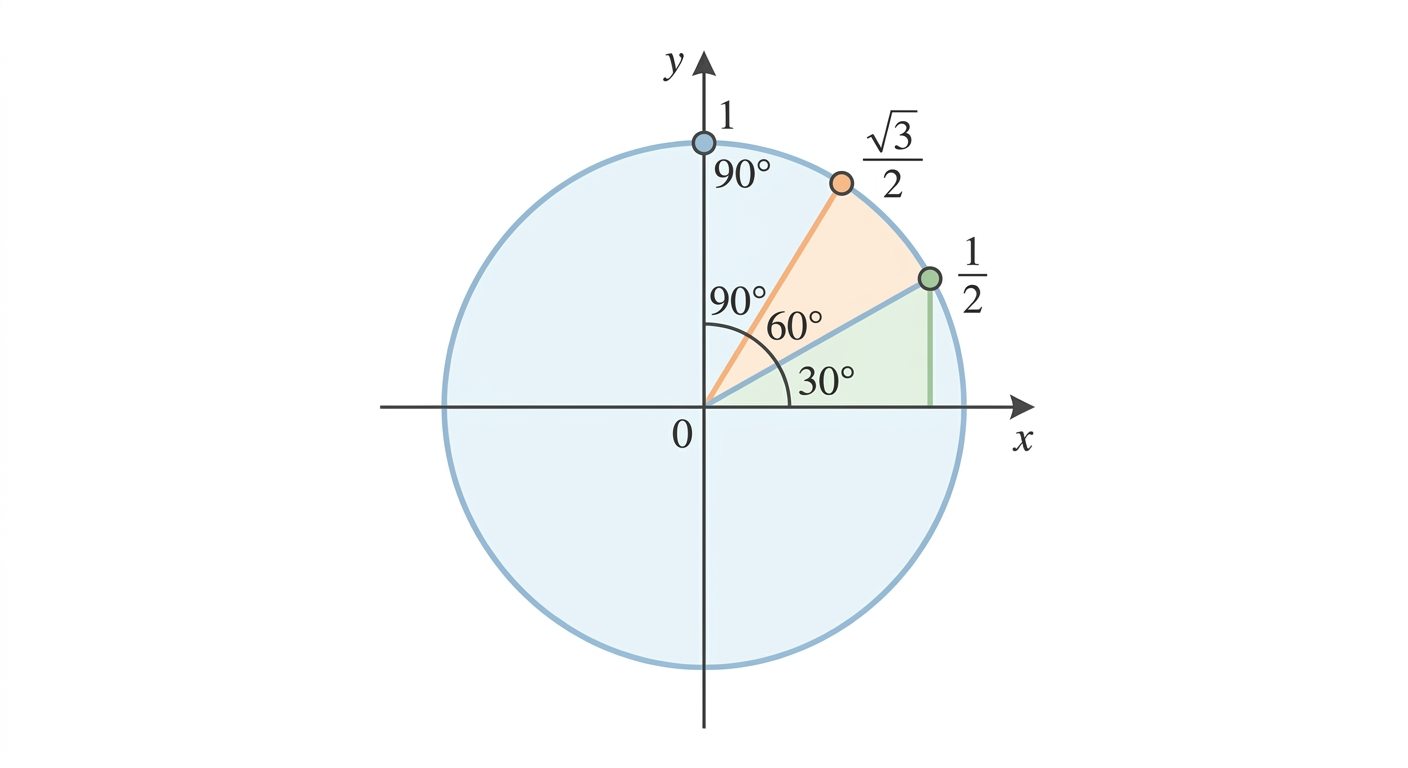
We see that 1\mathbf{1} is not equal to 1+32\mathbf{\frac{1 + \sqrt{3}}{2}}. So, the statement is false.

Diagram 1

Step 2 — Check statement (ii)

Now, let's check the second statement. It says the value of sinθ\sin \theta increases as θ\theta increases. Why sin increases: As angle θ grows from 0° to 90°, the opposite side gets longer relative to the hypotenuse in a right triangle — so sin θ = Opp/Hyp increases from 0 to 1.

We usually consider angles from 0\mathbf{0^\circ} to 90\mathbf{90^\circ} in Class 9. Let's look at some values of sinθ\sin \theta. For θ=0\theta = \mathbf{0^\circ}:

sin0\sin 0^\circ

0\boxed{0}

For θ=30\theta = \mathbf{30^\circ}:

sin30\sin 30^\circ

12\boxed{\frac{1}{2}}

For θ=45\theta = \mathbf{45^\circ}:

sin45\sin 45^\circ

12\boxed{\frac{1}{\sqrt{2}}}

For θ=60\theta = \mathbf{60^\circ}:

sin60\sin 60^\circ

32\boxed{\frac{\sqrt{3}}{2}}

For θ=90\theta = \mathbf{90^\circ}:

sin90\sin 90^\circ

1\boxed{1}

We can see that 0<12<12<32<1\mathbf{0 < \frac{1}{2} < \frac{1}{\sqrt{2}} < \frac{\sqrt{3}}{2} < 1}. The values are increasing. So, for angles from 0\mathbf{0^\circ} to 90\mathbf{90^\circ}, the statement is true.

Step 3 — Check statement (iii)

Let's check the third statement. It says the value of cosθ\cos \theta increases as θ\theta increases. Why cos decreases: As θ increases, the adjacent side gets shorter relative to the hypotenuse — so cos θ = Adj/Hyp decreases from 1 to 0.

Again, we consider angles from 0\mathbf{0^\circ} to 90\mathbf{90^\circ}. Let's look at some values of cosθ\cos \theta. For θ=0\theta = \mathbf{0^\circ}:

cos0\cos 0^\circ

1\boxed{1}

For θ=30\theta = \mathbf{30^\circ}:

cos30\cos 30^\circ

32\boxed{\frac{\sqrt{3}}{2}}

For θ=45\theta = \mathbf{45^\circ}:

cos45\cos 45^\circ

12\boxed{\frac{1}{\sqrt{2}}}

For θ=60\theta = \mathbf{60^\circ}:

cos60\cos 60^\circ

12\boxed{\frac{1}{2}}

For θ=90\theta = \mathbf{90^\circ}:

cos90\cos 90^\circ

0\boxed{0}

We can see that 1>32>12>12>0\mathbf{1 > \frac{\sqrt{3}}{2} > \frac{1}{\sqrt{2}} > \frac{1}{2} > 0}. The values are decreasing. So, for angles from 0\mathbf{0^\circ} to 90\mathbf{90^\circ}, the statement is false.

Diagram 3

Step 4 — Check statement (iv)

Now, let's check the fourth statement. It says sinθ=cosθ\sin \theta = \cos \theta for all values of θ\theta. We need to find if this is always true. Let's pick an angle, for example, θ=30\mathbf{\theta = 30^\circ}. First, we find sin30\sin 30^\circ.

sin30\sin 30^\circ

12\boxed{\frac{1}{2}}

Next, we find cos30\cos 30^\circ.

cos30\cos 30^\circ

32\boxed{\frac{\sqrt{3}}{2}}

We see that 12\mathbf{\frac{1}{2}} is not equal to 32\mathbf{\frac{\sqrt{3}}{2}}. They are only equal for θ=45\mathbf{\theta = 45^\circ}. So, the statement is false.

Step 5 — Check statement (v)

Finally, let's check the fifth statement. It says cotA\cot A is not defined for A=0A = 0^\circ. Undefined ratios: Any trig ratio with 0 in the denominator is undefined. cotA=cosAsinA\cot A = \frac{\cos A}{\sin A}, so it is undefined whenever sinA=0\sin A = 0, which happens at A=0°A = 0°.

We know that cotA\cot A is defined as cosAsinA\frac{\cos A}{\sin A}. Let's substitute A=0\mathbf{A = 0^\circ} into this definition.

cot0=cos0sin0\cot 0^\circ = \frac{\cos 0^\circ}{\sin 0^\circ}

=10= \frac{1}{0}

Undefined\boxed{\text{Undefined}}

Division by zero is not allowed. So, cotA\cot A is indeed not defined for A=0\mathbf{A = 0^\circ}. The statement is true.

Diagram 5

Answer

(i) False (ii) True (iii) False (iv) False (v) True

More questions in Exercise 8.2

Q1

Evaluate the following :

(i) sin60cos30+sin30cos60\sin 60^\circ \cos 30^\circ + \sin 30^\circ \cos 60^\circ

(ii) 2tan245+cos230sin2602 \tan^2 45^\circ + \cos^2 30^\circ - \sin^2 60^\circ

(iii) cos45sec30+cosec 30\frac{\cos 45^\circ}{\sec 30^\circ + \text{cosec } 30^\circ}

(iv) sin30+tan45cosec 60sec30+cos60+cot45\frac{\sin 30^\circ + \tan 45^\circ - \text{cosec } 60^\circ}{\sec 30^\circ + \cos 60^\circ + \cot 45^\circ}

(v) 5cos260+4sec230tan245sin230+cos230\frac{5 \cos^2 60^\circ + 4 \sec^2 30^\circ - \tan^2 45^\circ}{\sin^2 30^\circ + \cos^2 30^\circ}

Q2

Choose the correct option and justify your choice :

(i) 2tan301+tan230=\frac{2 \tan 30^\circ}{1 + \tan^2 30^\circ} = (A) sin60\sin 60^\circ (B) cos60\cos 60^\circ (C) tan60\tan 60^\circ (D) sin30\sin 30^\circ

(ii) 1tan2451+tan245=\frac{1 - \tan^2 45^\circ}{1 + \tan^2 45^\circ} = (A) tan90\tan 90^\circ (B) 11 (C) sin45\sin 45^\circ (D) 00

(iii) sin2A=2sinA\sin 2A = 2 \sin A is true when A=A = (A) 00^\circ (B) 3030^\circ (C) 4545^\circ (D) 6060^\circ

(iv) 2tan301tan230=\frac{2 \tan 30^\circ}{1 - \tan^2 30^\circ} = (A) cos60\cos 60^\circ (B) sin60\sin 60^\circ (C) tan60\tan 60^\circ (D) sin30\sin 30^\circ

Q3

If tan(A+B)=3\tan (A + B) = \sqrt{3} and tan(AB)=13\tan (A - B) = \frac{1}{\sqrt{3}}; 0<A+B900^\circ < A + B \le 90^\circ; A>BA > B, find AA and BB.

Q4

State whether the following are true or false. Justify your answer.

(i) sin(A+B)=sinA+sinB\sin (A + B) = \sin A + \sin B.

(ii) The value of sinθ\sin \theta increases as θ\theta increases.

(iii) The value of cosθ\cos \theta increases as θ\theta increases.

(iv) sinθ=cosθ\sin \theta = \cos \theta for all values of θ\theta.

(v) cotA\cot A is not defined for A=0A = 0^\circ.

← Back to Introduction to Trigonometry