Question 2
Choose the correct option and justify your choice :
(i) (A) (B) (C) (D)
(ii) (A) (B) (C) (D)
(iii) is true when (A) (B) (C) (D)
(iv) (A) (B) (C) (D)
- To solve these multiple-choice problems, we evaluate each expression by substituting standard trigonometric values (such as and ) or by using standard double-angle formulas:
- For equations involving an unknown angle , we test each given option by substituting it into both the and .
(i) (A) (B) (C) (D)
Step 1 · Evaluate the Expression
Using the double-angle identity with
(i) (A)
(ii) (A) (B) (C) (D)
Step 1 · Evaluate the Expression
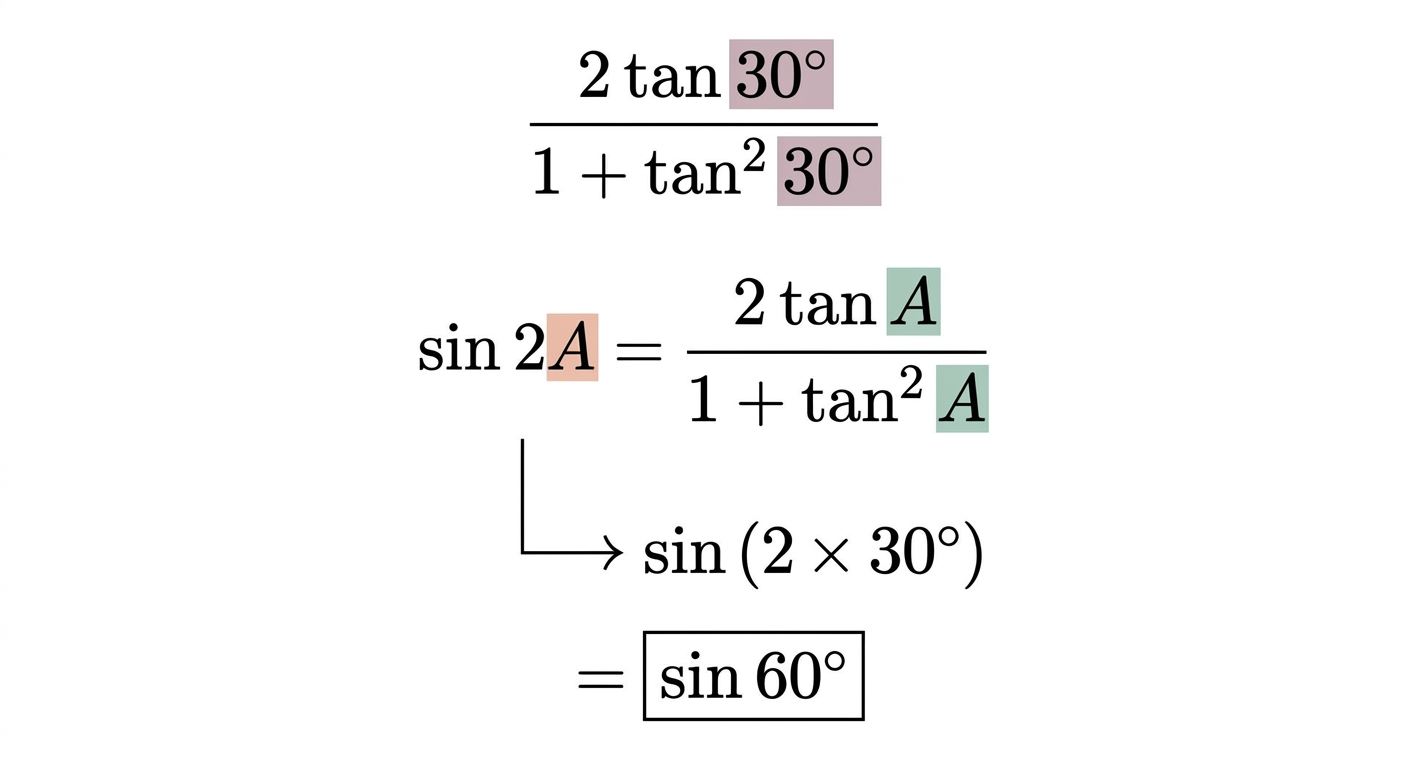
Using the identity with
(ii) (D)
(iii) is true when (A) (B) (C) (D)
Step 1 · Verify Option (A)
Substitute into and
Since , the equality holds true when .
(iii) (A)
(iv) (A) (B) (C) (D)
Step 1 · Evaluate the Expression
Using the double-angle identity with
(iv) (C)
- Denominator Sign Confusion: In part (i) the denominator has a plus sign (), giving , whereas in part (iv) the denominator has a minus sign (), giving .
- Linear Angle Fallacy: Assuming is an identity that holds for all angles . In reality, it only holds for specific values such as .
More questions in Exercise 8.2
Evaluate the following :
(i)
(ii)
(iii)
(iv)
(v)
Choose the correct option and justify your choice :
(i) (A) (B) (C) (D)
(ii) (A) (B) (C) (D)
(iii) is true when (A) (B) (C) (D)
(iv) (A) (B) (C) (D)
If and ; ; , find and .
State whether the following are true or false. Justify your answer.
(i) .
(ii) The value of increases as increases.
(iii) The value of increases as increases.
(iv) for all values of .
(v) is not defined for .