Introduction to Trigonometry | Exercise 8.2

Question 3

If tan(A+B)=3\tan (A + B) = \sqrt{3} and tan(AB)=13\tan (A - B) = \frac{1}{\sqrt{3}}; 0<A+B900^\circ < A + B \le 90^\circ; A>BA > B, find AA and BB.

Check your answer with HomiSolve it yourself, then let Homi check your steps and spot mistakes.
Solution

We will use the given tangent values to find the angles A+BA+B and ABA-B. Then we will solve the resulting system of linear equations.

Step 1 — Find the angles

Key principle: If tanθ1=tanθ2\tan\theta_1 = \tan\theta_2 and both angles are acute (between 0° and 90°), then θ1=θ2\theta_1 = \theta_2. So matching the expression to a known tan value directly gives the angle.

We are given the value of tan(A+B)\tan(A+B). We know that tan60\tan 60^\circ is equal to 3\sqrt{3}. So, we can write the first equation.

tan(A+B)=3\tan (A + B) = \sqrt{3}

tan(A+B)=tan60\tan (A + B) = \tan 60^\circ

A+B=60\boxed{A + B = 60^\circ}

Next, we use the second given value. We know that tan30\tan 30^\circ is equal to 13\frac{1}{\sqrt{3}}. So, we can write the second equation.
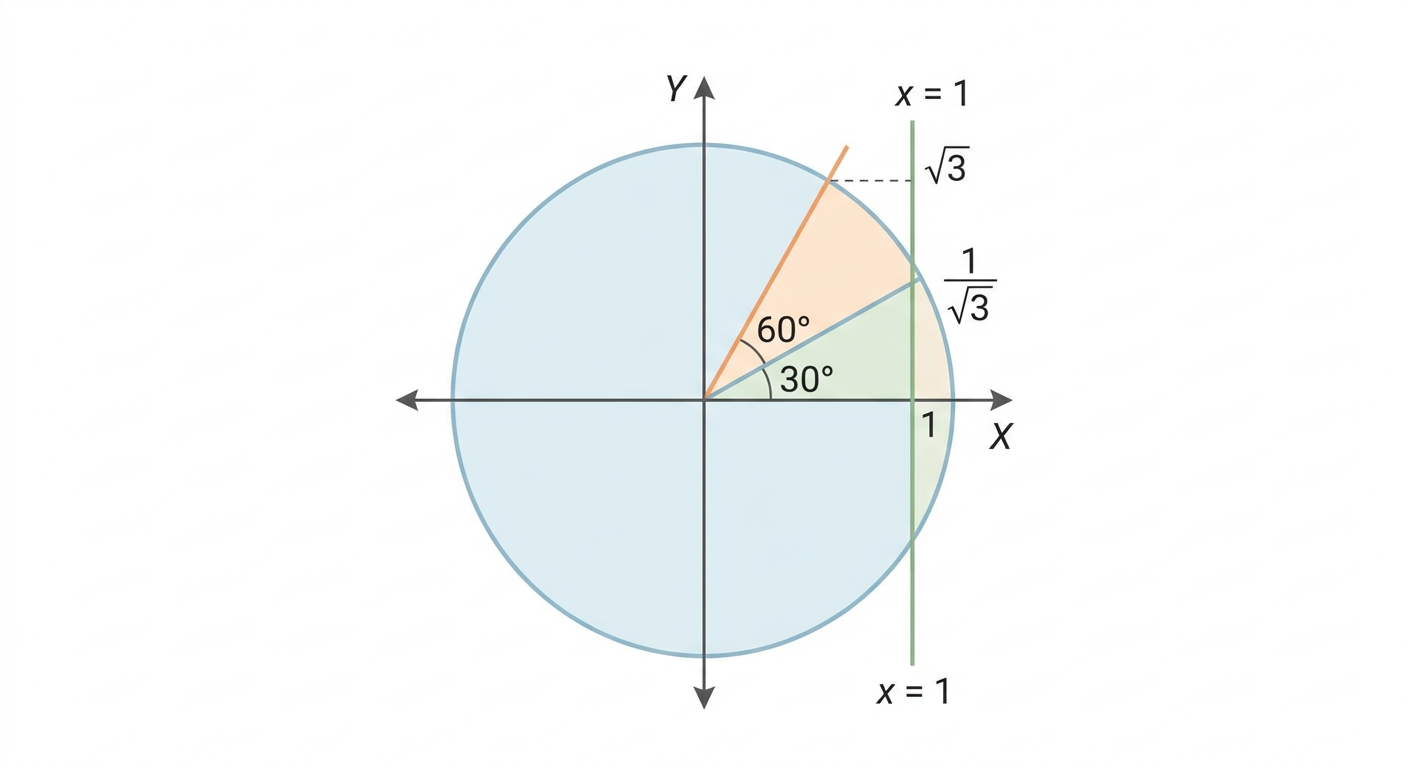
tan(AB)=13\tan (A - B) = \frac{1}{\sqrt{3}}

tan(AB)=tan30\tan (A - B) = \tan 30^\circ

AB=30\boxed{A - B = 30^\circ}

Diagram 1

Step 2 — Solve for A and B

System of Linear Equations: Two equations with the same two unknowns (A and B). We use the elimination method — adding both equations cancels B and gives A directly, then we substitute back to find B.

Now we have a system of two linear equations. Let's call A+B=60A + B = 60^\circ as Equation (1). Let's call AB=30A - B = 30^\circ as Equation (2). We can add Equation (1) and Equation (2) together.

(A+B)+(AB)=60+30(A + B) + (A - B) = 60^\circ + 30^\circ

2A=902A = 90^\circ

A=902A = \frac{90^\circ}{2}

A=45\boxed{A = 45^\circ}

Now, let's substitute the value of A into Equation (1). Equation (1) is A+B=60A + B = 60^\circ.

45+B=6045^\circ + B = 60^\circ

B=6045B = 60^\circ - 45^\circ

B=15\boxed{B = 15^\circ}

Answer

(i) A=45A = 45^\circ (ii) B=15B = 15^\circ

More questions in Exercise 8.2

Q1

Evaluate the following :

(i) sin60cos30+sin30cos60\sin 60^\circ \cos 30^\circ + \sin 30^\circ \cos 60^\circ

(ii) 2tan245+cos230sin2602 \tan^2 45^\circ + \cos^2 30^\circ - \sin^2 60^\circ

(iii) cos45sec30+cosec 30\frac{\cos 45^\circ}{\sec 30^\circ + \text{cosec } 30^\circ}

(iv) sin30+tan45cosec 60sec30+cos60+cot45\frac{\sin 30^\circ + \tan 45^\circ - \text{cosec } 60^\circ}{\sec 30^\circ + \cos 60^\circ + \cot 45^\circ}

(v) 5cos260+4sec230tan245sin230+cos230\frac{5 \cos^2 60^\circ + 4 \sec^2 30^\circ - \tan^2 45^\circ}{\sin^2 30^\circ + \cos^2 30^\circ}

Q2

Choose the correct option and justify your choice :

(i) 2tan301+tan230=\frac{2 \tan 30^\circ}{1 + \tan^2 30^\circ} = (A) sin60\sin 60^\circ (B) cos60\cos 60^\circ (C) tan60\tan 60^\circ (D) sin30\sin 30^\circ

(ii) 1tan2451+tan245=\frac{1 - \tan^2 45^\circ}{1 + \tan^2 45^\circ} = (A) tan90\tan 90^\circ (B) 11 (C) sin45\sin 45^\circ (D) 00

(iii) sin2A=2sinA\sin 2A = 2 \sin A is true when A=A = (A) 00^\circ (B) 3030^\circ (C) 4545^\circ (D) 6060^\circ

(iv) 2tan301tan230=\frac{2 \tan 30^\circ}{1 - \tan^2 30^\circ} = (A) cos60\cos 60^\circ (B) sin60\sin 60^\circ (C) tan60\tan 60^\circ (D) sin30\sin 30^\circ

Q3

If tan(A+B)=3\tan (A + B) = \sqrt{3} and tan(AB)=13\tan (A - B) = \frac{1}{\sqrt{3}}; 0<A+B900^\circ < A + B \le 90^\circ; A>BA > B, find AA and BB.

Q4

State whether the following are true or false. Justify your answer.

(i) sin(A+B)=sinA+sinB\sin (A + B) = \sin A + \sin B.

(ii) The value of sinθ\sin \theta increases as θ\theta increases.

(iii) The value of cosθ\cos \theta increases as θ\theta increases.

(iv) sinθ=cosθ\sin \theta = \cos \theta for all values of θ\theta.

(v) cotA\cot A is not defined for A=0A = 0^\circ.

← Back to Introduction to Trigonometry