Question 16
Find the lengths of the hypotenuses of all the right triangles in Fig. 3.14 which is referred to as the square root spiral.
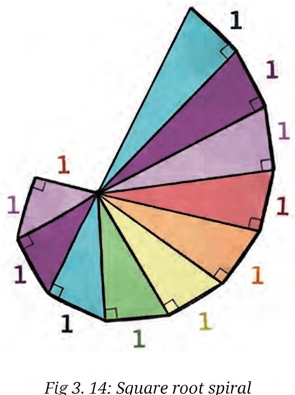
- The square root spiral (or Spiral of Theodorus) is constructed using consecutive right-angled triangles.
- The first triangle starts with two perpendicular legs of unit length .
- Each successive right triangle uses the hypotenuse of the previous triangle as its base and a perpendicular side of unit length .
- By applying the Pythagoras theorem successively, the lengths of the hypotenuses form the sequence .
Step 1 · Find the Hypotenuse of the First Triangle (OP₂)
In the first right-angled triangle :
Applying the Pythagoras theorem:
Step 2 · Find the Hypotenuse of the Second Triangle (OP₃)
In the second right-angled triangle :
Applying the Pythagoras theorem:
Step 3 · Find the Hypotenuse of the Third Triangle (OP₄)
In the third right-angled triangle :
Applying the Pythagoras theorem:
Step 4 · Generalise the Lengths for the Entire Spiral
Continuing this process for each subsequent right triangle , where the base is and the perpendicular is :
Thus, the lengths of the hypotenuses of successive right triangles are:
- Squaring Radicals Incorrectly: Forgetting that , which leads to incorrect algebraic sums under the square root.
- Varying Perpendicular Length: Assuming the perpendicular leg changes length; in a square root spiral, every perpendicular leg is always fixed at .
More questions in EOT
Convert the following rational numbers in the form of a terminating decimal or non-terminating and repeating decimal, whichever the case may be, by the process of long division:
(i)
(ii)
Prove that is an irrational number.
Convert the following decimal numbers in the form of .
(i)
(ii)
(iii)
(iv)
(v)
(vi)
(vii)
(viii)
(ix)
Locate the following rational numbers on the number line.
(i)
(ii)
Find 6 rational numbers between and .
Find 5 rational numbers between and .
Find 5 rational numbers between and .
If , find the rational number .
Let and be two non-zero rational numbers such that . Without assigning any numerical values, determine whether is positive or negative. Justify your answer.
A rational number has a terminating decimal expansion whose last non-zero digit occurs in the 4th decimal place. Show that such a number can be written in the form , where is an integer not divisible by 10. Is it necessary that the denominator of this rational number, when written in the lowest form, is divisible by or ? Give reasons.
Without performing division, determine whether the decimal expansion of is terminating or non-terminating. If it terminates, state the number of decimal places.
A rational number in its lowest form has denominator . How many decimal places will its decimal expansion have? Explain your answer.
Let and . Express both and in the form and where , and are integers and . Using the same denominator , write exactly five distinct rational numbers lying between and keeping an integer numerator. Explain why the condition is necessary to find such rational numbers between the two rational numbers and using this method.
Three rational numbers satisfy and . Show that all the rational numbers must be simultaneously zero.
Show that the rational number lies between the rational numbers and .
Find the lengths of the hypotenuses of all the right triangles in Fig. 3.14 which is referred to as the square root spiral.