Question 1
A merchant in the port city of Lothal is exchanging bags of spices for copper ingots. He receives 15 ingots for every 2 bags of spices. If he brings 12 bags of spices to the market, how many copper ingots will he leave with?
- The exchange rate is given as for every .
- To find the total number of ingots obtained for , determine the number of ingots received per bag (or find how many 2-bag groups are in ) and multiply accordingly.
Step 1 · Calculate Ingots per Bag
Given exchange rate:
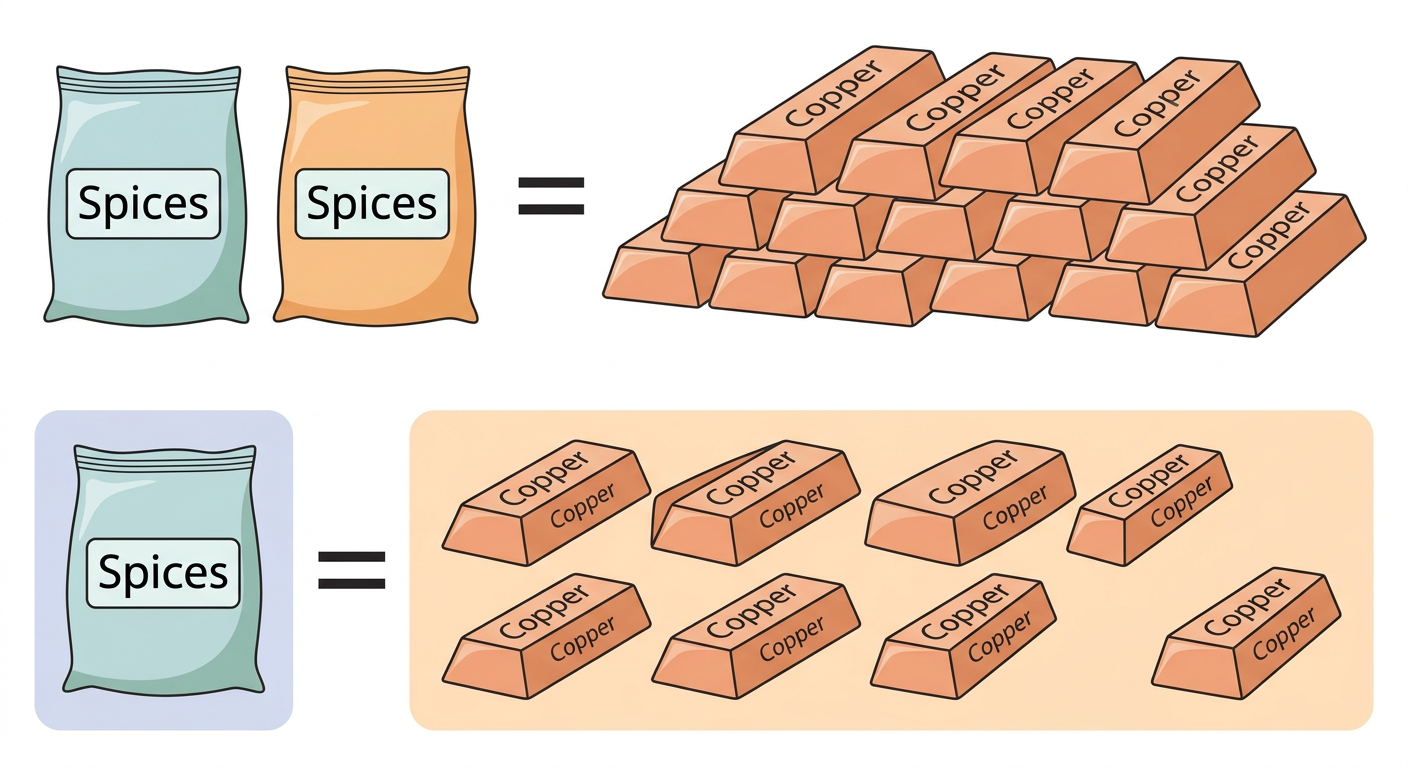
Step 2 · Calculate Total Ingots for 12 Bags
For of spices:
90 copper ingots
- Inverting the Ratio: Dividing by instead of , which incorrectly calculates bags per ingot instead of ingots per bag.
- Skipping the Group Size: Multiplying directly without dividing by , forgetting that corresponds to , not .
More questions in Exercise 3.1
A merchant in the port city of Lothal is exchanging bags of spices for copper ingots. He receives 15 ingots for every 2 bags of spices. If he brings 12 bags of spices to the market, how many copper ingots will he leave with?
Look at the sequence of numbers on one column of the Ishango bone: . What do these numbers have in common? List the next three numbers that fit this pattern.
We know that Natural Numbers are closed under addition (the sum of any two natural numbers is always a natural number). Are they closed under subtraction? Provide a couple of examples to justify your answer.
Ancient Indians used the joints of their fingers to count, a practice still seen today. Each finger has 3 joints, and the thumb is used to count them. How many can you count on one hand? How does this relate to the ancient base-12 counting systems?