Question 2
Let us say that you have a box containing 3 red pens, 4 black pens and 2 green pens. You pick a pen (without looking) from the box and put it back. Then your friend does the same.
(i) What are the possible outcomes of the pen colours? Can you draw a tree diagram representing the possible outcomes?
(ii) Can you use the tree diagram to guess the probability that both you and your friend pick pens of the same colour?
- A box contains Red (), Black (), and Green () pens.
- A pen is picked, its colour noted, and placed back in the box before the second pen is picked (sampling with replacement).
- Each pick has possible colour outcomes: , , or .
- We can determine all possible pairs of outcomes using a tree diagram and find the probability of both picking the same colour.
(i) What are the possible outcomes of the pen colours? Can you draw a tree diagram representing the possible outcomes?
Step 1 · List All Possible Outcomes
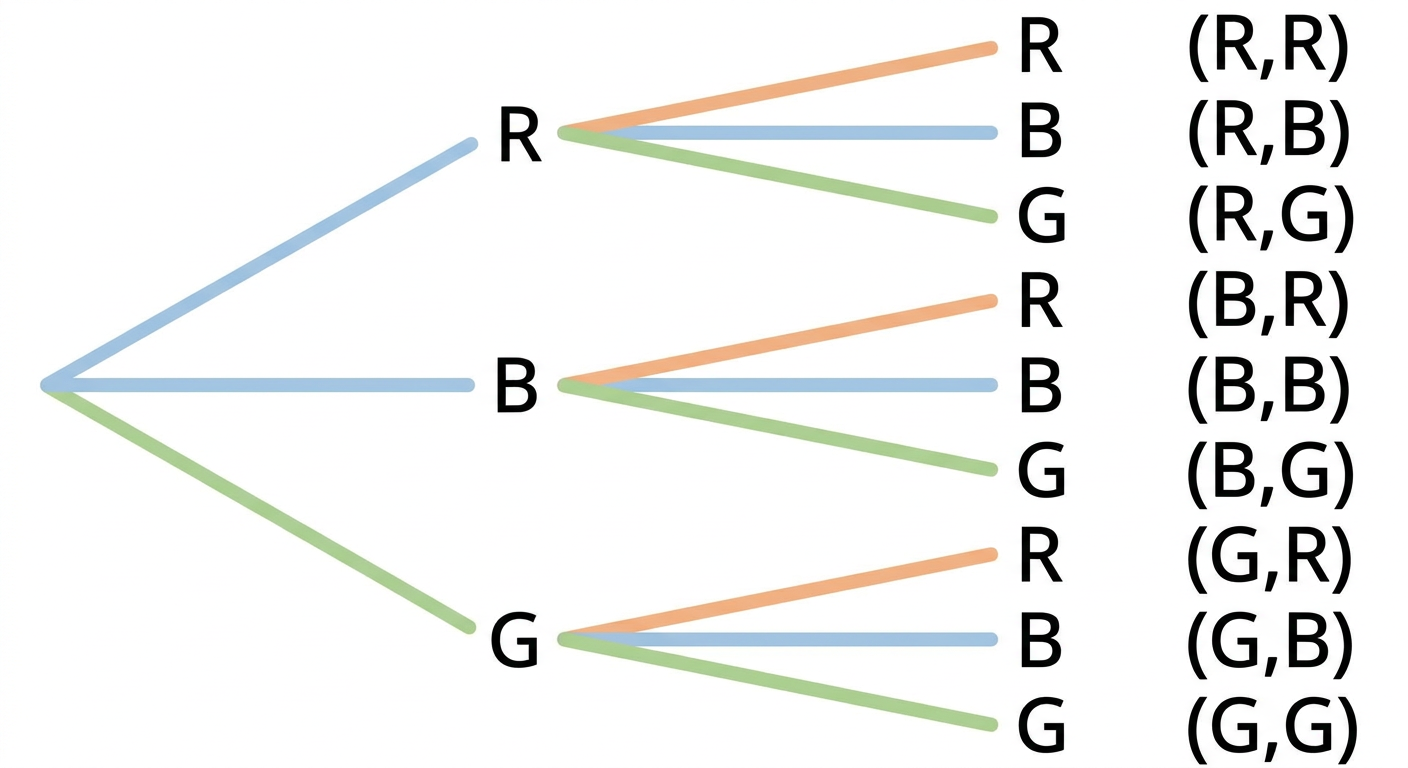
Possible colour outcomes for each pick are , , and .
The sample space of all possible colour pairs is:
Total number of possible outcomes .
(i)
(ii) Can you use the tree diagram to guess the probability that both you and your friend pick pens of the same colour?
Step 1 · Calculate the Probability of the Same Colour
Outcomes where both pens are of the same colour:
(ii)
- Sampling Without Replacement: Assuming the first pen is not returned to the box. The problem specifies the pen is put back before the second draw.
- Counting Favourable Outcomes: Forgetting that "same colour" includes all matching pairs: , , and .
More questions in Exercise 7.4
There are two fruit baskets A and B. Basket A has one apple and two oranges. Basket B has one banana and one mango. You randomly pick one fruit from each basket.
(i) Draw a tree diagram showing all possible pairs of fruits.
(ii) List the sample space.
(iii) What is the probability of picking one apple and one banana?
Let us say that you have a box containing 3 red pens, 4 black pens and 2 green pens. You pick a pen (without looking) from the box and put it back. Then your friend does the same.
(i) What are the possible outcomes of the pen colours? Can you draw a tree diagram representing the possible outcomes?
(ii) Can you use the tree diagram to guess the probability that both you and your friend pick pens of the same colour?