Question 16
Plot the points , , , and in the coordinate plane. Is a square? Can you explain why? What is the area of this square?
- The probability of a dye landing inside the circular region is the ratio of the favorable area (area of the circle) to the total area (area of the rectangular region):
- Total Area: Area of the rectangle .
- Favorable Area: Area of the circle with diameter (radius ) .
Step 1 · Find the Area of the Rectangle
The rectangle has a length of and a width of .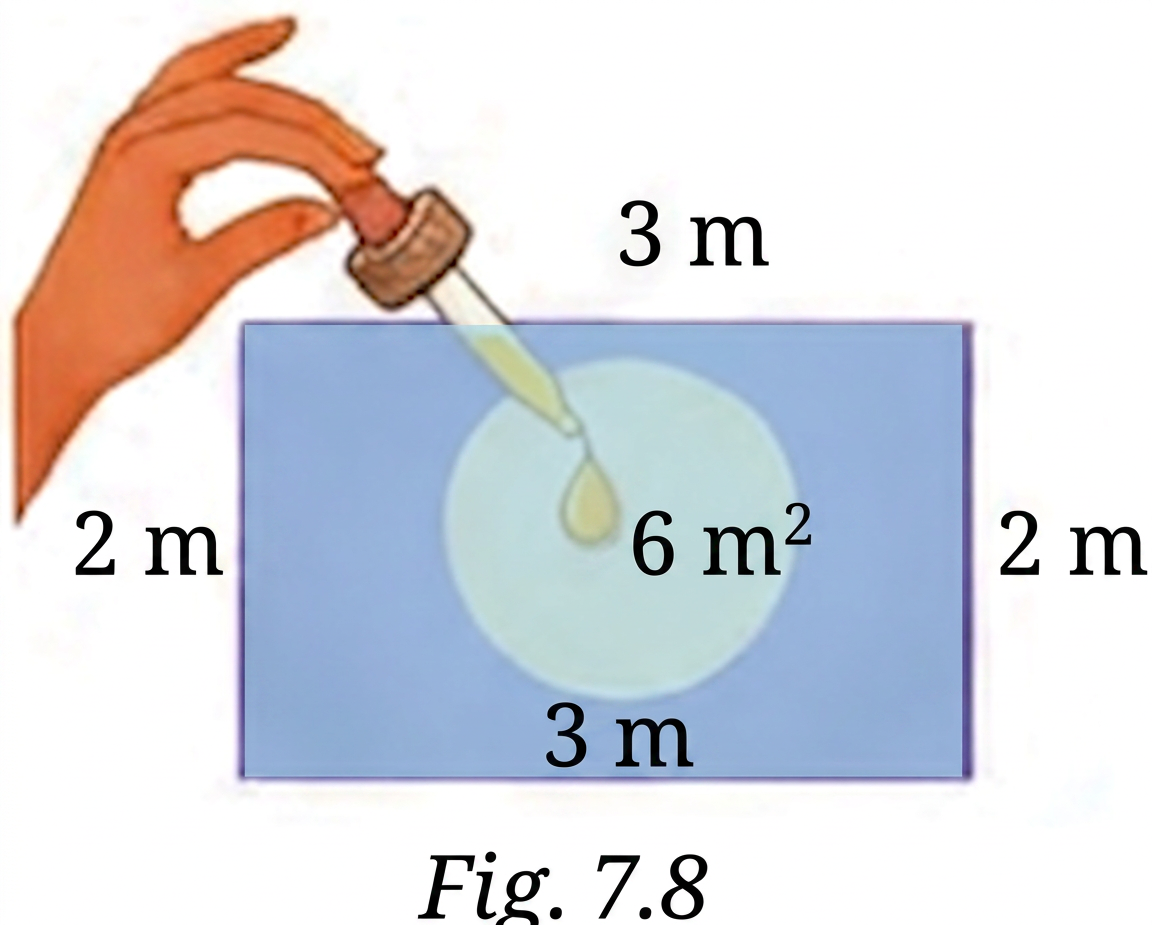
Step 2 · Find the Area of the Circle
The circle has a diameter of , so its radius .
Step 3 · Calculate the Probability
The probability of the dye landing inside the circle is the ratio of the area of the circle to the area of the rectangle:
- Diameter vs. Radius Error: Using the diameter as the radius in the formula instead of halving it to ().
- Fraction Simplification Error: Incorrectly simplifying .
More questions in EOT
What are the -coordinate and -coordinate of the point of intersection of the two axes?
Point has -coordinate equal to . Can you predict the coordinates of point which is on the line through parallel to the -axis? Which quadrants can lie in?
Consider the points , , , and . If they are joined in the same order, predict:
(i) Two sides of that are perpendicular to each other.
(ii) One side of that is parallel to one of the axes.
(iii) Two points that are mirror images of each other in one axis. Which axis will this be?
Now plot the points and verify your predictions.
Plot point on the Cartesian plane. Construct a right-angled triangle and find the lengths of the three sides.
(Comment: Answers may differ from person to person.)
What would a system of coordinates be like if we did not have negative numbers? Would this system allow us to locate all the points on a 2-D plane?
Are the points , and on the same straight line? Suggest a method to check this without plotting and joining the points.
Use your method (from Problem 6) to check if the points , and are on the same straight line. Now plot both sets of points and check your answers.
Using the origin as one vertex, plot the vertices of:
(i) A right-angled isosceles triangle. (ii) An isosceles triangle with one vertex in Quadrant III and the other in Quadrant IV.
The following table shows the coordinates of points , and . In each case, state whether is the midpoint of segment . Justify your answer.
When is the mid-point of , can you find any connection between the coordinates of , and ?
Use the connection you found to find the coordinates of given that is the midpoint of and .
Let be points of trisection of , with closer to , and closer to . Using your knowledge of how to find the coordinates of the midpoint of a segment, how would you find the coordinates of and ? Do this for the case when the points are and .
(i) Given the points , and , show that they lie on a circle whose center is the origin . What is the radius of circle ?
(ii) Given the points and , check whether and lie within the circle, on the circle, or outside the circle .
The midpoints of the sides of triangle are the points , , and . Given that the coordinates of , , and are , , and , respectively, find the coordinates of , , and .
A city has two main roads which cross each other at the centre of the city. These two roads are along the North-South (N-S) direction and East-West (E-W) direction. All the other streets of the city run parallel to these roads and are apart. There are 10 streets in each direction.
(i) Using , draw a model of the city in your notebook. Represent the roads/streets by single lines.
(ii) There are street intersections in the model. Each street intersection is formed by two streets — one running in the N-S direction and another in the E-W direction. Each street intersection is referred to in the following manner: If the second street running in the N-S direction and 5th street in the E-W direction meet at some crossing, then we call this street intersection . Using this convention, find: (a) how many street intersections can be referred to as . (b) how many street intersections can be referred to as .
A computer graphics program displays images on a rectangular screen whose coordinate system has the origin at the bottom-left corner. The screen is 800 pixels wide and 600 pixels high. A circular icon of radius 80 pixels is drawn with its centre at the point . Another circular icon of radius 100 pixels is drawn with its centre at the point . Determine:
(i) whether any part of either circle lies outside the screen.
(ii) whether the two circles intersect each other.
Plot the points , , , and in the coordinate plane. Is a square? Can you explain why? What is the area of this square?