Introduction to Linear Polynomials | Exercise 2.1
Question 1
Find the degrees of the following polynomials:
(i)
(ii)
(iii)
(iv)
Solution
Understand the Question
- The degree of a polynomial is the highest exponent (power) of the variable in the polynomial with a non-zero coefficient.
- For a non-zero constant polynomial (like a standalone number ), it can be written as , so its degree is always .
- For linear terms like , the exponent is understood to be (since ).
(i)
Step 1 · Find the Degree of
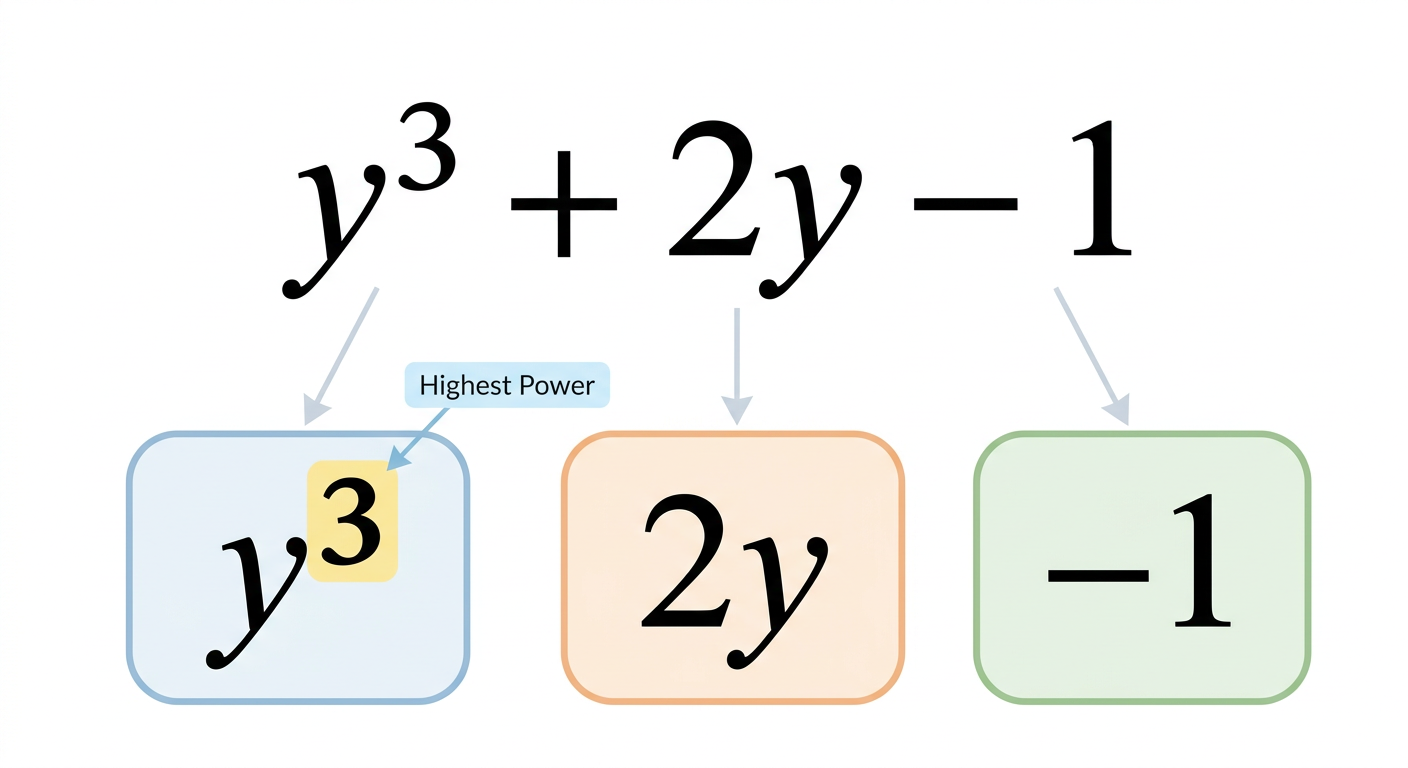
In the polynomial , the powers of the variable in each term are , , and .
Answer
(i)
(ii)
Step 1 · Find the Degree of
In the polynomial , the powers of the variable in each term are , , and .
Answer
(ii)
(iii)
Step 1 · Find the Degree of
The given polynomial is a non-zero constant polynomial.
We can write as .
Answer
(iii)
(iv)
Step 1 · Find the Degree of
In the polynomial , the powers of the variable in each term are and .
Answer
(iv)
Common Mistakes
- Constant Polynomial Error: Assuming a non-zero constant like has no degree or degree . A non-zero constant can be written as , giving it a degree of .
- Missing Implied Exponents: Forgetting that a variable with no written power (e.g., ) has an exponent of , not .
- Confusing Coefficients and Exponents: Looking at the largest coefficient (such as or ) instead of the highest power of the variable.