Question 2
A rally starts with 120 members. Each hour, 9 members drop out of the group. How many members will remain after hours? Find a linear expression to represent the number of members at the end of the hour.
- The rally begins with 120 members, and 9 members leave every hour.
- To find the remaining members at any hour, subtract the total number of members who have left from the initial .
- By calculating the remaining count for and hours, we can establish a pattern and form a general linear expression for hours.
Step 1 · Calculate Members Remaining After 1, 2, and 3 Hours
Initial number of members
Number of members dropping out each hour 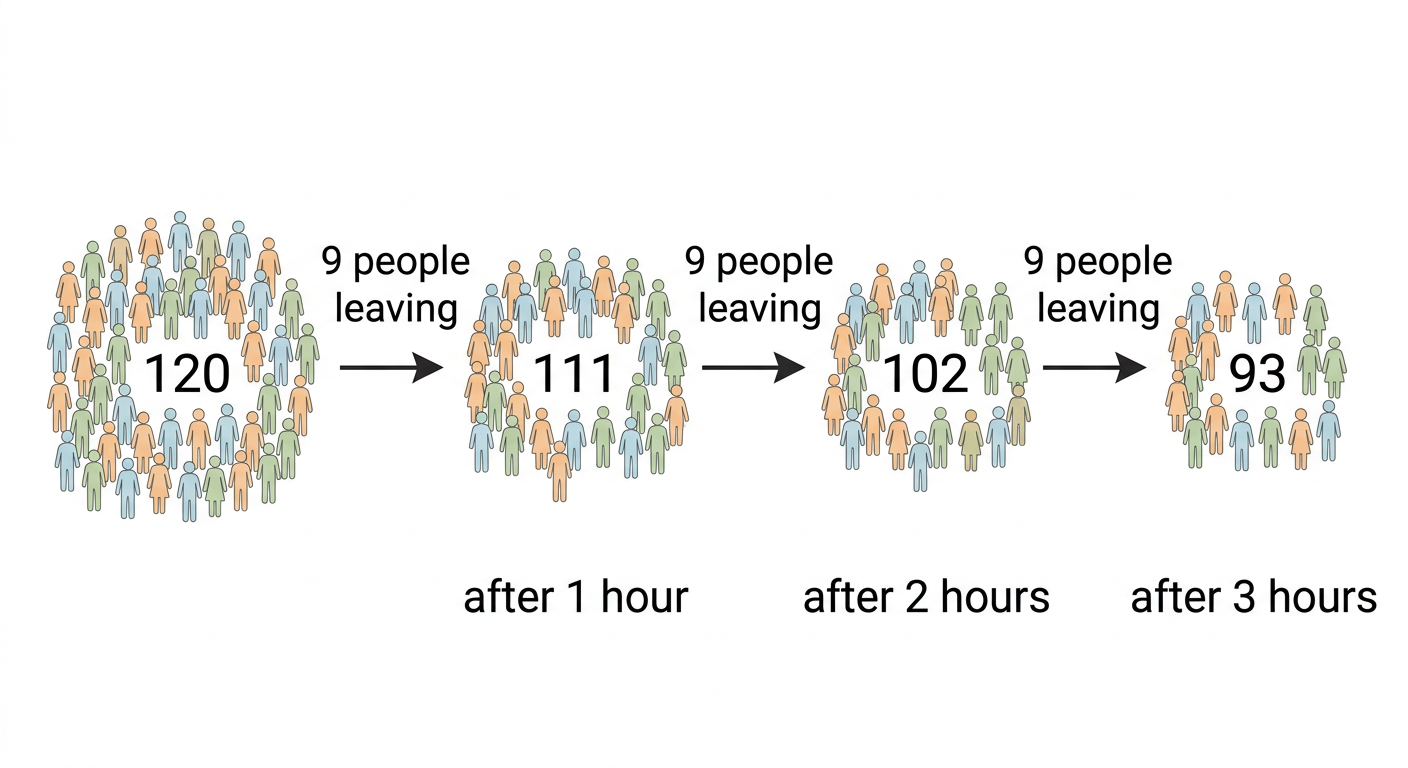
Members remaining after hour:
Members remaining after hours:
Members remaining after hours:
Step 2 · Find Linear Expression for Hours
Observing the pattern:
- After hour:
- After hours:
- After hours:
Let represent the number of members remaining at the end of the hour:
Members remaining after hours are , and the linear expression for the hour is .
- Adding Instead of Subtracting: Writing instead of . Since members are dropping out, the total count decreases each hour.
- Off-by-one Variable Assignment: Using instead of . At the end of the hour, exactly members have left, so the term is simply .
More questions in Exercise 2.3
Solve the following:
- A student has ₹500 in her savings bank account. She gets ₹150 every month as pocket money. How much money will she have at the end of every month from the second month onwards? Find a linear expression to represent the amount she will have in the month.
A rally starts with 120 members. Each hour, 9 members drop out of the group. How many members will remain after hours? Find a linear expression to represent the number of members at the end of the hour.
Suppose the length of a rectangle is . Find the area if the breadth is (i) , (ii) , (iii) . Find the linear pattern representing the area of the rectangle.
Suppose the length of a rectangular box is and breadth is . Find the volume if the height is (i) , (ii) , (iii) . Find the linear pattern representing the volume of the rectangular box.
Sarita is reading a book of 500 pages. She reads 20 pages every day. How many pages will be left after 15 days? Express this as a linear pattern.