Rational Numbers | A

Question 2

Context: Look at the following numbers: 3,6,10,15,13, 6, 10, 15, 1. They are arranged such that each pair of adjacent numbers adds up to a square: 3+6=93 + 6 = 9, 6+10=166 + 10 = 16, 10+15=2510 + 15 = 25, 15+1=1615 + 1 = 16.

Q. Can you do the same with numbers from 11 to 3232 (again, without repetition), but this time arranging all the numbers in a circle?
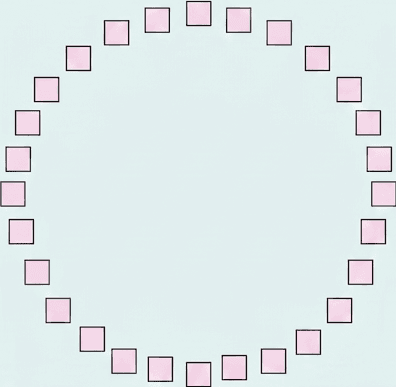
Question diagram 1
Check your answer with HomiSolve it yourself, then let Homi check your steps and spot mistakes.
Solution
Understand the Question
  • We need to arrange all numbers from 11 to 3232 (each used exactly once) in a circle.
  • Every pair of adjacent numbers in the circle must add up to a perfect square.
  • Since the arrangement is circular, the first and last numbers in the sequence must also add up to a perfect square.

Step 1 · Identify Possible Perfect Square Sums

The minimum sum of two distinct numbers is 1+2=31 + 2 = 3. The maximum sum of two distinct numbers is 31+32=6331 + 32 = 63.

The perfect squares between 33 and 6363 are:

22=432=942=1652=2562=3672=49\begin{aligned} 2^2 &= 4 \\ 3^2 &= 9 \\ 4^2 &= 16 \\ 5^2 &= 25 \\ 6^2 &= 36 \\ 7^2 &= 49 \end{aligned}

Thus, each adjacent pair must sum to one of: 4,9,16,25,36, or 494, 9, 16, 25, 36, \text{ or } 49.

Step 2 · Construct the Circular Arrangement

By analyzing the possible square-sum connections for each number from 11 to 3232, we can form a continuous loop.Question diagram

A valid circular sequence of the 3232 numbers is:

1828214321719306313122425115311872920169272214223261015(1)1 - 8 - 28 - 21 - 4 - 32 - 17 - 19 - 30 - 6 - 3 - 13 - 12 - 24 - 25 - 11 - 5 - 31 - 18 - 7 - 29 - 20 - 16 - 9 - 27 - 22 - 14 - 2 - 23 - 26 - 10 - 15 - (1)

Verifying adjacent pair sums:

1+8=9=32,8+28=36=62,28+21=49=72,21+4=25=524+32=36=62,32+17=49=72,17+19=36=62,19+30=49=7230+6=36=62,6+3=9=32,3+13=16=42,13+12=25=5212+24=36=62,24+25=49=72,25+11=36=62,11+5=16=425+31=36=62,31+18=49=72,18+7=25=52,7+29=36=6229+20=49=72,20+16=36=62,16+9=25=52,9+27=36=6227+22=49=72,22+14=36=62,14+2=16=42,2+23=25=5223+26=49=72,26+10=36=62,10+15=25=52,15+1=16=42\begin{aligned} 1 + 8 &= 9 = 3^2, & 8 + 28 &= 36 = 6^2, & 28 + 21 &= 49 = 7^2, & 21 + 4 &= 25 = 5^2 \\ 4 + 32 &= 36 = 6^2, & 32 + 17 &= 49 = 7^2, & 17 + 19 &= 36 = 6^2, & 19 + 30 &= 49 = 7^2 \\ 30 + 6 &= 36 = 6^2, & 6 + 3 &= 9 = 3^2, & 3 + 13 &= 16 = 4^2, & 13 + 12 &= 25 = 5^2 \\ 12 + 24 &= 36 = 6^2, & 24 + 25 &= 49 = 7^2, & 25 + 11 &= 36 = 6^2, & 11 + 5 &= 16 = 4^2 \\ 5 + 31 &= 36 = 6^2, & 31 + 18 &= 49 = 7^2, & 18 + 7 &= 25 = 5^2, & 7 + 29 &= 36 = 6^2 \\ 29 + 20 &= 49 = 7^2, & 20 + 16 &= 36 = 6^2, & 16 + 9 &= 25 = 5^2, & 9 + 27 &= 36 = 6^2 \\ 27 + 22 &= 49 = 7^2, & 22 + 14 &= 36 = 6^2, & 14 + 2 &= 16 = 4^2, & 2 + 23 &= 25 = 5^2 \\ 23 + 26 &= 49 = 7^2, & 26 + 10 &= 36 = 6^2, & 10 + 15 &= 25 = 5^2, & 15 + 1 &= 16 = 4^2 \end{aligned}
Answer

Yes, they can be arranged in a circle as:

1,8,28,21,4,32,17,19,30,6,3,13,12,24,25,11,5,31,18,7,29,20,16,9,27,22,14,2,23,26,10,151, 8, 28, 21, 4, 32, 17, 19, 30, 6, 3, 13, 12, 24, 25, 11, 5, 31, 18, 7, 29, 20, 16, 9, 27, 22, 14, 2, 23, 26, 10, 15

Common Mistakes
  • Forgetting the Circular Condition: Ensure the last number (1515) and the first number (11) also add up to a square (15+1=1615 + 1 = 16).
  • Duplicate or Missing Numbers: Each integer from 11 to 3232 must appear exactly once.
  • Ignoring Constrained Numbers: Numbers with only two valid square partners (such as 16,18,25,26,27,28,29,30,31,3216, 18, 25, 26, 27, 28, 29, 30, 31, 32) must be placed adjacent to their exact paired neighbors.

More questions in A

Q1

Context: Look at the following numbers: 3 6 10 15 1. They are arranged such that each pair of adjacent numbers adds up to a square: 3+6=93 + 6 = 9, 6+10=166 + 10 = 16, 10+15=2510 + 15 = 25, 15+1=1615 + 1 = 16.

Q. Try arranging the numbers 1 to 17 (without repetition) in a row in a similar way — the sum of every adjacent pair of numbers should be a square. Can you arrange them in more than one way? If not, can you explain why?

Q2

Context: Look at the following numbers: 3,6,10,15,13, 6, 10, 15, 1. They are arranged such that each pair of adjacent numbers adds up to a square: 3+6=93 + 6 = 9, 6+10=166 + 10 = 16, 10+15=2510 + 15 = 25, 15+1=1615 + 1 = 16.

Q. Can you do the same with numbers from 11 to 3232 (again, without repetition), but this time arranging all the numbers in a circle?

← Back to Rational Numbers