Question 1
: How Close Can You Get?
Make a pair. Each of you choose a number. Suppose, the numbers chosen are and . Share your numbers with each other. Both of you should estimate the percentage equivalent to the fraction (where ) and announce your answers by a fixed time, say, 5 seconds. The one whose estimate is the closest wins this round. Play this for 10 rounds.
- To convert any fraction into a percentage, multiply it by :
- For quick mental estimation within seconds, you can either:
- Perform quick mental division and scale by .
- Compare to familiar benchmark fractions like , , , , or , then adjust.
Step 1 · Fraction to Percentage Conversion
To convert a fraction to a percentage, multiply by :
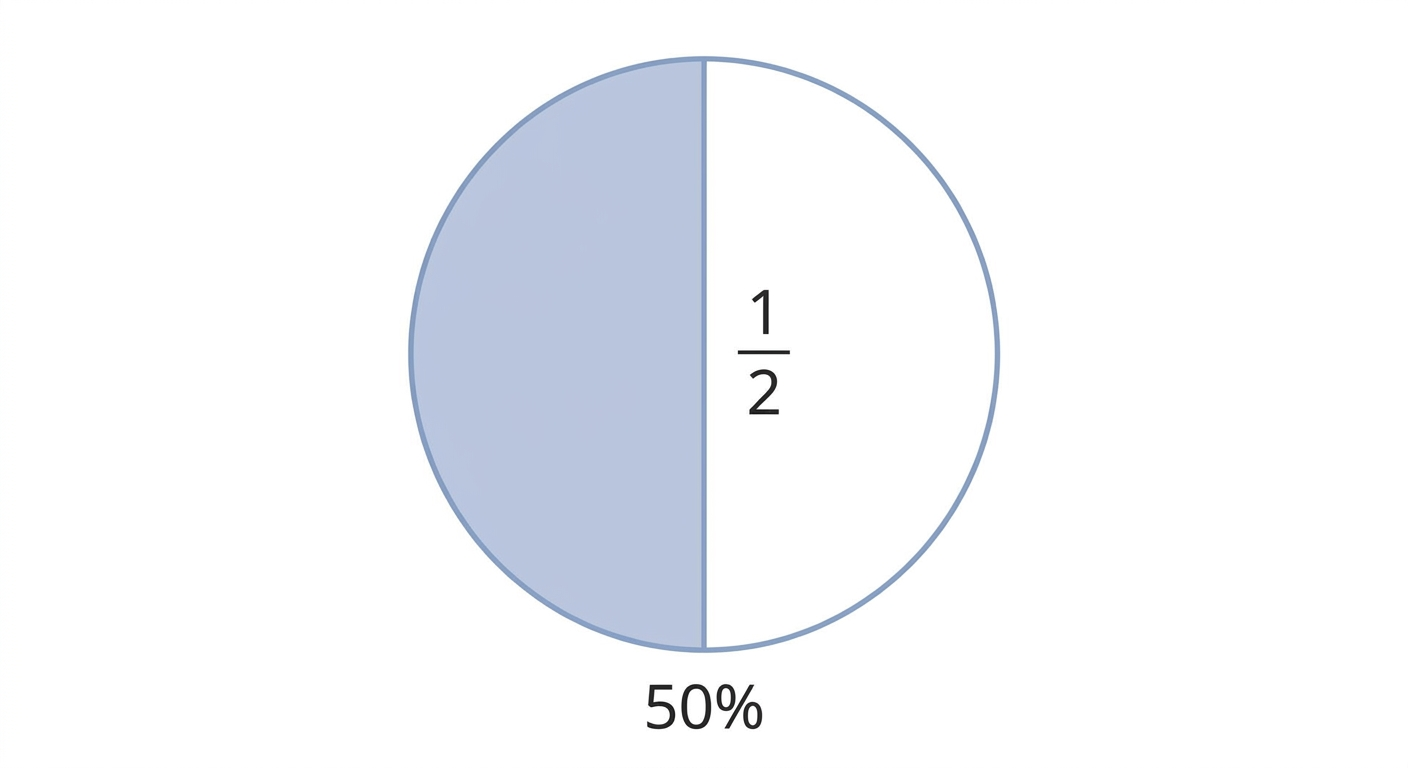
For example, if and :
Step 2 · Estimation via Mental Division
To quickly estimate , perform approximate division and multiply by .
For example, to estimate :
Step 3 · Refining the Estimate with Benchmarks
Compare to a known benchmark such as .
Convert both to a common denominator:
Find the difference:
Estimate as a percentage by rounding the denominator:
Add the adjustment to the benchmark:
Use either fast mental division () or standard benchmarks ( adjusted by ).
- Inverting the Fraction: Estimating instead of .
- Forgetting the Multiplier: Stating the decimal result (e.g. ) without multiplying by to state it as a percentage.
- Distant Benchmarks: Choosing a benchmark fraction that is too far away from the given fraction, leading to a less accurate mental estimate.
More questions in A
: How Close Can You Get?
Make a pair. Each of you choose a number. Suppose, the numbers chosen are and . Share your numbers with each other. Both of you should estimate the percentage equivalent to the fraction (where ) and announce your answers by a fixed time, say, 5 seconds. The one whose estimate is the closest wins this round. Play this for 10 rounds.
Peaceful Knights
Place 8 knights on the chess board so that no knight attacks another. A knight moves in an 'L-shape'. It can move either (a) two steps vertically and one step horizontally, or (b) two steps horizontally and one step vertically. Possible moves of a knight are shown below.