Question 16
Look at the following expressions and the visualisation. Write the corresponding explanation and examples.
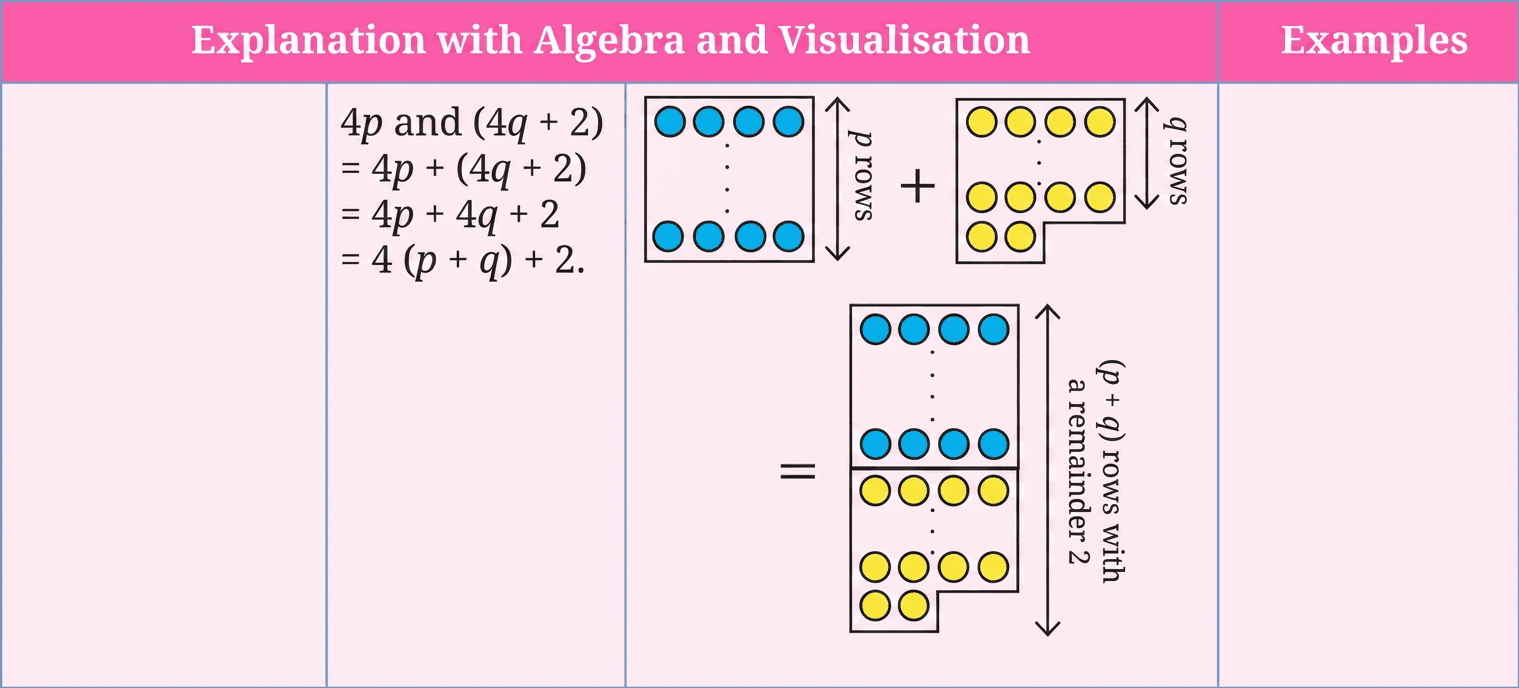
- A number that is a multiple of can be expressed as (where is a whole number).
- A number that leaves a remainder of when divided by can be expressed as (where is a whole number).
- Visually, each group of items forms a complete row of . Combining rows of and rows of gives complete rows of , with extra items left over.
Step 1 · Algebraic Explanation and Visualisation
Let the first number be and the second number be , where and are whole numbers.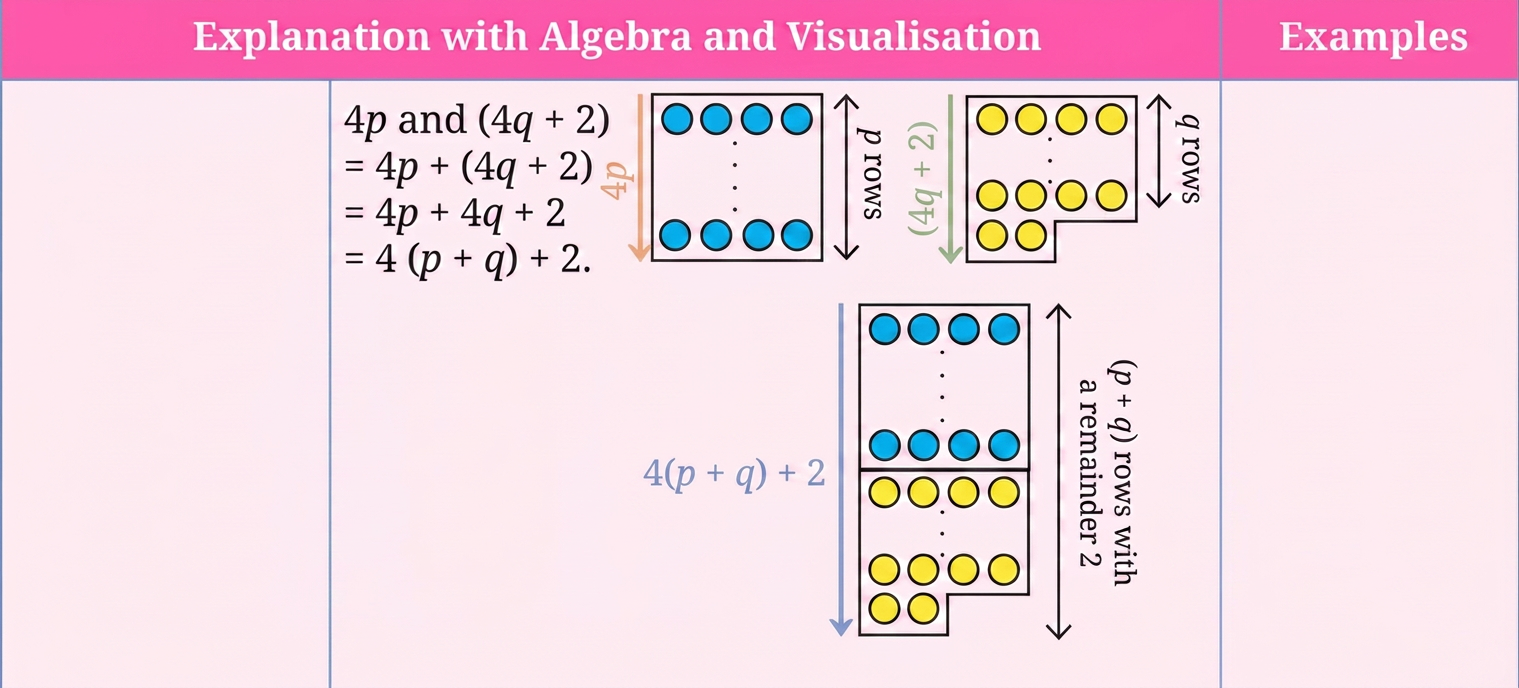
Adding the two expressions and factoring out :
- Visual meaning: The rows of blue circles and rows of yellow circles combine to form full rows of circles. The extra circles remain separate, showing that the total is always a multiple of plus .
Step 2 · Verification with Numerical Examples
Example 1: Let and .
- First number:
- Second number:
- Sum:
Using the combined formula:
Example 2: Let and .
- First number:
- Second number:
- Sum:
Using the combined formula:
In both examples, the sum is , which is (a multiple of plus ).
, which represents a multiple of plus .
- Factoring Error: Incorrectly attempting to factor out of the constant , writing instead of .
- Misinterpreting the Remainder: Assuming that adding a multiple of and an even number always yields a multiple of , overlooking the leftover remainder of .
More questions in IT
Evaluate each expression and write the result next to it. Do you notice anything interesting?
Now, take four other consecutive numbers. Place the '' and '' signs as you have done before. Find out the results of each expression. What do you observe?
Repeat this for one more set of 4 consecutive numbers. Share your findings.
Do these patterns occur no matter which 4 consecutive numbers are chosen? Is there a way to find out through reasoning?
Hint: Use algebra and describe the 8 expressions in a general form.
Now take any 4 numbers, place '+' and '-' signs in the eight different ways, and evaluate the resulting expression. What do you observe about their parities?
Repeat this with other sets of 4 numbers.
Is there a way to explain why this happens?
Hint: Think of the rules for parity of the sum or difference of two numbers.
Context: Now, let us see what happens when a negative sign is switched to a positive sign.
Q. Replace any negative sign in the expression with a positive sign and find the difference between the two numbers.
Context: Replace any negative sign in the expression with a positive sign and find the difference between the two numbers.
Q. What do you conclude from this observation?
Is the phenomenon of all the expressions having the same parity limited to taking 4 numbers? What do you think?
Breaking Even
We know how to identify even numbers. Without computing them, find out which of the following arithmetic expressions are even.
Using our understanding of how parity behaves under different operations, identify which of the following algebraic expressions give an even number for any integer values for the letter-numbers.
Context: The algebraic expressions from the previous page are:
Q. Similarly, determine and explain which of the other expressions always give even numbers. Write a couple of examples and non-examples, as appropriate, for each expression.
Write a few algebraic expressions which always give an even number.
Pairs to Make Fours
Take a pair of even numbers. Add them. Is the sum divisible by 4?
Try this with different pairs of even numbers. When is the sum a multiple of 4, and when is it not? Is there a general rule or a pattern?
When will two even numbers add up to give a multiple of 4?
This problem is similar to the question of identifying when adding two numbers will result in an even number. Can you see this?
There are three cases to examine:
Look at the following expressions and the visualisation. Write the corresponding explanation and examples.
Always, Sometimes, or Never
We examine different statements about factors and multiples and determine whether a statement is 'Always True', 'Sometimes True', or 'Never True'.
We know that the sum of any two multiples of 2 is also a multiple of 2.
- If 8 exactly divides two numbers separately, it must exactly divide their sum.
Statement 1 is always true. Determine if it is true with subtraction.
Examine each of the following statements, and determine whether it is 'Always true', 'Sometimes true', 'Never true'.
-
If a number is divisible by both 9 and 4, it must be divisible by 36.
-
If a number is divisible by both 6 and 4, it must be divisible by 24.
Context: Let us consider another expression, , and see the values it takes for different values of .
Numbers that leave a remainder of when divided by can also be seen as less than multiples of ; , where .
Q. Are there other expressions that generate numbers that are more than a multiple of ?
Similarly, explain using algebra why the divisibility shortcuts for 5, 2, 4, and 8 work.
Look at each of the following statements. Which are correct and why?
(i) If a number is divisible by 9, then the sum of its digits is divisible by 9.
(ii) If the sum of the digits of a number is divisible by 9, then the number is divisible by 9.
(iii) If a number is not divisible by 9, then the sum of its digits is not divisible by 9.
(iv) If the sum of the digits of a number is not divisible by 9, then the number is not divisible by 9.
The shortcut to find the divisibility by 3 is similar to the method for 9. A number is divisible by 3 if the sum of its digits is divisible by 3. Explore the remainders when powers of 10 are divided by 3. Explain why this method works.
Using these observations, can you tell whether the number 462 is divisible by 11?
Context: This alternating pattern of one more than 11 and one less than 11 continues for higher place values. Since 400 contains 4 hundreds, 400 is 4 more than a multiple of 11 (). Since 60 contains 6 tens, 60 is 6 less than a multiple of 11 (). Since 2 contains 2 units, 2 is 2 more than a multiple of 11, i.e., . Using these observations, can you tell whether the number 462 is divisible by 11?
Q. What could be a general method or shortcut to check divisibility by 11?
If this difference is 11 or a multiple of 11, what does that say about the remainder obtained when the number is divisible by 11?
Using this shortcut, find out whether the following numbers are divisible by 11. Further, find the remainder if the number is not divisible by 11.
(i) 158 (ii) 841 (iii) 481 (iv) 5529 (v) 90904 (vi) 857076
Is this method similar to or different from the method we saw just before?
Fill in the following table. Find a quick way to do this?
More on Divisibility Shortcuts
Divisibility Shortcuts for Other Numbers
How can we find out if a number is divisible by 6?
Will checking its divisibility by its factors 2 and 3 work? Use the shortcuts for 2 and 3 on these numbers and divide each number by 6 to verify— 38, 225, 186, 64.
How about checking divisibility by 24? Will checking the divisibility by its factors, 4 and 6, work? Why or why not?
What property do you think this digital root will have? Recall that we did this while finding the divisibility shortcut for 9.
Between the numbers 600 and 700, which numbers have the digital root: (i) 5, (ii) 7, (iii) 3?
Write the digital roots of any 12 consecutive numbers. What do you observe?
Now, find the digital roots of some consecutive multiples of (i) 3, (ii) 4, and (iii) 6.
What are the digital roots of numbers that are 1 more than a multiple of 6? What do you notice?
Try to explain the patterns noticed.
I’m made of digits, each tiniest and odd, No shared ground with root #1—how odd!
My digits count, their sum, my root— All point to one bold number’s pursuit— The largest odd single-digit I proudly claim.
What’s my number? What’s my name?
Solve the cryptarithms given below:
Try this now: .
This means a 2-digit number multiplied by a 1-digit number gives another 2-digit number in the 90s. Observe the letters corresponding to the units digits in this cryptarithm. Pick the solution to this question from the options given below: , , , , , , .
Solve the following:
(i)
(ii)
(iii)
(iv)
(v)
(vi)