Question 4
Find a few numbers that leave a remainder of 2 when divided by 3 and a remainder of 2 when divided by 4. Write an algebraic expression to describe all such numbers.
- A number leaves a remainder of when divided by both and .
- This means subtracting from the number gives a value that is divisible by both and .
- Any number divisible by both and must be a multiple of their least common multiple, .
- Therefore, all such numbers can be represented by the general expression , where is a non-negative integer ().
Step 1 · Express the Conditions Algebraically
Let the required number be .
When is divided by , the remainder is :
When is divided by , the remainder is :
Step 2 · Find the First Few Common Numbers
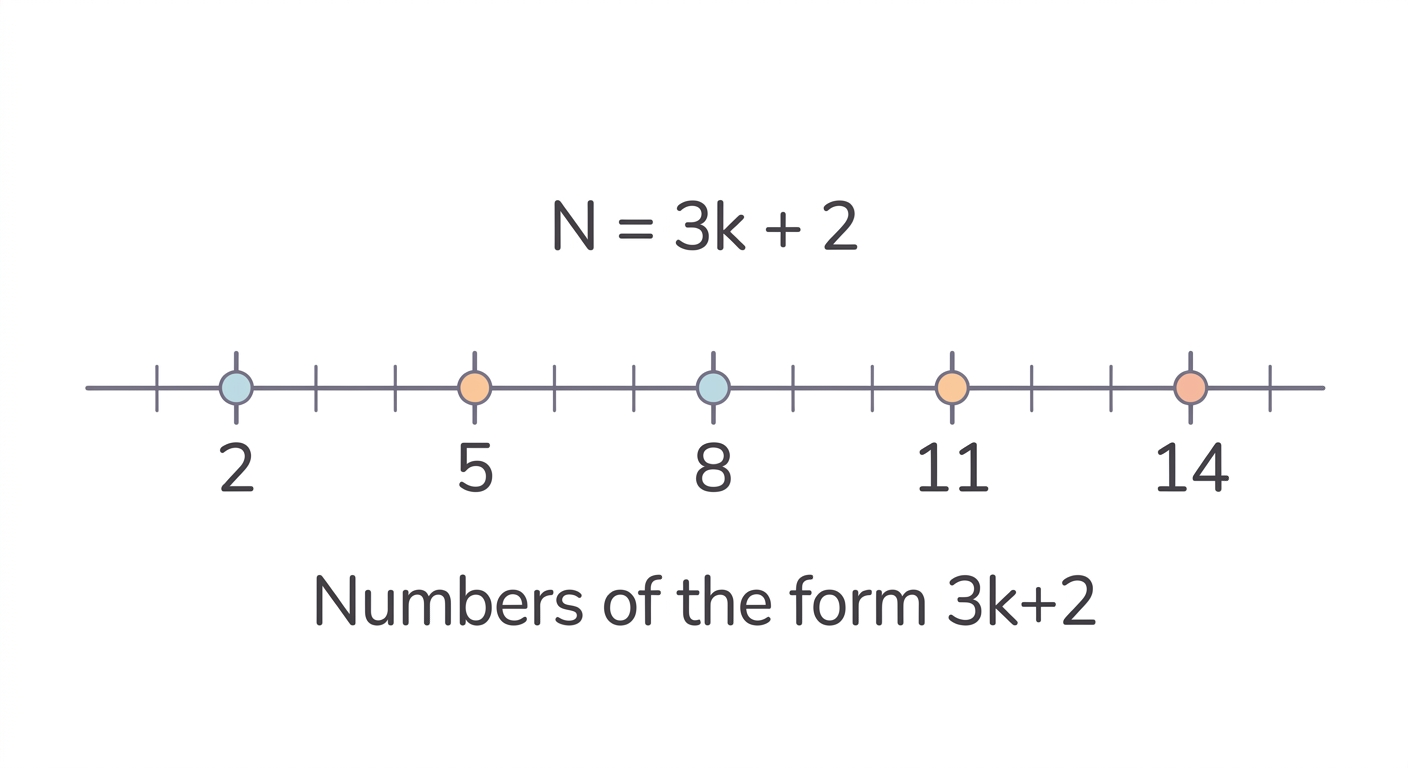
Numbers of the form :
- For :
Numbers of the form :
- For :
Common numbers appearing in both lists:
The difference between consecutive common terms is (, ). Continuing this pattern:
Thus, a few such numbers are .
Step 3 · Derive the General Algebraic Expression
Equating the two forms for :
Since and are coprime (they share no common factor other than ), must be a multiple of . Let , where is a whole number.
Substituting into :
Replacing with the variable , the general algebraic expression is , where .
A few such numbers are , and the algebraic expression describing all such numbers is (where is a non-negative integer).
- Missing the Smallest Solution: Forgetting that gives , which is the very first valid positive number ( and ).
- Incorrect Multiplier: Using without checking if is needed; while works here, with non-coprime divisors always use .
- Omitting the Remainder: Writing instead of .
More questions in FIO
The sum of four consecutive numbers is 34. What are these numbers?
Suppose is the greatest of five consecutive numbers. Describe the other four numbers in terms of .
For each statement below, determine whether it is always true, sometimes true, or never true. Explain your answer. Mention examples and non-examples as appropriate. Justify your claim using algebra.
(i) The sum of two even numbers is a multiple of 3.
(ii) If a number is not divisible by 18, then it is also not divisible by 9.
(iii) If two numbers are not divisible by 6, then their sum is not divisible by 6.
(iv) The sum of a multiple of 6 and a multiple of 9 is a multiple of 3.
(v) The sum of a multiple of 6 and a multiple of 3 is a multiple of 9.
Find a few numbers that leave a remainder of 2 when divided by 3 and a remainder of 2 when divided by 4. Write an algebraic expression to describe all such numbers.
“I hold some pebbles, not too many, When I group them in 3’s, one stays with me. Try pairing them up — it simply won’t do, A stubborn odd pebble remains in my view. Group them by 5, yet one’s still around, But grouping by seven, perfection is found. More than one hundred would be far too bold, Can you tell me the number of pebbles I hold?”
Tathagat has written several numbers that leave a remainder of 2 when divided by 6. He claims, “If you add any three such numbers, the sum will always be a multiple of 6.” Is Tathagat’s claim true?
When divided by 7, the number 661 leaves a remainder of 3, and 4779 leaves a remainder of 5. Without calculating, can you say what remainders the following expressions will leave when divided by 7? Show the solution both algebraically and visually.
(i)
(ii)
Find a number that leaves a remainder of 2 when divided by 3, a remainder of 3 when divided by 4, and a remainder of 4 when divided by 5. What is the smallest such number? Can you give a simple explanation of why it is the smallest?
Find, without dividing, whether the following numbers are divisible by 9.
(i) 123 (ii) 405 (iii) 8888 (iv) 93547 (v) 358095
Find the smallest multiple of 9 with no odd digits.
Find the multiple of 9 that is closest to the number 6000.
How many multiples of 9 are there between the numbers 4300 and 4400?
The digital root of an 8-digit number is 5. What will be the digital root of 10 more than that number?
Write any number. Generate a sequence of numbers by repeatedly adding 11. What would be the digital roots of this sequence of numbers? Share your observations.
What will be the digital root of the number ?
Make conjectures by examining if there are any patterns or relations between (i) the parity of a number and its digital root. (ii) the digital root of a number and the remainder obtained when the number is divided by 3 or 9.
If is a multiple of , where is a digit, what is the value of ? Explain why there are two answers to this problem.
"I take a number that leaves a remainder of 8 when divided by 12. I take another number which is 4 short of a multiple of 12. Their sum will always be a multiple of 8", claims Snehal. Examine his claim and justify your conclusion.
When is the sum of two multiples of 3, a multiple of 6 and when is it not? Explain the different possible cases, and generalise the pattern.
Sreelatha says, "I have a number that is divisible by 9. If I reverse its digits, it will still be divisible by 9".
(i) Examine if her conjecture is true for any multiple of 9.
(ii) Are any other digit shuffles possible such that the number formed is still a multiple of 9?
If is a multiple of , list all possible pairs of values for and .
If is divisible by 44, list all possible pairs of values for and .
Find three consecutive numbers such that the first number is a multiple of 2, the second number is a multiple of 3, and the third number is a multiple of 4.
Are there more such numbers? How often do they occur?
Write five multiples of 36 between 45,000 and 47,000. Share your approach with the class.
The middle number in the sequence of 5 consecutive even numbers is . Express the other four numbers in sequence in terms of .
Write a 6-digit number that it is divisible by 15, such that when the digits are reversed, it is divisible by 6.
Deepak claims, "There are some multiples of 11 which, when doubled, are still multiples of 11. But other multiples of 11 don't remain multiples of 11 when doubled". Examine if his conjecture is true; explain your conclusion.
Determine whether the statements below are 'Always True', 'Sometimes True', or 'Never True'. Explain your reasoning.
(i) The product of a multiple of 6 and a multiple of 3 is a multiple of 9.
(ii) The sum of three consecutive even numbers will be divisible by 6.
(iii) If is a multiple of 6, then will be a multiple of 6.
(iv) is a multiple of 12.
Choose any 3 numbers. When is their sum divisible by 3? Explore all possible cases and generalise.
Is the product of two consecutive integers always multiple of 2? Why? What about the product of these consecutive integers? Is it always a multiple of 6? Why or why not? What can you say about the product of 4 consecutive integers? What about the product of five consecutive integers?
Solve the cryptarithms —
(i)
(ii)
Which of the following Venn diagrams captures the relationship between the multiples of 4, 8, and 32?