Question 36
Find the operations being done by Machine 2 and fill in the blank.
Make your own machine and challenge your peers in finding its operations.
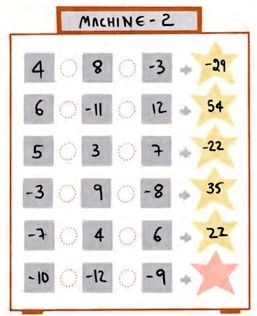
- An input-output machine processes a set of three numbers (let them be , , and ) using a fixed mathematical rule to produce an output.
- To find the rule for Machine 2, we test basic integer operations (multiplication, addition, negation) on the given rows until one consistent pattern holds for all rows.
- Once verified, we apply this rule to the row with missing values to fill in the blank.
- Finally, we design a custom machine with our own defined rule and create test cases.
(i) Find the operations being done by Machine 2 and fill in the blank.
Step 1 · Identify the Rule for Machine 2
For the first row with inputs and output :
Multiply the first two numbers:
Add the third number:
Negate the entire sum:
Thus, the candidate rule for inputs is:
Step 2 · Verify the Rule Across All Rows
Verify the rule with the remaining rows:
Row 2: Inputs
Row 3: Inputs
Row 4: Inputs
Row 5: Inputs
The rule matches all outputs.
Step 3 · Calculate the Missing Value
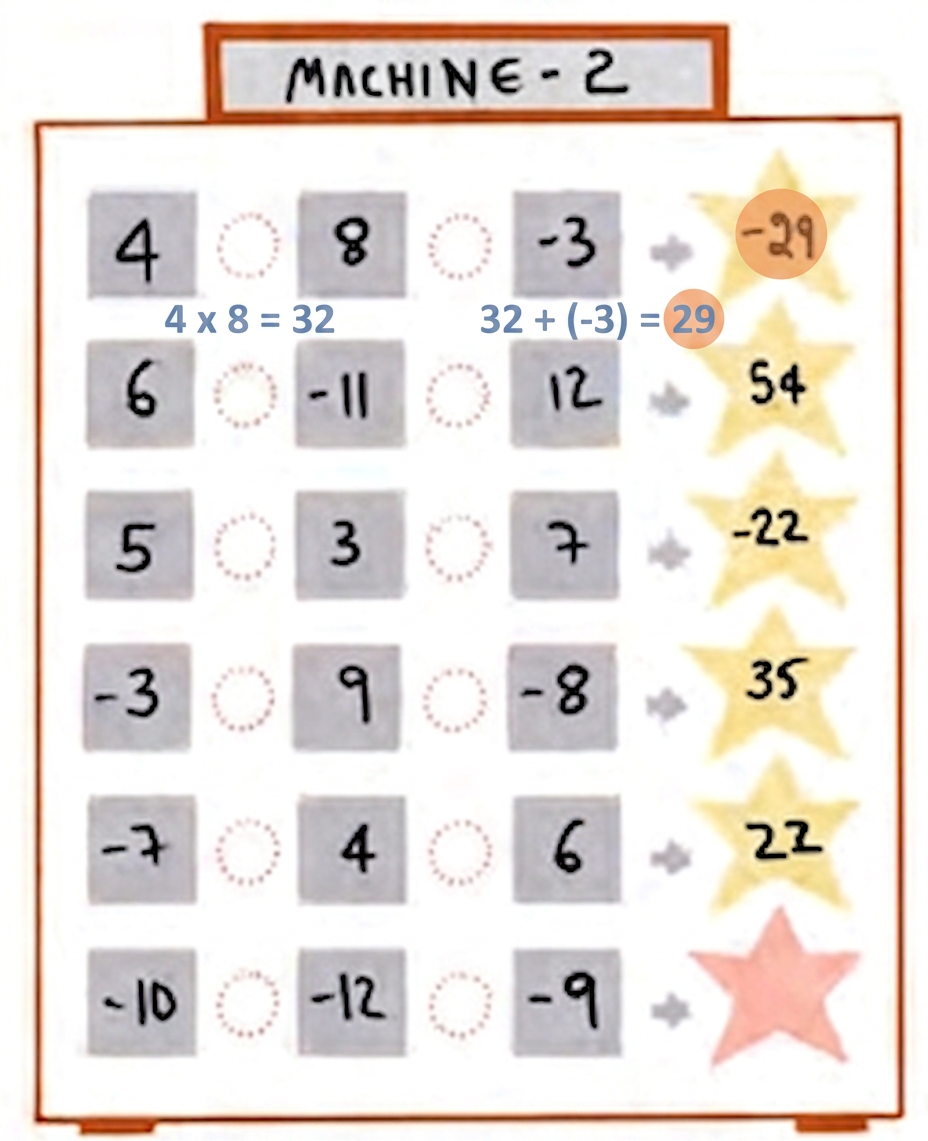
For inputs :
Multiply the first two numbers:
Add the third number:
Take the negative of the sum:
(i) Operation: , Blank value:
(ii) Make your own machine and challenge your peers in finding its operations.
Step 1 · Define Machine-3 Rule and Examples
Let Machine-3 take three numbers with the operation rule:
Example 1: Inputs
Example 2: Inputs
Example 3: Inputs
Peer Challenge: For inputs :
(ii) Rule: . Challenge output for is .
- Sign Error in Multiplication: Multiplying two negative numbers yields a positive product: , not .
- Negation Placement: Forgetting to negate the entire bracket at the final step, resulting in instead of .
- Order of Operations: Incorrectly adding the second and third numbers before multiplying by the first number.
More questions in IT
Rakesh gives you a challenge.
“I have thought of two numbers”, he says. “Their sum is 25, and their difference is 11.”
Can you tell me the two numbers?
You don’t need to use any formulas. Just try different pairs of numbers and then check:
- Do the two numbers add up to 25?
- Is the difference between them 11? (Remember: the difference means first number – second number.)
Write your guesses like this:
Context: Rakesh gives you a challenge. "I have thought of two numbers", he says. "Their sum is , and their difference is ."
Can you tell me the two numbers? You don't need to use any formulas. Just try different pairs of numbers and then check:
- Do the two numbers add up to ?
- Is the difference between them ? (Remember: the difference means first number second number.)
Write your guesses like this:
Q. Did you find the right pair?
Context: Rakesh's Puzzle: A Number Game Rakesh gives you a challenge. “I have thought of two numbers”, he says. “Their sum is , and their difference is .”
Can you tell me the two numbers? You don't need to use any formulas. Just try different pairs of numbers and then check:
- Do the two numbers add up to ?
- Is the difference between them ? (Remember: the difference means .)
Write your guesses like this:
Q. Now that you’ve found the correct pair, Rakesh gives you a second challenge:
“Think of two numbers whose sum is , but their difference is .”
Use the same method. Try different pairs of numbers and fill in the table again. You will notice that if you swap the numbers from the first puzzle, you get the answer to Rakesh’s second puzzle. That is, the first number is and the second is !
The coin is at . If it is struck twice (the direction of the two strikes may be the same or different) can you give a formula for the final position of the coin?
Context: Suppose the first strike moves the coin rightward by units from , and the second strike leftward by units, then we take the and .
Q. What is the final position of the coin?
Based on this new model, answer the following questions:
- If the first movement is and the final position is , what is the second movement?
- If there are multiple strikes causing movements in the order , what is the final position of the coin?
If there are multiple strikes causing movements in the order , what is the final position of the coin?
From the figures below, what can you conclude about the magnitudes of and compared to each other, and what are their directions? Remember to start from .
Using tokens, argue out the following statements.
(a) (additive inverse of is )
(b) (additive inverse of is )
Similarly find the values of and ? How can we interpret ?
Context: Consider the numbers represented by the following tokens:
We can see that all of them represent the number . Now, take times each of these token sets. That is, place each set into the empty bag times.
Q. What integer do we get as the final answer in each case? Do we get different answers because the sets look different, or the same answer because they all represent ?
Context: We can see that all of them represent the number . Now, take times each of these token sets. That is, place each set into the empty bag times.
What integer do we get as the final answer in each case? Do we get different answers because the sets look different, or the same answer because they all represent ?
Q. Check this for , by taking different token sets corresponding to .
We have seen that is the number obtained by removing 2 positive tokens from the empty bag 4 times.
We know that removing or subtracting a number is the same as adding its inverse.
Using this, can be defined through a process of addition of tokens instead of removal of tokens?
What do you notice in this pattern? Can you describe it?
Will this pattern continue when the multiplier goes below zero and becomes a negative number?
What is the pattern when the multiplicand is a negative integer?
Context: Consider the expression . We know that the value of this expression is for all positive integers.
Q. Is this true for all negative integers too?
What is the value of the expression ?
In the case of integers, is the product the same when we swap the multiplier and the multiplicand? Try this for some numbers.
Observe the following pairs of multiplications (fill in the blanks where needed):
What do you notice in these pairs of multiplication statements?
Context: The product is the same when we 'swap' the multiplier and multiplicand. Earlier, we have seen a similar property with addition.
Q. Will this always happen?
Does the sign of the product change if we swap the multiplier and multiplicand?
Context: An exam has 50 multiple choice questions. 5 marks are given for every correct answer and 2 negative marks for every wrong answer.
Q. What are the maximum possible marks in the exam? What are the minimum possible marks?
Context: An elevator in a mining shaft moves above and below the ground. The elevator's positions above the ground are represented as positive integers and positions below the ground are represented as negative integers. In part (b), the elevator begins to descend from above the ground at the speed of . Method 1 models this using subtraction.
Q. Find the solution to part (b) using Method 1 described above.
Can you summarise the rules for integer division looking at the above pattern?
Take a few more examples of multiplication of 3 integers and check this property. What do you observe?
Are there orders in which can be evaluated? Will the product be the same in all these cases?
Multiply the expression in all the different orders and check if the product is the same in all cases.
Look at the following series of multiplications:
When is multiplied or times the product is positive. When it is multiplied or times the product is negative. Can you generalise these statements further?
Using this understanding of multiplication of many integers, can you give a simple rule to find the sign of the product of many integers?
Now, consider the expression . As in the case of positive integers, is this expression equal to ?
Check if the distributive property holds for (that is, if this expression equals ), and for a few other such expressions of your choice.
What do you observe? We see that the distributive property seems to hold for integers, as well. Will this always happen?
Can you visually show the distributive property for an expression like ? [Hint: Use the fact that multiplying a number by is adding the inverse of the number 4 times.]
Pick the Pattern
Two pattern machines are given below. Each machine takes 3 numbers, does some operations and gives out the result.
Find the operations being done by Machine 1.
Context: The operation done by Machine 1 is (first number) + (second number) - (third number). Written as an expression, this will be , where is the first number, is the second number, and is the third number. For example, , and .
Q. So, the result of the last group will be, (-10) + (-12) - (-9) = \text{_______}.
Find the operations being done by Machine 2 and fill in the blank.
Make your own machine and challenge your peers in finding its operations.