Question 29
Can you find the other possible positions for 1 and 9?
Now, we have one full row or column of the magic square! Try completing it!
[Hint: First fill the row or columns containing 1 and 9]
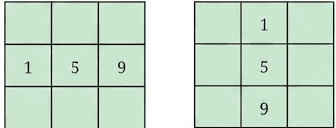
- In a magic square using numbers from to , the magic sum of every row, column, and diagonal is , and the center cell is always .
- Any straight line (row, column, or diagonal) passing through the center must sum to . Since , the numbers and must always lie at opposite ends of a line containing the center .
- Since the middle row and middle column are two such lines, the remaining possible positions for and are along the two main diagonals (opposite corner pairs).
- We can then solve for the remaining values by forming sum equations for each row, column, and diagonal.
Step 1 · Find Other Positions for 1 and 9
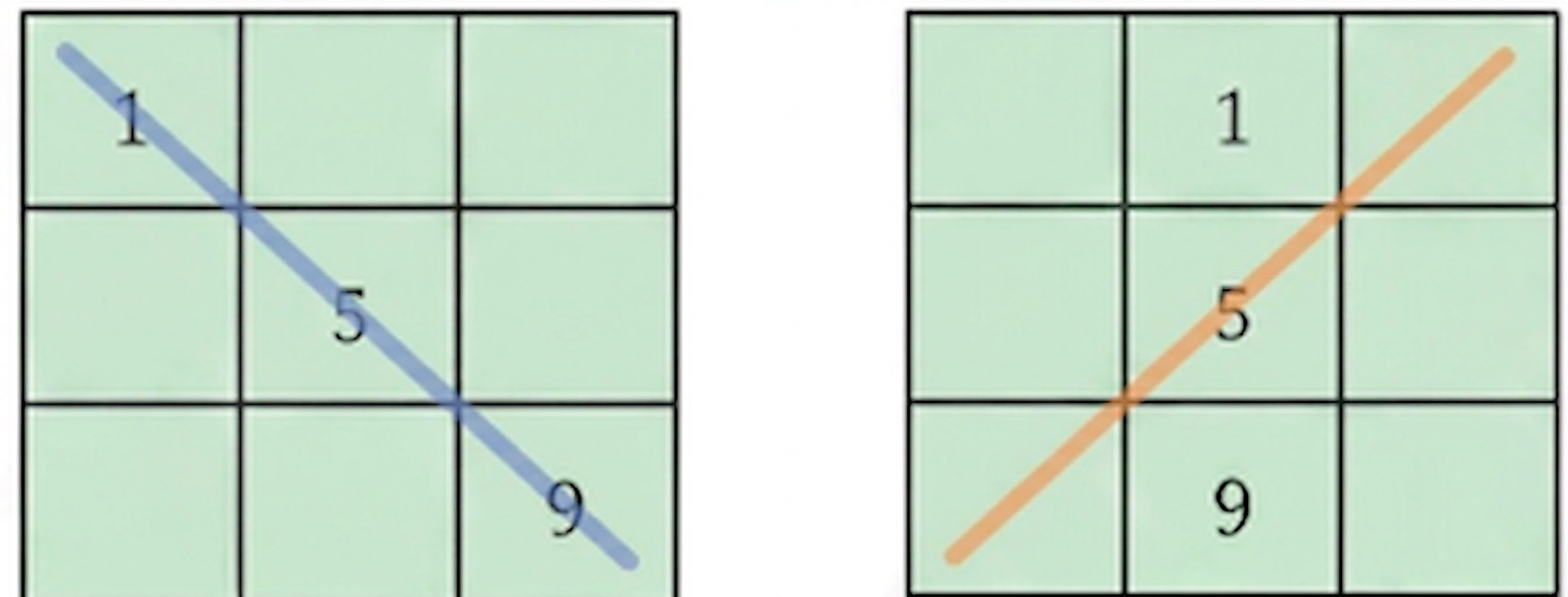
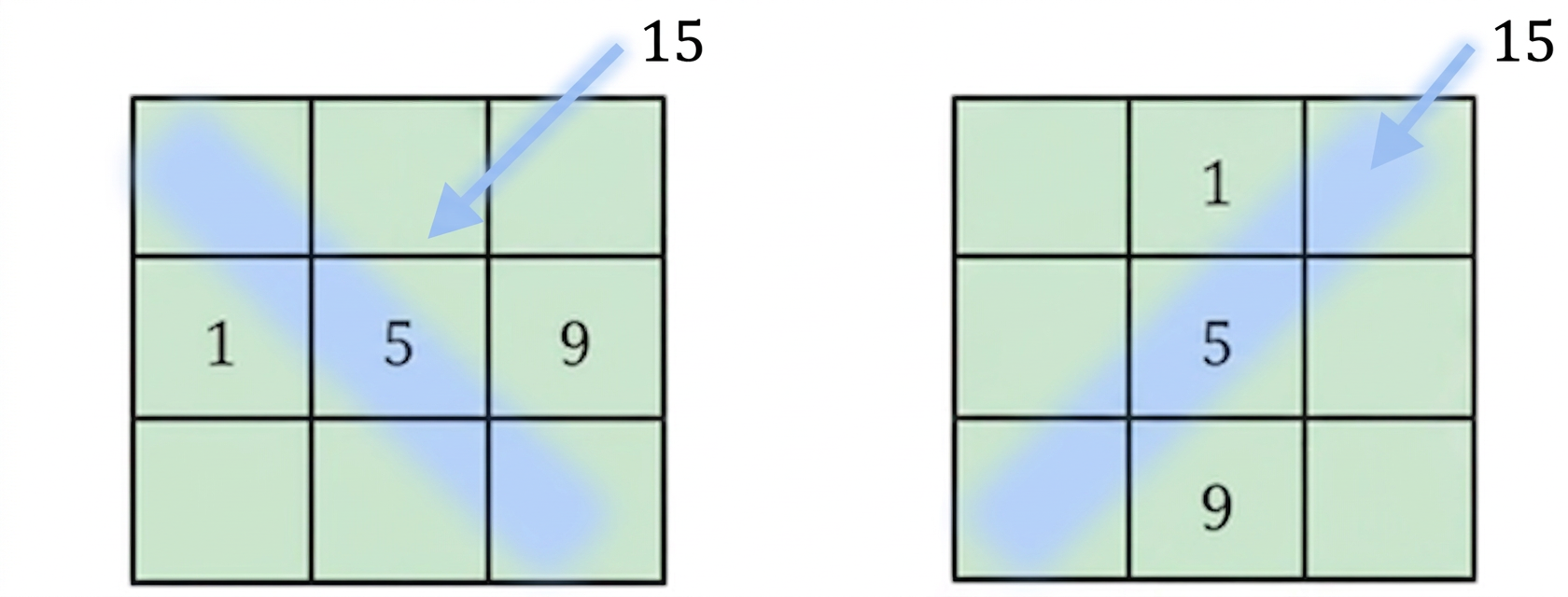
The center cell is always . Any straight line passing through the center must add up to :
Thus, , , and must always form a straight line passing through the center.
Besides the middle row and middle column, the other lines passing through the center are the two diagonals. Therefore, and can occupy opposite corners:
- Top-left corner and bottom-right corner
- Top-right corner and bottom-left corner
Step 2 · Complete the Magic Square
Let the numbers be placed in the middle row:
The remaining numbers to place are .
Setting the sum of each column and diagonal to :
From the remaining numbers, pairs summing to are or , and pairs summing to are or .
Let :
Check anti-diagonal: (valid).
Now find and from the remaining numbers :
, [1, 5, 9], and [6, 7, 2], where every row, column, and diagonal adds up to 15.]
The completed magic square is:
- Other positions for 1 and 9: Along the two diagonals (opposite corners: top-left & bottom-right, or top-right & bottom-left).
- Completed Magic Square:
- Non-Collinear Placement: Placing and such that they do not lie on a straight line passing through the center . Since , they must always be opposite each other with in between.
- Ignoring Diagonal Sums: Finding values that satisfy row and column sums of but forgetting to verify that both diagonal sums also equal .
More questions in IT
What do the numbers in the figure below tell us?
Remember the children from the Grade 6 textbook of mathematics? Now, they call out numbers using a different rule.
What do you think these numbers mean?
The children rearrange themselves and each one says a number based on the new arrangement.
Context: The children rearrange themselves and each one says a number based on the new arrangement.
Q. Could you figure out what these numbers convey? Observe and try to find out.
Write down the number each child should say based on this rule for the arrangement shown below.
Kishor has some number cards and is working on a puzzle: There are 5 boxes, and each box should contain exactly 1 number card. The numbers in the boxes should sum to 30. Can you help him find a way to do it?
Can you figure out which 5 cards add to 30? Is it possible? There are many ways of choosing 5 cards from this collection. Is there a way to find a solution without checking all possibilities? Let us find out.
Context: Kishor has some number cards and is working on a puzzle: There are 5 boxes, and each box should contain exactly 1 number card. The numbers in the boxes should sum to 30. Can you help him find a way to do it? Can you figure out which 5 cards add to 30? Is it possible? There are many ways of choosing 5 cards from this collection. Is there a way to find a solution without checking all possibilities? Let us find out.
Q. Add a few even numbers together. What kind of number do you get? Does it matter how many numbers are added?
Context: As we see in the figure, adding any number of even numbers will result in a number which can still be arranged in pairs without any leftovers. In other words, the sum will always be an even number.
Q. Now, add a few odd numbers together. What kind of number do you get? Does it matter how many odd numbers are added?
Context: Can we also think of an odd number as one less than a collection of pairs? This figure shows that the sum of two odd numbers must always be even! This along with the other figures here are more examples of a proof!
Q. What about adding 3 odd numbers? Can the resulting sum be arranged in pairs?
Explore what happens to the sum of:
(a) 4 odd numbers
(b) 5 odd numbers
(c) 6 odd numbers
Two siblings, Martin and Maria, were born exactly one year apart. Today they are celebrating their birthday. Maria exclaims that the sum of their ages is 112. Is this possible? Why or why not?
Context: Small Squares in Grids In a grid, there are 9 small squares, which is an odd number. Meanwhile, in a grid, there are 12 small squares, which is an even number.
Q. Given the dimensions of a grid, can you tell the parity of the number of small squares without calculating the product?
Find the parity of the number of small squares in these grids:
(a)
(b)
(c)
Context: Consider the algebraic expression: . For different values of , the expression has different parity:
(a) Come up with an expression that always has even parity. Some examples are: and . Try to find more.
(b) Come up with expressions that always have odd parity.
(c) Come up with other expressions, like , which could have either odd or even parity.
(d) The expression evaluates to (for ) — many even numbers are missing.
(e) Are there expressions using which we can list all the even numbers? Hint: All even numbers have a factor .
(f) Are there expressions using which we can list all odd numbers?
Context: We saw earlier how to express the term of the sequence of multiples of , where is the letter-number that denotes a position in the sequence (e.g., first, twenty third, hundred and seventeenth, etc.).
(1) What would be the term for multiples of ? Or, what is the even number?
Let us consider odd numbers.
(2) What is the odd number?
To answer this question, consider the following question:
(3) What is the even number?
(4) Write a formula to find the odd number.
Context: Observe this grid. It is filled following a simple rule — use numbers from to without repeating any of them. There are circled numbers outside the grid. The numbers in the yellow circles are the sums of the corresponding rows and columns.
Q. Fill the grids below based on the rule mentioned above:
Make a couple of questions like this on your own and challenge your peers.
Can 1 occur in a corner position? For example, can it be placed as follows?
Q. If yes, then there should exist three ways of adding 1 with two other numbers to give 15. We have . Is any other combination possible?
Q. Similarly, can 9 can be placed in a corner position?
Can you find the other possible positions for 1 and 9?
Now, we have one full row or column of the magic square! Try completing it!
[Hint: First fill the row or columns containing 1 and 9]
Choose any magic square that you have made so far using consecutive numbers. If is the letter-number of the number in the centre, express how other numbers are related to , how much more or less than .
[Hint: Remember, how we described a grid of a calendar month in the Algebraic Expressions chapter].
Context: Choose any magic square that you have made so far using consecutive numbers. If is the letter-number of the number in the centre, express how other numbers are related to , how much more or less than .
[Hint: Remember, how we described a grid of a calendar month in the Algebraic Expressions chapter].
Q. Once the generalised form is obtained, share your observations with the class.
Chautīsā means 34. Why do you think they called it the Chautīsā Yantra? Every row, column and diagonal in this magic square adds up to 34. Can you find other patterns of four numbers in the square that add up to 34?
How many rhythms are there with 8 beats consisting of short syllables (1 beat) and long syllables (2 beats)? That is, in how many ways can one fill 8 beats with short and long syllables, where a short syllable takes one beat of time and a long syllable takes two beats of time?
Context: A short syllable takes one beat of time and a long syllable takes two beats of time. Some possibilities to fill 8 beats are:
- long long long long
- short short short short short short short short
- short long long short long
- long long short short long
Q. Can you find others?
Context: We can write the number as a sum of s and s in several ways, for example:
Q. Do you see other ways?
Try writing the number 5 as a sum of 1s and 2s in all possible ways in your notebook! How many ways did you find? (You should find 8 different ways!) Can you figure out the answer without listing down all the possibilities? Can you try it for ?
Context: Thus, there are 8 rhythms having 5 beats! The reason this method works is that every 5-beat rhythm must begin with either a '1+' or a '2+'. If it begins with a '1+', then the remaining numbers must give a 4-beat rhythm, and we can write all those down. If it begins with a 2+, then the remaining number must give a 3-beat rhythm, and we can write all those down. Therefore, the number of 5-beat rhythms is the number of 4-beat rhythms, plus the number of 3-beat rhythms. How many 6-beat rhythms are there? By the same reasoning, it will be the number of 5-beat rhythms plus the number of 4-beat rhythms, i.e., . Thus, there are 13 rhythms having 6 beats.
Q. Use the systematic method to write down all 6-beat rhythms, i.e., write 6 as the sum of 1's and 2's in all possible ways. Did you get 13 ways?
Write the next 3 numbers in the sequence:
If you have to write one more number in the sequence above, can you tell whether it will be an odd number or an even number (without adding the two previous numbers)?
Context:
What is the parity of each number in the sequence? Do you notice any pattern in the sequence of parities?
Context: Let us look at one more example. Here means that the number is a 2-digit number having the digit '2' in the units place and 'K' in the tens place. is added to itself to give a 3-digit sum :
Q. What digit should the letter correspond to? Both the tens place and the units place of the sum have the same digit. What about ? Can it be 2? Can it be 3?
Context: These types of questions can be interesting and fun to solve! Here are some more questions like this for you to try out. Find out what each letter stands for. Share how you thought about each question with your classmates; you may find some new approaches.
Q. Find out what each letter stands for:
(i)
(ii)
(iii)
(iv)